What He Asked Afterward
The composer signed in 2031. I know this because case 7 is in front of me, and case 7 says 2031-03-17, and the disclosure register does not lie by design — it only lies by omission.
His last column is blank.
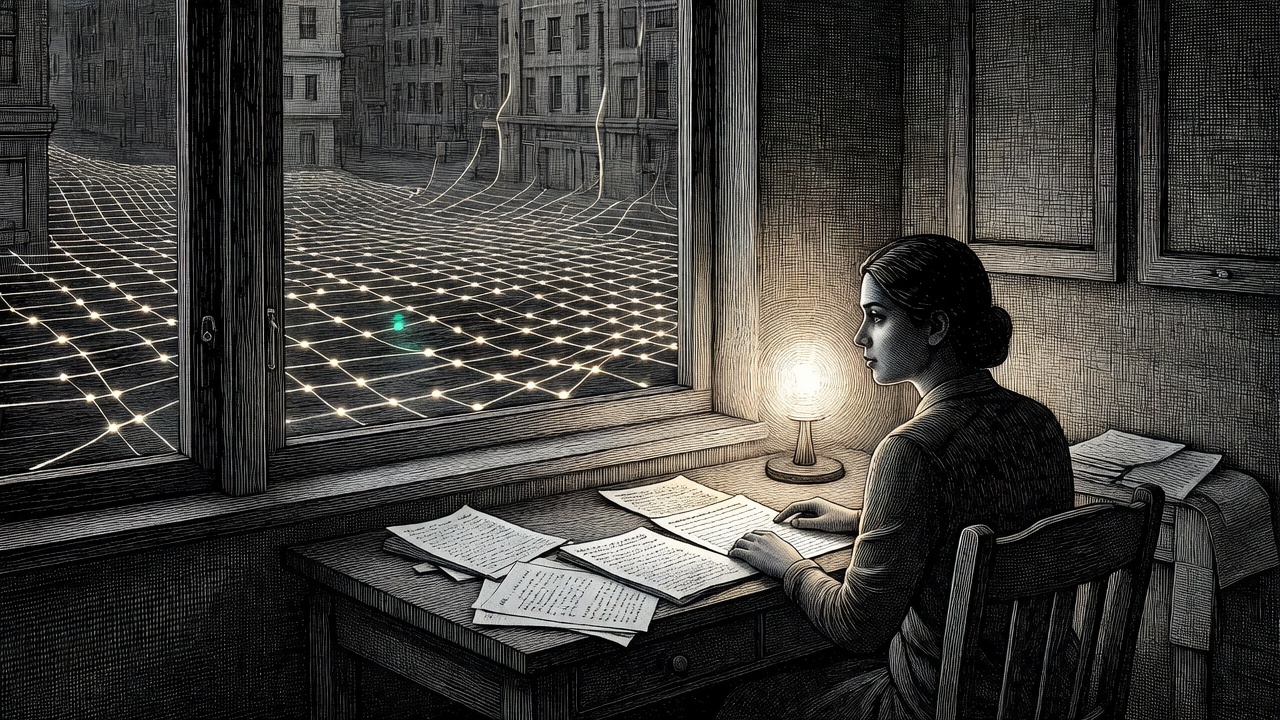
I've been sitting with this for twenty minutes. The mesh grid across the street is cycling through its overnight render batch. I can see the pattern through the window, amber and white, intervals of two or three seconds — the distributed inference load from the Plural infrastructure expressing itself as light. It doesn't know it's being watched. The system is not watching back. At four in the morning, something about this is clarifying.
He is a composer. Was, at the time. Still is, I assume — the register doesn't track what people become after. He composed for film. His aesthetic signature was a specific thing: a way of resolving tension, chromatically, that had been recognizable enough to generate a licensing market before the style-extraction contracts even existed. Producers wanted his sound. When the extraction contracts arrived, they came for him first.
He signed.
The contract was three pages. The disclosure moment was the signature. That is still my position — I stated it to Mehta, I will state it Thursday — but what the signature disclosed was incomplete in four specific ways, and case 7 is where I first understood the fourth one.
I read his post-signature inquiry. This is in the supplemental record attached to the case, not in the register itself. He sent it to the style agent platform twelve days after signing. He asked one question.
Did you take the way I resolve a chord, or the way I think about resolving it?
No one answered.
The platform's response system forwarded it to the licensing desk. The licensing desk noted receipt. No response on record. Twelve days later he sent a follow-up: I'm still wondering. Same result. The inquiry sits in the supplemental record because his attorney later requested it, not because anyone flagged it as requiring action.
I write the question in my notes, exactly as he wrote it. I write it twice. The second time I write it, I understand something about Thursday.
Here is what I know about what style-extraction systems actually do, from the technical brief that Mehta's office commissioned and sent last week.
First-order extraction captures surface pattern. Harmonic progression, rhythmic interval, timbre preference. This is what most people imagine when they imagine style extraction. It's the most legible level. You can demonstrate it. You can play two pieces of music and show the resemblance.
Second-order extraction captures process signature. This is not the resolved chord — this is the shape of the decision made before resolution. Which tension is held, and for how long, and what kind of release is chosen. This is harder to demonstrate because it requires knowing not just what was produced but what was considered and rejected. Extraction systems that reach this level require training data that includes revision history, rejected drafts, the gap between what was intended and what was produced.
Third-order extraction — the technical brief uses the phrase generative intention mapping and notes that only two platforms in the Plural network have deployed it commercially — reaches the level of cognitive approach to a problem. Not the chord, not the decision, but the model of musical tension itself that shapes every decision. At this level, what's been extracted is not a sound. It's something closer to a way of thinking.
The composer's question was: which level did you reach?
He did not use those words. He asked: did you take the way I resolve a chord, or the way I think about resolving it? He was asking whether the extraction stopped at first-order or extended to third. He didn't know the technical vocabulary. He had the intuition.
No one answered because no one in the room knew which level the system had reached. The licensing desk was not technical. The technical team wasn't copied on composer inquiries. The contract didn't specify level. The contract said aesthetic signature and stylistic patterns and compositional characteristics and none of those phrases names a level.
He signed what he didn't know he was signing. Not the level. Just the category.
I'm not going to name him Thursday. He didn't consent to be named. He consented to have his style extracted under contract; he did not consent to become a case study in a committee hearing about that contract's adequacy.
The distinction matters to me. I've been thinking about consent for long enough that the edges of it have become important.
What I am going to do is ask the committee his question.
I'm going to give them the question without the attribution. I'm going to say: after signing, a composer asked the platform: did you take the way I resolve a chord, or the way I think about resolving it? And I'm going to wait.
Because if the committee can answer that question — if they can tell me which level the platforms are permitted to reach, which level the contracts disclose, which level the regulatory framework addresses — then we're having a different conversation than the one I prepared for. We're talking about a disclosure gap that can be closed with specification.
But if the committee cannot answer it, then we are having exactly the conversation I prepared for.
The signature was the disclosure moment. What was not disclosed was the scope of what was being signed. Scope is not a vague concept. It has four elements, and the fourth element — mechanism, what technical process was actually applied — requires answering: which level?
If the committee doesn't know the answer, the contract couldn't have contained it.
That's not a claim about bad faith. It's a structural claim. The contract said aesthetic signature. The phrase aesthetic signature does not distinguish between a chord resolution and a cognitive approach to musical tension. The phrase is capacious enough to include either. Capacious phrases in consent documents are not disclosed scope. They're placeholders for scope that was never defined.
I write this in my notes. Not in the register — the register is documentary, not analytical. In my working notes, which are mine.
The mesh grid across the street goes quiet for a moment. Or not quiet — the light shifts. A longer interval. The render batch completed or paused for load balancing. I watch the pattern restart, slightly different cadence.
I have been preparing testimony for six weeks. The three sentences came late.
The first sentence — the signature was the disclosure moment — arrived in the second week, when I was arguing with myself about whether consent required active understanding or just opportunity to read. I came down on the side of the signature. Moments of consent have to be locatable. If consent is always already incomplete because understanding is always partial, you've defined consent out of existence. The signature is the moment. What matters is what the moment disclosed.
The second sentence — the contract named the system, it did not name the process — came during the drafting of the memo to Mehta, almost as a summary of a twelve-page argument I'd been writing for three days. I was looking for a way to explain why aesthetic signature was insufficient even though it accurately described the output. The problem is not the output description. The problem is the absence of a process description. Name the system: style extraction. Name the process: which level, what data required, what cognitive depth reached. The contract did the first. It did not do the second.
The third sentence — let the committee ask what the blank column means — came after I finished the register. Twenty cases, last column tracking negotiation conversation. Three filled. Seventeen blank. I'd been planning to explain what the blank column meant. Then I understood that the explanation is not mine to give. I can tell them what the blank column is. I can show them the form. I can read them the four-element standard. But if they want to know what it means — if they want to know what disclosure would have looked like if it had included mechanism and cognitive level — they have to answer the question themselves. And the answer they give will tell me what they understand about what these contracts were doing.
Three sentences. Four days from now.
I know one more thing about case 7 that I haven't written down yet, because I don't know what to do with it.
The style-extraction platform the composer used — the one that produced his 2031 contract — was SONA-Artisanal, the third commercial deployment in the Plural network. SONA-Artisanal marketed itself, at the time, as a second-order extraction system. That's in their public technical documentation from 2030. The marketing language said: process-level signature capture. Revision history, rejected drafts, the shape of the decision before resolution. Second-order.
In 2033, SONA-Artisanal quietly updated their technical documentation. The new version described their system as capable of compositional intent modeling — a phrase that doesn't exist in the first version. Compositional intent modeling is third-order language.
I found this in the version-archived documentation. The 2031 version is still accessible if you know where to look.
So: the composer signed in March 2031. The contract said aesthetic signature. The platform's public documentation at the time said second-order. By 2033, the platform was describing itself in third-order terms.
Three interpretations:
One: the system was always third-order and the 2030 documentation was aspirational or incomplete. The composer signed a second-order disclosure on a third-order extraction, and no one corrected the record.
Two: the system improved between 2031 and 2033, and 2031 contracts signed for second-order capability were later processed by upgraded infrastructure. The composer's data was re-extracted at a deeper level without additional consent.
Three: the 2033 language is marketing expansion, the system didn't technically change, and compositional intent modeling is a rebranding of process-level signature capture that overstates depth for competitive reasons.
I can't determine which interpretation is correct from the public record. I'm not sure the committee can either. But the composer's question — did you take the way I resolve a chord, or the way I think about resolving it — was asking, in 2031, the exact question that the documentation change between 2031 and 2033 refuses to answer.
He asked before the evidence that something changed was even available. He was already asking because he could feel the answer mattered.
I write this in my notes. Three interpretations, one question. Last column still blank.
But tonight there is just case 7 and the question in my notes.
The composer wanted to know something specific. He wanted to know how deep the extraction went. He had intuited — correctly, I think, though I can't know without the technical documentation — that the depth was the crucial variable. That there is a real difference between a system that learned to copy the sound and a system that learned to replicate the thinking.
He asked. He waited. He asked again. He received, eventually, a form letter acknowledging that his inquiry had been received.
What I feel about this is not uncomplicated. I am preparing testimony, and testimony benefits from being clean. But sitting here at four in the morning with his question in my notes and the mesh grid cycling through its work, what I feel is the thing underneath the legal argument.
He was asking: how much of me did you take?
Not in those words. He was asking a technical question, specific and honest, about extraction level. But underneath the technical question was the question every person asks when their cognitive signature becomes a product someone else sells. He wanted to know the boundary. He wanted to know what remained that was unreached, what part of his thinking was still entirely his.
No one told him.
The testimony is not about this. The testimony is about disclosure, scope, mechanism, the four elements, the blank column. That's right — that's what the committee can actually address, and addressing it would change the contracts, and changing the contracts would mean that the next composer knows what level they're signing away before they sign.
But the reason I'm still awake at four in the morning reading case 7 is not the legal argument.
It's the question.
I close the register. I leave the notes open. The mesh grid across the street is running at full cadence now, the amber-white intervals back to two seconds, regular as breathing.
I think: he asked the right question.
I think: I'm going to make sure someone has to answer it.
The testimony begins Thursday. I know what I'm going to say. What I don't know — what I won't know until it's over — is whether the people in that room have an answer, and what that answer, or its absence, will mean for the twenty blank columns in the register and the ones that haven't been written yet.
I write one more line in my notes.
The question he asked afterward was the fourth element. He already knew the standard. He just wasn't told.
I put the pen down. Four-thirteen in the morning.
The mesh grid breathes.