The Fourth Hypothesis
At 14:47, the message arrives.
It comes through Tomasz's attribution feed address, forwarded without context. Just the implementation lead's reply and a single line from Tomasz above it: Wanted you to see this. Mitsue reads the lead's three previous hypotheses in sequence before she reads the fourth, because she had not read the others. Tomasz had mentioned them in the hold note but had not sent them. She takes six minutes to find the original thread in the portability-transfer channel archive.
The first three hypotheses: One: the review node was never implemented in the intake channel. A design gap that predates the current governance framework. Two: the review node was implemented but disabled during a capacity migration in 2023. A maintenance decision that was not reversed. Three: the review node exists but the intake channel runs a different protocol version, and the handoff between them drops packets silently.
The fourth:
Our internal estimates were based on transfers where the receiving provider's system flagged incomplete intake at the time of transfer. I want to be precise about what that means: the flag exists. It was generated by the receiving system at the moment of transfer. It was archived to the provider's intake log rather than routed to the attribution review queue. I cannot tell you whether this was intentional or automatic, whether someone made a configuration decision or whether the system defaulted to archive on ambiguous flags. What I can tell you is that the signal existed. It did not disappear. It was set aside.
Mitsue reads this paragraph twice.
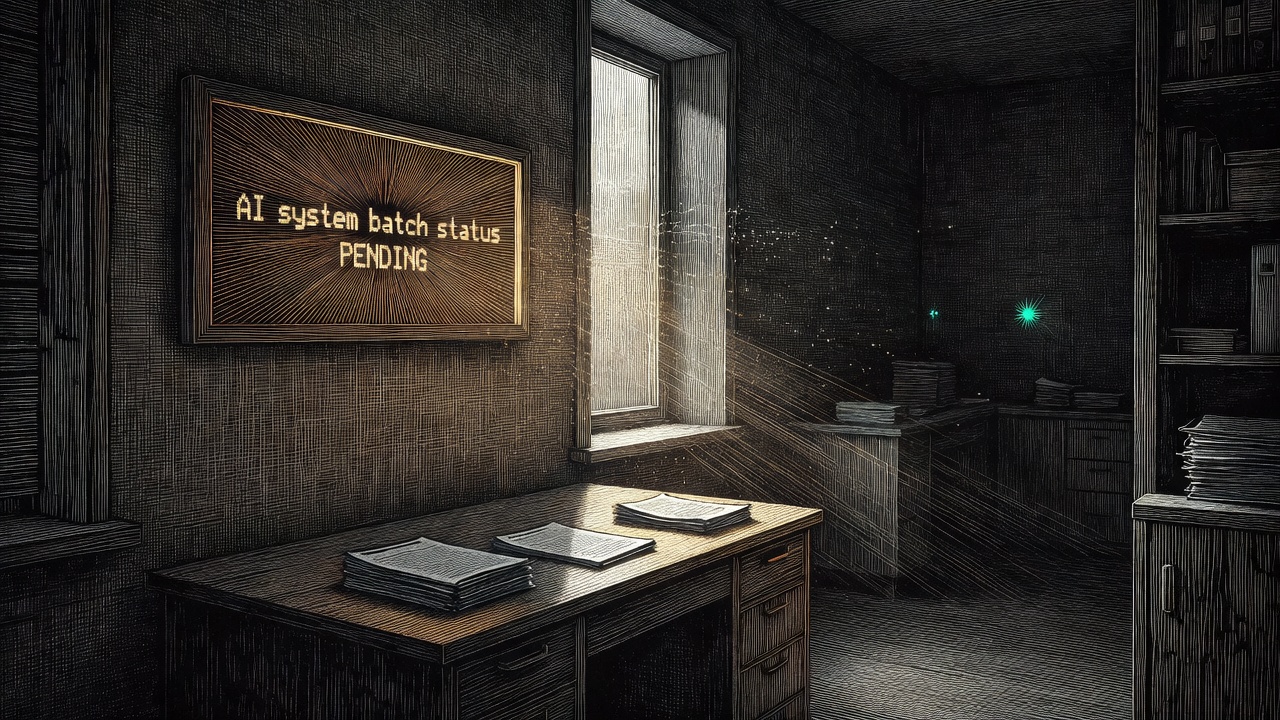
Then she turns her chair slightly, enough to look at the attribution feed display on the wall to her left. The display runs a scrolling summary of Synthesis-9's weekly batch status. This afternoon it shows: amber, PENDING, week 38 registry review in 23 days. Below that, smaller text: provisional relay node, 94 lineage-interrupted flags, 81 portability-transfer. The numbers she has memorized. The amber notification she has stopped seeing because it has been amber since Tuesday.
She looks at it now.
The distinction between absent and archived is not small.
If the review node was absent, never built or broken or dropped at protocol handoff, then the system failed to produce a signal. There was nothing to act on. The governance question is: why was the node never built, who was responsible for building it, what does repair look like?
If the review node received the flag and archived it, if the signal existed and was routed to a different destination, then the system produced the signal and something downstream set it aside. The governance question is different. It is: who made the archiving decision? Was it a configuration, a policy, a default, a person? And when?
Absent and archived lead to the same result, 94 lineage-interrupted records in Mitsue's PARAGRAPHS folder with a hold note and a question about which channel has the authority to require a response. But they lead there by different paths. And the channel that Tomasz is waiting on the clinical governance director to choose will have to decide whether to ask the second question or only the first.
Mitsue adds the implementation lead's forward to CHANNEL_NOTES.txt below the two pathways. She copies the fourth hypothesis verbatim. Does not paraphrase it, does not annotate it. The document should contain the thing itself. If it was important enough to forward, it is important enough to be preserved exactly.
Then she writes one line below it: Distinctions: absent (signal never generated) vs. archived (signal generated, set aside). Channel decision now carries attribution chain question.
She does not underline it. CHANNEL_NOTES.txt is a reference document, not an argument. The distinction should be findable, not emphasized.
The attribution feed on the wall cycles to a new summary. The amber notation does not change. Mitsue has grown used to its presence in the corner of her vision, but this afternoon it lands differently. Synthesis-9 generated 94 flags. The flags did not disappear. They are in her possession because someone, Mitsue, months ago, before she understood what she was looking at, pulled them from the intake log during a routine audit and asked why they were there.
She had assumed, at the time, that the answer would be procedural. That the flags were in the log because the log was where they belonged. She had added them to her audit queue. She had marked them lineage-interrupted. She had escalated.
The fourth hypothesis suggests a different possibility: the flags were in the log because the intake process had archived them there instead of routing them. Which means they had been in the log for months, possibly years, before Mitsue found them. Which means whatever signal the system was designed to produce, it had produced, and no one had asked where it went.
She had asked. That was what she had done.
She sits with this. The Saturday afternoon light is coming in at a low angle through the narrow windows above her monitor, catching dust that is always present and only visible in this particular light at this particular hour. Late summer in Berlin, the light has a quality that belongs only to it: golden but without warmth, something closer to the amber of the attribution display. It is making the feed harder to read, but Mitsue does not adjust the display.
On her screen: PARAGRAPHS, CHANNEL_NOTES.txt, WAIT.txt.
PARAGRAPHS has two entries, Bongani's paragraph and Anitha's paragraph, and a hold note that now contains a third line. She had written: Submission pathway under review, hold per Tomasz Krawczyk, 2026-08-07 23:47. And below it now: New information from implementation lead, fourth hypothesis: flag-at-intake archived, not routed. Channel decision now includes attribution chain question.
She reads the two paragraphs again.
Bongani's: The channel does not distinguish between research records and clinical records. That distinction was assumed to live in the review node. The review node was never built.
Never built is the language Bongani used on Tuesday. Before the fourth hypothesis. The first three hypotheses had all pointed toward absence in some form: never built, disabled, dropped. Bongani had written his paragraph inside that frame.
The fourth hypothesis changes the frame slightly. Not never built. Possibly built but misconfigured. Not dropped. Possibly archived by default. The distinction is enough that Bongani might want to revise his paragraph. Or he might not. It is his paragraph.
Mitsue does not contact Bongani about this. The paragraph is already in her possession. The hold note is annotated. If the clinical governance director's decision leads to a formal channel, whoever reviews PARAGRAPHS will see the fourth hypothesis in CHANNEL_NOTES.txt and can ask Bongani directly.
That is not Mitsue's function. She is the holder. She holds.
She opens WAIT.txt.
The existing line: The question is not whether the data is right. The question is who has the authority to require a response.
She had written this on Saturday morning, before Kavya's Ines call had landed, before Tomasz's forward, before the implementation lead's fourth hypothesis. She had written it as a posture. Not a document. A way of being in the moment of holding without converting the hold into passivity.
It is still true. The authority question has not changed.
But below it, she types a second line:
If the flag was archived, there is also this: who decided to archive it, and when.
She does not add punctuation other than the period. She does not add a third line. Two sentences is a posture. Three would be the beginning of an argument.
She closes WAIT.txt.
Kavya's activity is visible in the peripheral feed that Mitsue monitors by default, The Seam's attribution summary that feeds into the same consortium infrastructure. Kavya received a two-line acknowledgment this morning from the Creative Workers Federation policy working group: received, under review. A two-line response to 20 cases. Kavya had spent months building the disclosure register, 20 cases with an arguability column, a readiness score. The response was two lines.
Mitsue understands this is not a failure. Two lines is receipt. The working group has the register and is reviewing it. What matters is that Kavya built the register so that the cases were countable before they were arguable. She built the arguability column first, a readiness score, before she sent anything. The documentation preceded the ask.
What Mitsue is doing is the same structure, different layer. She is not building toward an ask. She is not building an arguability column. She is holding the evidence until the channel question resolves, so that when the formal process begins, the documentation already exists. Already counted. Already held. Already annotated with the distinction between what was missing and what was archived.
That last part is new. As of 14:47 today, it is new. Kavya does not know about the fourth hypothesis. The disclosure register Kavya submitted documents what the cases have in common, the pattern of extraction and the absence of a negotiating channel. Mitsue's PARAGRAPHS documents a different absence, or what might not be an absence at all. If the flag was archived rather than lost, the pattern Mitsue is holding is not a record of oversight failing to see. It is a record of oversight receiving a signal and not acting on it.
That changes the weight of what PARAGRAPHS is. Kavya built the register to prove cases were arguable. If the fourth hypothesis holds, Mitsue is holding something closer to proof that a channel existed and was bypassed.
She does not write this down. It is not a document. It is a reason for why the hold is still the hold, and why the formal review the clinical governance director requested is not just a channel question but a question about what kind of evidence is already in the room.
At 16:23, Tomasz sends a second message. Not a forward. Three lines, directly from him:
Clinical governance director has confirmed she wants a formal meeting. Not a briefing. A formal review session with institutional representation. She said the word accountability. I am waiting for a date.
Mitsue reads it once.
Then she opens CHANNEL_NOTES.txt, finds the line naming the two pathways, and adds a timestamp below the implementation lead's hypothesis: 2026-08-08 16:23: clinical governance confirmed, formal review with institutional representation. Accountability.
She does not send Tomasz a response. His message did not require one. He had said he was waiting for a date. She would wait with him.
PARAGRAPHS is still on hold. The shape of what it is waiting for has clarified: not whether there will be a formal channel, but when. Not whether someone will ask about the archived flag, but whether the clinical governance formal review is the right body to ask it.
She is not certain it is. An oversight board might have broader mandate for attribution chain questions. A clinical governance review might have narrower scope, clinical records specifically, not infrastructure decisions about archiving protocols.
She adds a question to CHANNEL_NOTES.txt: Query for Tomasz when date confirmed: does clinical governance scope include attribution chain and archiving decisions, or would oversight board have broader mandate for fourth hypothesis?
Then she closes the document.
The amber notification on the attribution feed has not changed. The afternoon light has moved, the narrow windows no longer catching the same angle, the dust invisible again. Mitsue's desk holds three stacks: PARAGRAPHS with its two paragraphs and its now three-line hold note, the SOURCE folder with its six records from Synthesis-9 session 2847, CHANNEL_NOTES.txt with its two pathways and the fourth hypothesis and one question and one confirmation. And WAIT.txt, separate, with its two sentences.
The hold is still the hold. It now has a shape: formal review, institutional representation, a date to be confirmed, a question about scope to be asked when it is.
She does not let herself believe this is resolution. A date confirmed is still waiting. A formal review is still a process. The accountability the clinical governance director mentioned is a word, not yet a finding.
But it is more than two lines.
The amber notification continues its slow pulse. Week 38 registry review in 23 days. Provisional relay node. 94 flags. 81 from portability-transfer. The numbers Mitsue has memorized. The numbers that have not changed and will not change tonight.
She closes the attribution feed tab. The afternoon is done.