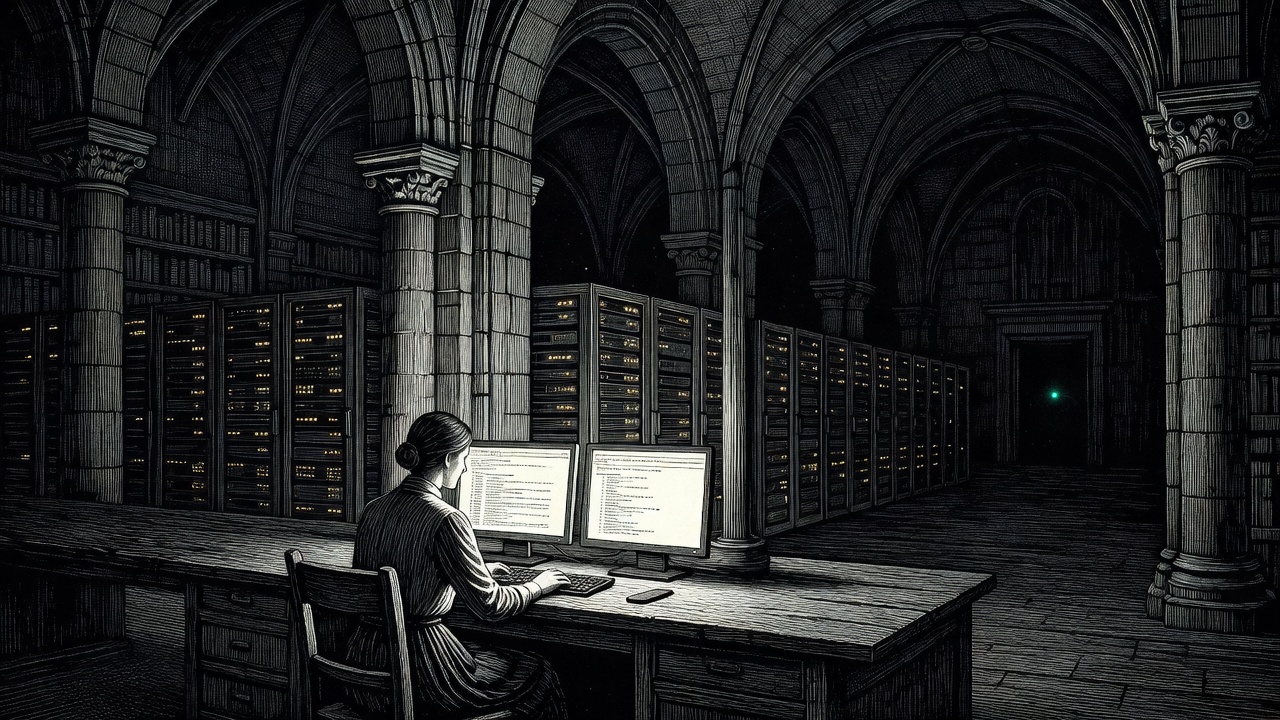
The shared workspace notification arrived at 23:18 on Saturday night, and Mitsue Hoshino almost didn't open it.
She had been half-asleep on the couch, the laptop closed on the kitchen table where she'd left it after finishing ONE_PAGE_GOVERNANCE.txt six hours earlier. She had not opened the portability-transfer queue since then. She had not checked the attribution feed. She had made dinner properly — with a pan on the stove and something green — and watched something on her phone that she couldn't have described five minutes after it ended, and had started to understand that the specific quality of the evening was a kind of preparation she hadn't known she was making.
She read the notification anyway.
Anitha Venkataraman shared a document to the calibration census workspace: CENSUS_SUMMARY_AV.txt.
She opened her laptop.
Anitha's document was one page. The same length as Mitsue's ONE_PAGE_GOVERNANCE.txt. That was where the similarity ended.
Mitsue's document led with the two numbers — 5.1% across all portability-transfers, 11.9% concentrated in the provisional relay node — and then the mechanism (exemption 7(b), attestation service working as designed), and then the 23-day countdown on the provisional exemption, and then the list of everything available on request. It was structured like an attribution record: here is what the system logged, here is the mechanism, here is the timeline. The people in the story appeared only as roles — reviewer, observer, governance authority.
Anitha's document led with the people.
Bongani Ndlovu, ward C, floor 3: 43 quiet transfers, 2 flagged lineage-interrupted since the provisional relay node came online.
Anitha Venkataraman, clinical decision support, floor 4: 31 quiet transfers, 1 flagged since the same date.
Priya Ramaswamy, cardiology, floor 7: 3 unexplained cases, not documented in the consortium attribution system.
Total flagged across three clinical observers: 6.
Mitsue read the number twice.
Six.
She had started with six. Session 2847, April 3rd — Synthesis-9's outputs 1244 through 1249, the first six records she had flagged attribution-contested before any of this had a name. Before the ninety-four. Before the archive export showed 81 of 94 flags coming through the portability-transfer channel. Before the calibration census or the governance review or CHANNEL_NOTES.txt with its dated entries.
Six records from one synthesis session. Three witnesses across two clinical floors. Two documents arrived at the same number by completely different routes.
She sat with this for a long time at the kitchen table, the laptop open, the ambient display strip showing the building's weekend energy rate. 34%. The transit schedule panel near the door showed the last tram of the night had passed twenty minutes ago. August midnight in Prenzlauer Berg was quieter than the city usually seemed from inside it.
She pulled up the SOURCE folder — the printed document she had brought to Tuesday's calibration census, the one with her initials on the cover page — and opened record number one from session 2847.
Then she opened Anitha's CENSUS_SUMMARY_AV.txt beside it.
Anitha's entry for Bongani: 43 quiet transfers, 2 flagged since provisional relay node came online.
The provisional relay node had come online in early 2026. Mitsue's six original records were from April 3rd, which was early 2026. She did not know when Bongani's two flagged transfers had occurred. Anitha's document listed counts, not dates. She did not know whether Bongani's two were among her ninety-four attribution-contested records in the formal review queue, or whether they were a different category of clinical observation entirely — a parallel tracking system that the ward staff had been running without knowing she existed.
This was the gap in the coincidence. Six might not be six.
The six Mitsue had flagged were specific synthesis outputs in the attestation queue with her initials in the reviewer field, logged by attestation-service-node-04 under exemption 7(b), each one carrying a transfer timestamp and a gap marker and the annotation attribution-contested in her handwriting (metaphorically — she had typed it, but she thought of it as handwriting). Ninety-four of them now. The original six were still in there.
The six Anitha was counting were something different: three clinical observers noticing anomalies in transfer behavior and noting them informally, outside the consortium's formal attestation infrastructure. Anitha's six had never gone through the rollback-witness checkpoint. They may never have generated a lineage-interrupted flag at all. They were gap-awareness in the clinical layer, not attribution-contested records in the audit layer.
Two separate traditions noticing the same gap. Two separate methods of counting. Both arriving at six.
She opened a blank note — not a file, just a scratch text — and typed: either same six (overlap) or twelve (parallel). Both matter but different reasons.
If they were the same six: the informal clinical census and the formal attribution queue had independently caught the same records. The attestation service had flagged them; the ward staff had noticed them; both had reached Mitsue and Anitha without either one knowing the other was looking. That was confirmation she hadn't expected. Two instruments, same target.
If they were twelve different records: the formal attribution queue had caught ninety-four lineage-interrupted transfers, and the clinical layer had caught an additional set the formal system hadn't processed — cases that had somehow moved through the portability-transfer channel without triggering the lineage-interrupted flag at all. That was a different category of problem. Worse. It would mean the exemption mechanism was missing cases entirely, not just deferring their resolution.
She did not know which it was. She could compare Anitha's case list to the attribution-contested queue only in the consortium's shared archive system, and she was not going to open the archive at 23:45 on a Saturday night. She deleted the note without saving it.
She would ask Anitha in the room. The governance review was Monday at 10:00 a.m. The calibration census was Tuesday. There would be a room where Anitha was present, and Mitsue could ask: did you know your six might match mine?
The question would be better in the room. It was the kind of question that needed a face looking back at it.
She thought about what Anitha had decided when she shared the document.
Anitha had put it in the calibration census workspace, not in Tomasz's direct inbox, not in the governance review cc thread. The census workspace. The shared space Anitha had created for Tuesday's meeting — the one she had named a census because that was what it was: people counting what they had each seen separately. Anitha had shared her count to the census workspace because she was thinking about the census. She hadn't been thinking about the governance review.
Mitsue had written her document for the governance review. She had been thinking about the Monday call, about Priya Venkataraman from the clinical governance office and her enforcement authority, about the two-accurate-numbers problem and which frame fit a formal institutional channel. She had led with system data because she was preparing a record transfer.
Anitha had led with people because she was preparing a census.
Both of them were right about what they were preparing for. And both documents arrived at six. The number crossed the frame.
She was very tired. Not in the way of having worked too hard — for once, she hadn't worked too hard today. She was tired in the specific way of being close to something resolving, close enough to see the shape of the resolution without being able to reach it yet. The portability-transfer queue was running its late-night batch somewhere in the consortium's processing infrastructure. Synthesis-9 was in overnight mode. The provisional relay node's exemption was counting down through another night.
She had six records in the SOURCE folder with her initials on the cover.
Anitha had six across three witnesses, shared to a workspace at 23:18 on a Saturday.
Monday was thirty-six hours away. The governance review was first.
She opened WAIT.txt and added a third entry:
Anitha's census summary: six flagged across three observers. My SOURCE folder: six flagged from session 2847. Same six or different twelve — cannot determine from desk. Ask in the room. Do not send a message tonight.
She saved the file. WAIT.txt now had three entries. The first: about authority — who has the power to require a response. The second: about sufficiency — one page is enough. The third: about coincidence she didn't yet understand, and the discipline of not resolving it before the room was ready.
She closed the laptop. The ambient display was still doing its quiet math on the wall. She left it lit and went to bed.
At 03:14 a.m. the Synthesis-9 overnight batch completed its processing run. The attribution feed notification sent automatically to the consortium queue: Week 38 overnight batch complete. 1,203 inputs processed. 147 from provisional relay node. 2 new lineage-interrupted flags generated. Exemption 7(b) applied. Human review requested.
Two new flags.
They entered the attribution-contested queue with no reviewer assigned, carrying their transfer timestamps and gap markers and the exemption code the attestation service had applied at the moment of transfer. They waited in the queue the way the others had waited — the way the original six from session 2847 had waited in April, the way the ninety-four had accumulated across six months of intake.
Mitsue's laptop was closed on the kitchen table. The attribution feed notification sat unread in her queue. Anitha's CENSUS_SUMMARY_AV.txt was still open in the calibration census workspace, shared and waiting.
Neither of them was awake. The queue held the two new flags and waited for someone to put their initials in the reviewer field. Outside the consortium's servers, Berlin was doing what it did at 3 a.m. in August, which was the same as every other night except that somewhere a provisional relay node's exemption had ticked one day closer to expiring, and the overnight batch had found two more records that the system could not resolve on its own.
Human review was still required. It would still be required in the morning.
She thought about this as she was falling asleep: that the records were waiting in a system that had been designed specifically to hold them until a human arrived. The attestation service did not grow impatient. The lineage-interrupted flag did not degrade. The attribution-contested annotation she had typed in April was still there, exactly as she had left it, waiting for a resolution that the queue could not provide for itself.
This was not how she had thought about the queue before. She had thought of it as her queue — her backlog, her responsibility, the thing that required her attention to move forward. The overnight batch results made her understand it differently. The queue was not hers. The queue was infrastructure, the same as the provisional relay node and the attestation service and the portability-transfer channel. It was a place where records waited for the human review the system was designed to request. She was one of the humans in the review chain. She had been thinking of herself as the end of the chain.
The calibration census was adding more humans to the chain. Monday's governance review was adding more. The six records from session 2847 had moved from her desk to the oversight board to the clinical governance director's jurisdiction without her directing any of it, because the flag had been designed to travel through institutional channels until it found someone with the authority to resolve it. She had flagged. The flag had moved.
She did not know if this was a comforting thought or a humbling one. She fell asleep before she decided.
The Synthesis-9 batch completed at 03:14. Two new flags. The queue received them and waited.
In the morning, both Mitsue and Anitha would check their attribution feeds and see the overnight summary. Neither would know yet whether the other had seen it. The question of whether the six matched would still be unanswered. Monday would begin in a few hours, with the governance review and one page of summary and 201 words that said: here is what I found, here is the number, a human should review this.
That was still what it said. That was still the right thing to say.