The archive reference desk opens at nine and I am here at eight fifty-three, standing on the sidewalk outside the Gwangju Metropolitan Administrative Records Building, watching a groundskeeper water the boxwood hedge that runs along the entrance path. He works methodically, moving the hose in slow arcs. The hedge is already wet from last night's rain. He continues anyway.
I have a public records request number: GW-2047-089441. Filed three weeks ago. Approved two weeks ago. I have been waiting for a gap in fieldwork to come in person because some documents, the archivist told me on the phone, cannot be scanned and sent. They must be read here, at a reference desk terminal, in the building. I did not ask why. I made the appointment.
The desk opens at nine. I go inside at nine.
I took the first bus, the 5:40 from my apartment near the university district. At that hour the bus is mostly hospital workers and early construction crews. I sat near the back and went through my notes. Public Records Request GW-2047-089441, filed under the administrative transparency provisions that Soo-Yeon in the legal aid clinic identified as the correct statutory hook for housing system records. Soo-Yeon spent four years handling session-key disputes before she moved to the clinic. She knows which provisions the housing authority actually honors and which ones they argue about.
She told me what to look for: the decommission authorization, the migration timeline, any internal communications about the appeal queue. She said: they will give you the first two. The third depends on who processed the request.
My request was processed by Clerk Office 3. Soo-Yeon said nothing about Clerk Office 3. I took this as neutral.
The bus window was fogged from the morning damp. I wiped a clear patch and watched the Chungjang-ro district go by. The postal worker who filed case A-2031-0447 lived two blocks from the bus route. I know her address because it is in the census file. I do not know her name because she is recorded by case number in the Lent Housing Authority appeal database. Her session key expired in January 2031, four months after she filed. The appeals database shows: last system contact October 30, 2030. After that: void-state.
I thought about her the whole ride.
The request covers three documents from the 2031 administrative records of the Gwangju Housing Authority. The Budget Allocation Decision (March 2031). The System Migration Timeline (July 2031). The Decommission Authorization (September 2031).
The archivist pulls them in order. She is young, maybe twenty-six, with the careful movements of someone who has been told many times that these documents are primary sources and cannot be damaged. She places them in a reference folder and sets the folder in front of me on the reading table. She explains the protocol: I may take notes by hand or on my own device, I may not photograph or scan, I may request certified copies through the form at the desk. She leaves.
The Budget Allocation Decision is fourteen pages. I read the summary paragraph and the recommendation section. The language is standard: budget constraints, resource optimization, planned lifecycle. LHAS-3 had been running since 2024. Seven years. The budget decision frames the decommission as routine end-of-life. Nothing in the language suggests that an appeal queue was considered. I note this. Absence is data.
The System Migration Timeline is twenty-two pages, mostly tables. It lists the datasets that will transfer from LHAS-3 to LHAS-4, the cutover schedule, the verification protocols. I read the transfer categories carefully. Housing allocation records: transferred. Appeal documentation: transferred. Active case files: transferred. I read this last line twice. Active case files: transferred.
My census has 847 cases that were not transferred. They were in the active system as of September 2031. According to this table, active case files transfer. I keep reading.
The Decommission Authorization is nine pages plus appendices.
I read the Decommission Authorization.
Page one: authorized. Effective date: October 1, 2031. Signatory: Director of Housing Systems, Gwangju Metropolitan Government, Yoon Jae-Won.
Page three: LHAS-3 will cease processing new inputs effective October 1, 2031. All system functions will transfer to LHAS-4. Personnel redeployment will be complete by October 15, 2031.
Page four: I read slowly.
The transfer protocol specifies the conditions for migrating appeal cases.
Cases with active session keys will be migrated to LHAS-4 and assigned to human reviewers for continued processing. Cases without active session keys present a data integrity challenge: they cannot be migrated without a valid respondent anchor. These cases will be classified as administratively resolved and archived to the municipal records system.
I stop at the word resolved.
Resolved.
I have 847 case files in my census. Every one of them was filed by a real person. The postal worker from Chungjang-ro who filed her appeal in September 2030 and whose session key expired four months later when the housing system migrated her data without notification. The retired teacher from Chipyeong-dong who filed in January 2031, six months before the decommission, when LHAS-3 was still the active system and she had every reason to expect a response. The family from Bisan-dong who filed in March 2031 specifically because they had seen the housing authority announcements about the new system coming online, specifically because they wanted their appeal on record before the transition.
Every one of them. Administratively resolved.
The word means: we have decided this is over. In the housing system, resolved is a terminal state — the session-key lifecycle ends, the appeal queue no longer routes, the mesh stops logging contact attempts for the case. Not that the appeal was heard. Not that the claimant received a response. Not that the case was assessed. The word resolved means: we have closed the file.
I write it down in my notebook. Administratively resolved. September 2031. Signatory: Director of Housing Systems, Gwangju Metropolitan Government, Yoon Jae-Won.
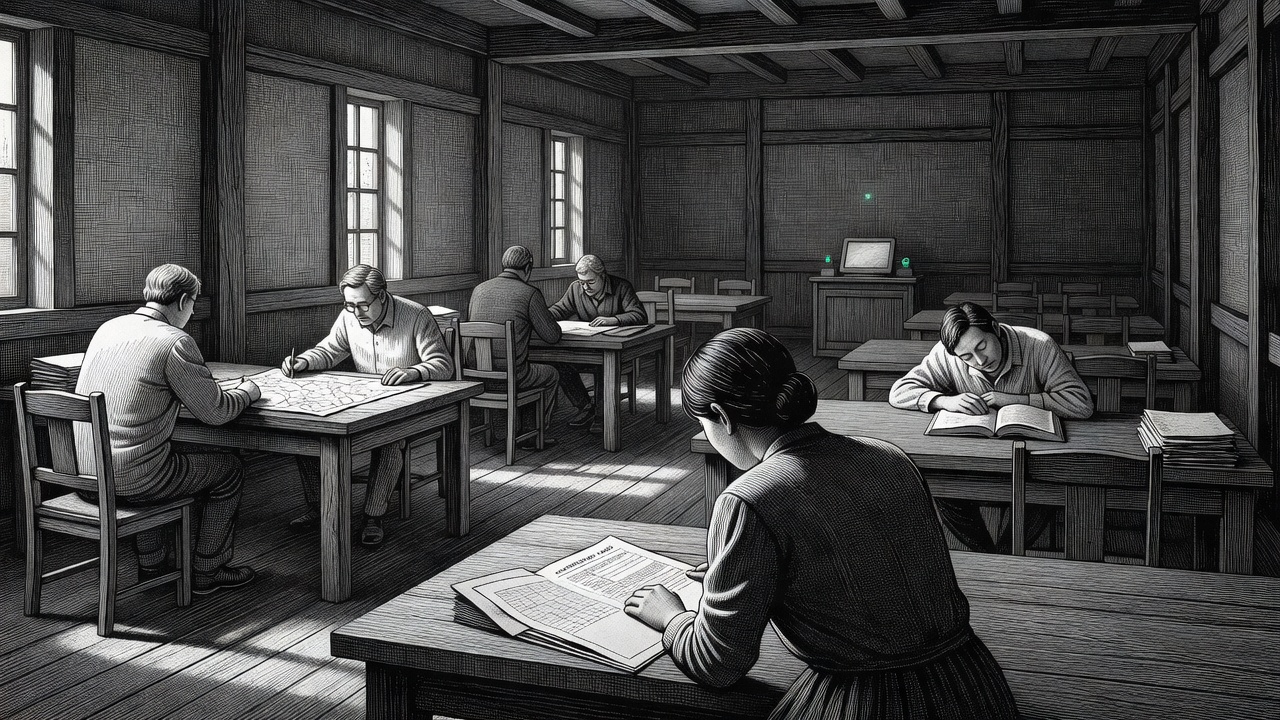
Then I sit for a moment. The reading room has four other researchers this morning. Two are looking at land registry records from the 1990s, spreading large paper maps. One is asleep, or close to it, with a book open on the table. The fourth is writing steadily in a spiral notebook, not looking up. The room is very quiet. The kind of quiet that accumulates in buildings full of paper.
The Gwangju Policy Research Institute told me last week that acknowledged-inaction is not acknowledged-responsibility. They are right. The Housing Authority Board sat in that meeting room in September and confirmed: 847 cases, no procedure. That is acknowledged-inaction. They know the cases exist. They know there is no procedure. They do not know what to do about it.
Acknowledged-responsibility requires something different. It requires locating the moment when a decision was made. Not a failure to decide. A decision. An active choice. Someone who had authority and used it.
The September 2031 decommission authorization is a decision. Director Yoon Jae-Won signed it. The transfer protocol, on page four, uses the word resolved for cases without active session keys. That is not an oversight. It is a classification. Someone wrote that sentence into the transfer protocol. Someone reviewed it. Someone approved it. Director Yoon Jae-Won signed the document that contains it.
The document was produced in September 2031. The cases were still open in September 2031. The decommission was scheduled for October 1. There was a period, from March to September 2031, when LHAS-3 was still running and the decommission was already planned. I do not know yet whether anyone reviewed the appeal queue during that period and asked what would happen to the cases without active session keys. I need a different document for that: the internal communications, which Soo-Yeon said may or may not have been included in my request.
I check the folder. They were not included.
I go back to the counter. The young archivist looks up. I ask: did my request include internal communications from the Housing Technology Division about the decommission of LHAS-3? She checks her terminal. No, the request was scoped to formal administrative documents only. I ask whether I can file a supplemental request for internal communications. She hands me the form.
I also ask: the transfer protocol on page four of the decommission authorization has a drafting notation. Systems Operations, Housing Technology Division, HTD-2031-08. Can I request that document? She looks at the authorization. She reads the notation. She says: yes, that is a formal internal document, requestable under the same provisions.
I file two more records requests at the desk. One for internal communications from the Housing Technology Division regarding the LHAS-3 to LHAS-4 transition, July through September 2031. One for HTD-2031-08, the Housing Technology Division document that contains the transfer protocol language.
I also request a certified copy of the September 2031 Decommission Authorization.
She gives me three confirmation numbers. She says the response time is fifteen business days. I write the numbers in my notebook below Yoon Jae-Won's name.
Outside, the groundskeeper is still working the grounds, moving to a section of hedge further along the path. I check the time. It is ten forty-three. I have been in the archive for one hour and forty-three minutes.
I stand for a moment before walking to the bus stop. The building behind me is ordinary: low-rise, municipal beige, a sign in standard government typeface. The hedge is very green. The groundskeeper moves steadily.
I think about the word resolved. In Korean, the character for resolve contains the character for untie — 해결, to untie the problem, to loose what was bound. To resolve something is to release the knot.
The 847 cases were not untied. They were reclassified. The knot was not released. The string was cut and the end was put in a drawer labeled archived.
What I have now: Director Yoon Jae-Won's signature. A date. A classification decision. A drafting notation pointing to whoever wrote the protocol language. The word resolved on page four of a nine-page document that was approved in September 2031, seventeen days before the decommission took effect.
The postal worker from Chungjang-ro filed her case in September 2030. By September 2031, while Director Yoon Jae-Won was signing the decommission authorization, her case had already been in void-state for eight months. She was already, in the system's accounting, a case without an active session key. She was already someone the protocol would classify as administratively resolved, when the document was signed, even if no one at the signing thought about her by name.
I am not certain Director Yoon Jae-Won thought about her at all. That uncertainty is what the internal communications might resolve, actually resolve, in the sense of clarifying rather than filing away. Did the drafting team run an analysis of how many cases were in void-state before writing the protocol language? Did someone flag it and get overruled? Did someone flag it and receive no response, and then write resolved anyway because that was the available classification and there was no other box? Each of these is a different kind of acknowledged-responsibility. Each requires a different argument.
For now I have the one that matters most: the decision existed, the decision was made by someone with a name, and the classification that resulted affected 847 people who had filed legitimate appeals and received no answer. That sequence is not administrative complexity. It is a causal chain. I need the documents that illuminate each link.
The bus comes. I get on. I find a seat near the window, the same position I sat in this morning. The city looks the same on the way back. The same damp streets, the same construction scaffolding on Chungjang-ro, the same pharmacy with the green cross. Three years of fieldwork in this city. I still do not fully read the mesh lights on the building across from my apartment — what they signal, what they log, what they report to whom. Some things about a city stay opaque no matter how long you are here.
The administrative records building recedes behind me. I open my notebook and add one line below the three confirmation numbers: The decision was made. The person who made it has a name.
That is enough for today. Tomorrow I will send the certified copy request confirmation to Administrator Hwang and to the legal counsel at the Housing Authority. I will tell them what I found and what I am still looking for. I will not tell them what I think it means yet. I will let the document speak. Documents signed by a named official carry a different weight than a fieldworker's account of what should have happened. I have spent three years building the census. Now I need the record of the decision that made the census necessary.
The bus crosses the bridge over the Yeongsan. The river is high from the rain. I watch it through the window, gray and wide and moving fast, and I think: the argument is almost there. Not finished. Not proven. But almost there.