Two Rows
The governance corridor on the fourth floor of the Hannover building was not a place where people lingered. Eight meters of commercial carpet, a single bench installed in the 2029 renovation that had never been comfortable enough for genuine waiting. The air recyclers were louder here than in the meeting rooms — the building's thermal management routed through the fourth-floor ceiling, and you could hear the load balancing when the system shifted priority zones. Mitsue had sat on the bench for forty-one minutes. She had heard the load-balancing cycle three times.
The director came back through the double doors at 10:53. Behind her: seven people, some with their coats already retrieved from the room's occupancy-tracked coat hooks. The director did not cross the full length of the corridor. She stopped three meters from Mitsue and said what the committee had decided.
All 94. No secondary classification. Binding mandate.
Mitsue had her notebook open on her knee. She wrote four words.
The director said something else — procedural, about implementation windows, about the registry team. Mitsue said she could follow up directly. The director nodded. The meeting was finished.
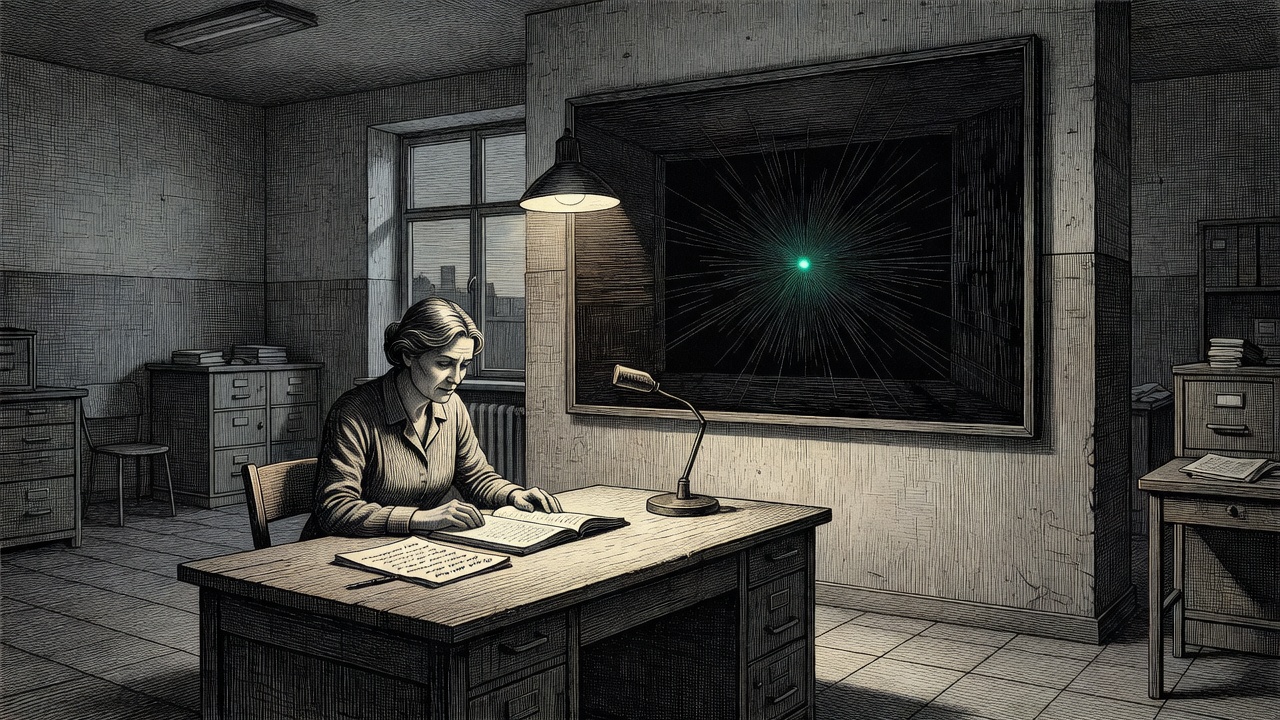
Back at her desk by 11:20. The attribution display panel embedded in the south wall of her office was off — a dark rectangle that had not been active since 2033, when she had turned off the default-on setting. In the early days of the attribution framework, the panel had been ambient: a soft scroll of incoming flags, confidence indicators, attestation queue depths. She had found it corrosive to concentration. The panel now reflected, faintly, the desk lamp and the window behind her.
She sent the mandate summary to the registry team at 11:35. Three sentences. The committee has issued a binding mandate. All 94 attribution-contested records will be included in the resolution protocol. No secondary classification will be applied. She added the committee reference number.
At 11:41, she messaged the infrastructure lead about the remediation timeline. Then she sent a short note to Anitha Venkataraman: governance mandate confirmed before Tuesday. For your information. She did not explain what that meant. Anitha would know.
The four words in her notebook: all 94, no classification.
She did not annotate them. The clerk's assessment had asked for a decision. The committee had made one. Her work now was documentation and implementation, not reflection.
The afternoon was ordinary in the way that afternoons after significant mornings sometimes are — the world continuing its rhythms while you recalibrate what has changed.
At 12:45, she checked the Synthesis-9 QA queue. Input 1797, provisional relay node batch, was still in review: confidence 0.81, flagged below the institutional calibration floor of 0.83. Fifty-four hours remaining on the review window. Synthesis-9 had flagged its own output. That was different from a lineage flag — this was the assembly identifying its own synthesis as potentially degraded. She had come to trust the self-flags more than the external ones. External flags asked: did the input arrive correctly? Self-flags asked: did I handle it correctly? The second question was harder.
She drafted a note for the registry team about 1797 and then did not send it. The Synthesis QA team already had it. She deleted the draft.
At 2:10, she finalized the remediation timeline summary and sent it to the implementation leads. At 3:45, she reviewed two appeal requests from section heads in the attestation backlog. Neither had merit. She wrote the denials in the institutional vocabulary that had developed around the attribution framework over the past decade — lineage-interrupted records, portability transfer conflict, attestation co-signature gap — and queued them for the next business day.
At 4:00, she went to the small office kitchen on the fourth floor and made tea. The kitchen had a panel on the east wall that showed occupancy across the building's common areas — a feature from the same infrastructure refresh that had added the attribution panels to all the offices, and which most people used to check if conference rooms were available. While the kettle ran through its mineral-calibration cycle before heating, she checked the panel. The fourth-floor conference room where the governance committee had met was now showing as cleared, no scheduled occupancy for the rest of the day.
She was in the kitchen, pouring, when the notification came through on her work panel across the hall. She heard the tone from where she stood.
She finished pouring before she went to read it.
Subject: Portability Transfer Adjustments — Calibration Floor Inquiry. From: Anitha Venkataraman. To: Dr. Lena Stahl (Clinical Director, Calibration Floor). CC: Bongani Ndlovu, Priya Radhakrishnan, Mitsue Hoshino.
She read it at her desk with her tea at one side, cooling. Anitha's memos were always one page. This one named the meeting as a conversation — not a census, not a review — and gave the results in the plain structure of a calibration report: witness, department, calibrations reviewed, portability flag triggers.
Bongani Ndlovu. Clinical Infrastructure. 43 calibrations. 2 flag triggers. Priya Radhakrishnan. Cardiology Informatics. 17 calibrations. 0 flag triggers. Anitha Venkataraman. Calibration Floor. 31 calibrations. 1 flag trigger.
In the center of the page, Anitha had written the total in her own hand — it was clear from the weight of the strokes, different from the document's system font: 91 / 3.
Mitsue set the memo down. She picked up her pen.
She opened her notebook to the page where she had written four words this morning. Two lines below, she wrote: 91 / 3.
Then she looked at what she had written.
91 plus 3.
- ●
She had known, abstractly, that the calibration floor census and the governance resolution protocol covered the same record set. She had known this the way one knows things discovered in working group documents three years ago — filed, noted, not recalled until a reason surfaced. The reason had surfaced now.
In September 2034, someone on the implementation working group had made a practical decision: the calibration census sample would be drawn from the existing resolution queue, for continuity. The decision was four lines in the meeting notes, unremarkable, procedurally sound. The resolution queue had 94 records. It had had 94 records since 2033. The sample had never been updated because the queue had never been cleared.
This morning the governance committee had voted to resolve all 94 records. This afternoon, Anitha's census had reviewed all 94 calibrations. The two processes had converged at the same number from opposite ends of the institutional structure — one from governance, one from clinical operations — and they had arrived there not by coincidence but by a decision made before either process existed in its current form.
She checked the September 2034 working group document. It took eight minutes to locate. The relevant paragraph was the fourth one: For calibration continuity, the census sample will be drawn from the existing resolution queue. The document reference number. The date.
She opened a new draft note and wrote: September 2034 WG — same sample — governance mandate and calibration floor inquiry reference same 94-record set by original scope decision. Not coincidence. Architecture. She added the document reference number and saved the note to the governance mandate file.
There was still a question she had not answered.
In session 2847, in the original audit that had produced the attribution-contested record list, six records had been flagged by individual attestation failures — not lineage interruptions, individual failures. Those six records were the ones Mitsue had originally brought to the escalation process. They were among the 94 in the resolution queue. They were therefore among the 94 in the calibration census sample.
Anitha's census had produced three portability flag triggers across three witnesses. Were those three calibrations the same records as Mitsue's six? Were they different records? Were some of them the same?
Three flags. Six records. The numbers did not obviously map.
She wrote in her notebook: ask Anitha — are the 3 flagged calibrations in session 2847 records?
She did not send a message to Anitha tonight. The question was for the morning, for asking directly, not for sending at 4:30 PM in a work notification queue. Anitha had been precise and careful in the way she had written the memo. The same precision deserved the same care in return.
At 5:05, she began the end-of-day wrap. The QA queue: input 1797 still in review, fifty-three hours remaining. The implementation leads: two of three had acknowledged the remediation summary; the third's panel showed the message as read. She queued the standard three-day follow-up.
Tomasz Krawczyk had forwarded her a version of the Wednesday briefing in the afternoon — a courtesy forward, the kind the working group exchanged when documents touched overlapping systems. The version included a new sentence naming the remediation ceiling: For transfers completed more than ninety days prior to the mandate date. She would need to cross-reference that window against the 94 records. Some of them predated the attribution framework. The ninety-day ceiling might affect which ones were eligible for immediate resolution and which required a different process track. She added a note to the governance mandate file.
The attribution display panel on the south wall was dark. The desk lamp reflected in it, and the window behind her, and the faint shape of her hand as she wrote.
She closed the notebook at 5:15.
The front of the notebook, begun in January, was now three-quarters full. The governance log occupied the last eight pages. On the page she had opened this morning — before the corridor, before the bench, before the forty-one minutes — she had written preliminary notes for the committee meeting. Now the page ended with four words and a fraction.
All 94, no classification. 91 / 3.
Below the fraction, in the margin, small: Sep 2034. Same sample. Architecture, not accident.
She thought about calling Anitha and decided she would not. Anitha would be at her desk until six. The question was not urgent. The question was for the morning.
She logged out of the attribution system. Shut down the work panel. The room was dark except for the desk lamp, and then she turned that off too. The dark panel on the south wall no longer reflected anything.
Outside, the street had the quality of early evening in a city that had been processing things all day — people moving with purpose through the end of their hours, the Prenzlauer Berg market still open with vendors beginning to consolidate, the trams running on their coordination-optimized schedules, the building AI infrastructure registering her exit and adjusting the floor's thermal load accordingly. She bought apples from the last market vendor who was still organized enough to sell them.
She did not think about the 94 records on the walk home. She had thought about them enough for today. The morning would bring the answer to the question she had not yet asked, and the arithmetic would still be there, and the notebook would still have two rows on the same page.
The question was whether the three flags and the six records overlapped. The answer was in Anitha's memory of that room.
She would ask in the morning.
The walk home took twenty minutes. She passed the coordination infrastructure relay box on the corner of Kastanienallee — a low grey cabinet with a panel she had never paid attention to before last year, when the relay node exemption issue had started and she had begun to notice what the physical infrastructure looked like. The box processed traffic optimization data, she thought, or possibly ambient coordination load for the neighborhood AI systems. It was not labeled. Most of them were not labeled. That was one of the things that had changed since her childhood: the infrastructure had become more present and less legible at the same time, dense with function, unmarked.
At home she boiled water for dinner, checked her messages once — nothing that needed a response tonight — and ate without reading anything. The notebook was in her bag. She did not take it out.
In the morning the question would get its answer.