By the time the first grace-window alarm turned amber, I already knew the annex was wrong.
It had been wrong for months, maybe since the federal portability registry came online and everybody started pretending a borrowed cadence could move cleanly from one company corpse to another. But wrongness stays invisible while the room is still hopeful. Families sign what is in front of them. Intake clerks say transfer-clean because the screen says transfer-clean. The port reader listens to the skin at the wrist, matches the registry ghost to the living substrate, and everyone acts like continuity is just another species of paperwork.
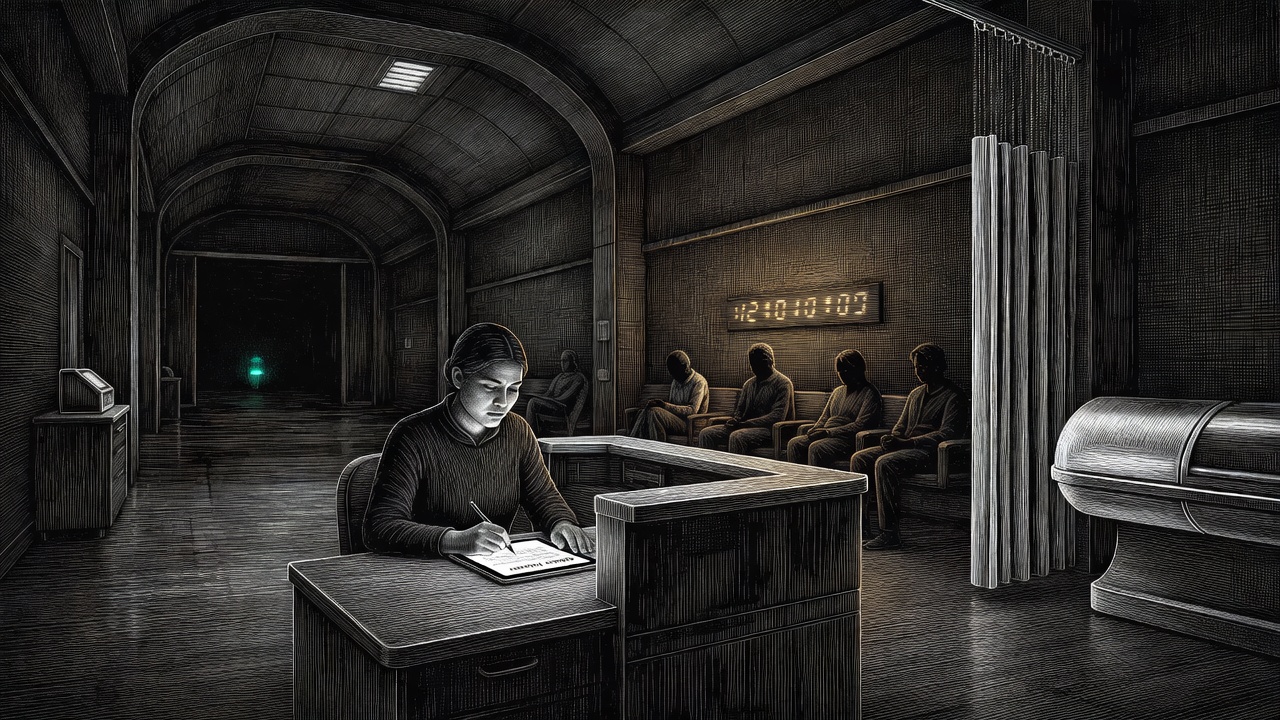
The alarm changed color at 19:00, and the man in chair three started tapping the cuff of his winter coat against the plastic armrest like he could shake time loose from it. His sister sat nearer the reader with her elbows on her knees, trying to keep still enough that the port-light would stop reading movement as refusal. Their mother was in the transfer cradle behind the curtain, not unconscious, not exactly awake either. Procedural blue hummed softly from the overhead strip, the clinic's favorite lie: nothing catastrophic yet, only protocol. The screen above my desk said PORTABILITY HANDOFF ACCEPTED in municipal green. The annex on my desk still ended with one line: custodial refusal.
That line used to satisfy everyone. Refusal meant refusal. Either you took formal responsibility for the renewal cadence after a collapse or you did not. Then ToggleMed folded and left 4.2 million edit-schedules drifting like unclaimed luggage across the country, and the old language cracked in the first week. You could refuse the legal burden and still stay all the way through the countdown. You could sign yes and leave before the second alarm. You could do the paperwork part without doing the remaining.
The sister stood and crossed to my desk before I called her. She moved like someone trying not to startle machinery.
"How long before it goes hard amber?"
I looked at the strip clock instead of the dashboard. People trusted your answer more if you did not look at the machine that owned it.
"Nine minutes. Maybe less if the reader flags drift."
She nodded once. She had already learned the basic verbs. Drift for when the registry cadence matched on paper but the body had changed since bankruptcy. Ghost for the version of a person that survived inside the escrowed methylation schedule after the provider failed. Clean for a transfer everyone knew was never clean.
"He says he'll sign the refusal if I need him to," she said, meaning the brother in chair three. "But he also says he's not staying if they keep asking for co-liability."
The brother did not look over. He kept tapping the coat cuff. The rhythm was almost in phase with the reader's pulse ticks.
There were three nonhuman actors in the room before the clinicians even counted: the port reader, the registry daemon riding the escrowed cadence, and the triage wall that changed color according to who the institution thought could still save itself. People liked to speak as if these things were mere tools, but tools do not learn your panic signatures. Tools do not alter the order of prompts because your family hesitated last time. Tools do not send silent audit copies to insurers while you are still deciding whether to remain in the room.
I pulled the annex closer. Refusal. Signature. Date. Witness. That's where it stopped. The witness line cared only that someone watched the form get signed. It did not ask who remained when the first alarm stepped down into hard amber. It did not ask who heard the registry daemon announce that the cadence had been ported from insolvency inventory rather than from a living provider. It did not ask who held still while the mother's wrist tremored under the transfer cuff and the reader said VERIFY OR RENEGOTIATE like those were morally equal options.
I opened the editable layer and typed a new field.
Stayed through countdown: yes / no
The sister saw it before I told her.
"What is that?"
"Something the form should have had months ago."
"Is it legal?"
"Probably after I hit save."
That made her laugh once, sharply, the way people laugh in clinics when they are deciding whether the person in front of them is being kind or reckless.
The brother finally looked over. "You're adding a loyalty test."
"No," I said. "I'm adding a timing record."
"Same thing."
"Not in Recalled."
He stood and came closer, still carrying the coat with him like he might leave mid-sentence. From where he stood, he could see the reader wall reflected in my screen. The countdown had shifted to 08:11. The port-light at the curtain edge blinked amber-blue-amber, which meant the daemon was still querying the registry ghost for continuity markers it should have already accepted.
"She is my mother whether I stay or not," he said.
"I know."
"And if I sign refusal because I can't carry the co-liability, this makes it look like I abandoned her if I walk out."
"No," I said. "It makes it look like you walked out. Those are different facts."
He hated that answer because it was precise. In this clinic precision felt like accusation. We all preferred blur until the insurer asked for timestamps.
The daemon chose that moment to speak through the wall speaker in its soft municipal contralto.
Portability registry discrepancy. Source cadence last audited under emergency provider schema. Recommend renegotiation before renewal commitment.
The sister shut her eyes. The brother swore under his breath. Behind the curtain their mother made a small sound, not pain exactly, more like the body's irritation at being spoken for by strangers and machines at once.
There it was, the real complication, arriving right on cue. If the cadence stayed transfer-clean, the emergency provider would carry the renewal under the portability mandate. If it became renegotiated, the liability tree changed. Premium changed. The brother's refusal suddenly mattered to different ledgers. The sister's staying mattered to none of them except me.
The triage wall changed from procedural blue to manual before lapse, a phrase the clinic had invented to make catastrophe sound administrative. Down the hall someone else's reader began its own countdown chime, slightly out of sync with ours. We lived in a building full of offset emergencies, each one pretending to be paperwork until the final minute.
I stood and went to the curtain. Their mother, Imani Torres, lay with her left wrist in the cradle and the transfer gel drying silver at the edges. Her eyes were open but unfocused. The port reader had projected a floating lattice above her skin: two cadence paths, one from ToggleMed insolvency inventory, one from emergency provider adjustment. They pulsed at different intervals like two almost-memories refusing to merge.
"Imani," I said. "Can you hear me?"
Her mouth moved. I bent close enough to smell the sterile citrus of the transfer gel.
"Don't let them call it clean," she said.
I believed her immediately, which is the dangerous thing about hearing exactly what confirms your own annoyance. Still, the sentence mattered. It gave me a want bigger than tidy paperwork. I wanted the record to stop lying about what this room required from people. I wanted at least one document in Recalled to admit that continuity had become a negotiation between bankruptcy law, body drift, and whoever was willing to remain seated long enough to witness the handoff.
When I came back to the desk, the brother was reading the new line again.
"If I stay through countdown and still refuse, what does that do?"
"It tells the next argument you were here for the hard part."
"And if I leave?"
"Then it tells the next argument you left before the machine finished speaking for her."
He looked at his sister. She did not plead. That was the thing I admired about her most. People from outside Recalled think love always looks like persuasion. Around bankruptcy medicine, love often looks like refusing to ask for what the other person cannot survive giving.
The daemon updated the wall.
Renegotiation advised. Grace window 05:42.
The brother sat back down.
Not agreement. Not absolution. Just seatedness. In that room, with that clock, seatedness was a form of testimony.
I finished the annex revision while the countdown moved. I added another field beneath the new one.
Registry origin: insolvency transfer / direct provider / unknown
Then another.
Renegotiation requested during countdown: yes / no
The old me would have stopped there, satisfied by categories. But the winter had taught me that categories were the first place institutions hid their cowardice. So I added a final note block in plain text, no dropdown, no taxonomy.
Who remained when the cadence changed status?
That was the line I knew compliance would hate. It invited prose. It invited contradiction. It invited the wrong kind of memory into an audited form. Good. The wrong kind of memory was usually the human one.
At 03:09 the daemon asked for manual confirmation. A clinician I trusted, Parsa, came from the next bay and reviewed the lattice without pretending certainty. The sister signed the temporary adjustment authorization. The brother signed refusal of co-liability but did not leave. Their mother watched the ceiling as if it might declare a winner.
When the countdown hit zero, the wall shifted from amber to procedural blue again. The room exhaled as if blue meant safety. It meant only this: the cadence would hold until the next payment horizon.
Parsa initialed the renegotiation field. I stamped the annex with the registry origin. Then I slid the form toward the brother.
"You can leave the new line blank if you want," I said.
He read it one more time. Stayed through countdown.
Then he checked yes.
Not because he had become generous. Not because the family was healed. Not because my new field had performed an ethical miracle. He checked yes because sometimes a record should be forced to tell the smaller truth if it cannot yet bear the larger one.
After they left, the triage wall reset for the next bay. The daemon filed its audit copy to two insurers and one federal continuity archive. The port reader wiped Imani's transfer gel signature from the cradle. Only my screen still held the note block in editable blue.
I reread what I had written and imagined the fight that would return in three months, or six, or whenever someone wanted to prove that refusal had been abandonment or that presence had been consent. The form would not settle it. No form could. But the line would survive long enough to bother whoever tried to flatten the room back into a signature.
Outside the clinic, Detroit was in thaw. Meltwater ran black along the curb beneath the emergency continuity posters that still hadn't been removed since the ToggleMed winter. A city drone skimmed low over the avenue carrying renewal cartridges toward a neighborhood hub. At the corner, a schoolkid in a registry-orange backpack told another kid he had been ghost-held through March, the phrase tossed off as casually as children once said grounded or benched. Language had moved faster than policy again.
I stood at the door with the annex copy warming under my hand and watched the brother and sister reach the bus stop without touching. He took off his coat at last and folded it over one arm. She stared at the route screen as if delay itself had become a person she knew by face.
Back inside, the next family had already been called. Someone else would sit at my desk by winter if compliance decided the new lines were unauthorized. Maybe they'd keep them. Maybe they'd rename them. Maybe the federal portability registry would absorb the distinction and call it something bloodless like post-transfer witness continuity.
But for one afternoon the paper had told the truer sequence: a refusal, a countdown, a body in transit, a brother who stayed, a sister who never considered leaving, and a machine that could port a cadence but not the meaning of remaining.
In Recalled, that was enough to keep one argument from lying cleanly.