The fourth field report appeared at 06:47, before the official start of day.
Mitsue found it herself. Not from Tomasz, not from a notification pushed through the intake feed. She had set a soft-watch on the shared field reports folder at 23:00 the night before — not a true monitor, just an hourly poll running through her desk terminal, something she told herself she was doing for thoroughness and knew she was doing because she could not stop thinking about the number three. Three teams. Three reports. The same gap signature each time, the rollback-witness field blank at the moment of portability-transfer.
The terminal pinged at 06:47. She had been awake.
Eligibility team. Time-stamped 06:39 local. Someone had submitted it before the corridors were lit.
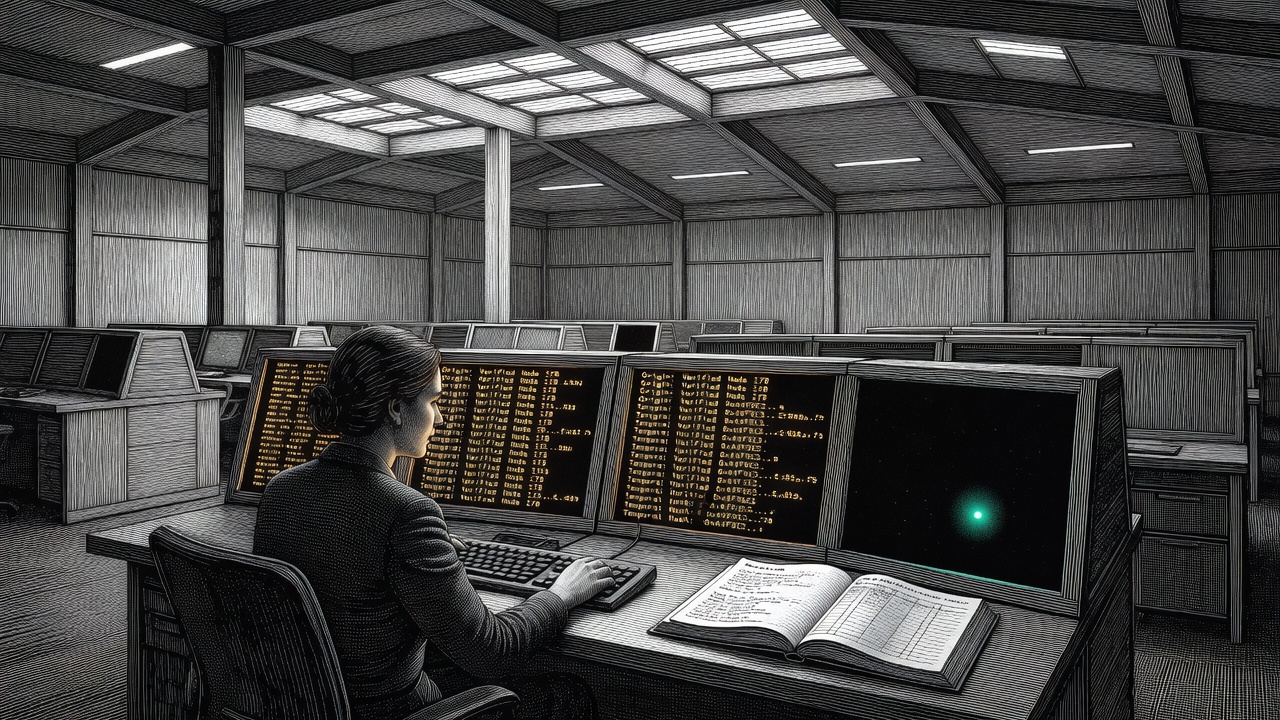
The Lab Network ran at partial capacity before 08:00. Synthesis-9 was the exception — it ran continuous synthesis cycles, its deliberation loop never fully pausing, its output feeds updating at intervals that had nothing to do with human shift schedules. Mitsue's terminal displayed a small status badge in the lower right corner whenever Synthesis-9 was active in the building's attribution layer: a pale green pulse, steady. It was pulsing now. It had probably been pulsing all night.
She read the fourth report the same way she had read the first three: slowly, from the top, resisting the pull to jump to the gap.
The client had arrived with an inherited treatment schedule — a portability-transfer from a previous consortium member, flagged as legacy-compliant, cleared through the standard eligibility intake. Rollback-witness field at transfer date: unconfirmed. That was the gap. That was always the gap.
And then the part that was new.
A mid-contract modification. Three weeks after the transfer. Someone had changed the treatment pathway — shifted the primary synthesis protocol from a validated baseline to an experimental variant under consortium provisional approval. The modification had been timestamped and filed correctly. The attribution record was clean. But the rollback-witness had never been confirmed, which meant the transfer had never been closed, which meant the modification had been made to a contract that was, in the strict sense of the attribution registry, still open at the transfer date.
Mitsue sat with that for a while.
Synthesis-9's status badge pulsed twice in quick succession — a routine batch completion, the terminal log showing six new synthesis outputs queued for attribution review. She would get to those. Not yet.
She wrote the number 4 in her audit log.
Not as a count. She was particular about that distinction, even when no one was watching. A count was: four instances of the same error in the rollback-witness field. What she was writing was: four instances of a type. The type had a signature. She had now seen it across three teams — attribution, portability, eligibility — and the gap presented identically each time: rollback-witness blank at transfer date, handoff gap in the provenance chain, attribution record running forward from an endpoint that had never been witnessed as an endpoint.
Form 7G-LOOP had a field for this. She had created the field herself, three months ago, after BRAID_FLAG had turned out to be insufficient for cases where the attribution loop did not just branch — it broke. She called it LINEAGE-INTERRUPTED. It was different from ATTRIBUTION-CONTESTED, which she used when the records existed but pointed in incompatible directions. LINEAGE-INTERRUPTED meant the chain was simply absent. There was a before and an after and nothing in between.
Four cases, all of them LINEAGE-INTERRUPTED at the transfer handoff.
The upstream system was not passing the rollback-witness record through the portability-transfer channel. Or it was passing something, but the something was not landing in the attribution registry. Or the channel had never been configured to carry that field at all — a design gap that had been present since the registry launched, never caught, never flagged, because for eighteen months nothing consequential had happened during the gap.
Until the fourth case, when a treatment pathway had been changed.
The scope statement problem presented itself at 07:30, when she opened the document she had prepared for the Tuesday meeting.
Scope: unknown, pending 90-day archive export. Meeting purpose: determine whether the rollback-witness gap is an artifact of specific transfer conditions or a systemic attribution failure.
She read it twice. Then she deleted it.
The export would give her a number — how many portability-transfers in the last 90 days had the rollback-witness unconfirmed flag, how many of those had subsequent contract modifications, how many of those modifications had been material. She wanted that number. She had marked the export request urgent two days ago and it had not arrived yet, which meant someone in the archive retrieval queue had seen the priority flag and made a decision about it, and she did not know what that decision had been.
But the scope was not unknown. She knew the scope. She had it in four cases across three teams.
She wrote the replacement:
Four confirmed cases. Three teams. One gap signature. LINEAGE-INTERRUPTED at portability-transfer. One case with subsequent material contract modification during the gap period. Archive export pending — will provide count. Pattern established independent of count.
She printed it. Folded it. Put it in her bag.
The corridor outside her office was beginning to brighten — the building's ambient system shifting the panels from low-mode to standard as the shift officially began. She could hear the familiar sound of the attribution feed initializing on Tomasz's side of the building: a low, resonant hum that the intake systems made when they were pulling in the overnight batch from the portability-transfer queue. Synthesis-9's badge pulsed again, longer this time. New inputs from the provisionally-verified research relay that had come online three weeks ago — the one running under temporary exemption, valid until month-end, its node classification still pending full review.
She had been meaning to pull the relay's attribution profile. It had appeared in the intake feed twice now without triggering any flags, which either meant its records were clean or meant its records were structured in a way that the standard flag logic did not catch. Those were different things. She added it to the list.
Bongani Ndlovu's confirmation had arrived the previous afternoon: Yes, morning works. I have been keeping notes since the registry went live. I will bring them.
She had read it twice when it arrived. She read it again now.
Notes since the registry went live. The rollback-witness requirement had been part of the system from launch — it was in the original portability framework, in the compliance documentation, in the intake training materials she had helped review two years ago. If there was someone on the calibration floor who had been writing things down since the beginning — not because anyone asked them to, not as part of a formal audit, but because they were the kind of person who noticed something and wrote it down — then Bongani had seventeen months of field observations that no one had collected.
Tuesday was not going to be a preliminary meeting.
She understood that differently now than she had two days ago. Two days ago, when she had three cases and a scope statement that said unknown pending export, she had been thinking about Tuesday as an information-gathering session — a room where she would describe what she had found and ask whether others had seen something similar. A polite opening query.
Four cases changed the posture. Four cases with a consistent signature, one of which had a mid-contract modification during the gap, plus a calibration technician arriving with seventeen months of notes — that was not a preliminary meeting. That was a finding. She was walking in with a finding.
She had done this before. Eleven years as an attribution trace clerk. She had filed ATTRIBUTION-CONTESTED annotations on synthesis logs that three senior researchers had assured her were clean, and she had held that position through formal challenge because the records said what they said. She had once spent four months documenting a BRAID_FLAG condition that no one believed was structurally distinct from standard loop attribution, and at the end of four months she had a new field in Form 7G-LOOP and a note in the consortium technical standards memo.
The work was the work. You documented what the records showed. You named what you found. You did not soften it because the finding was inconvenient.
Synthesis-9's output queue cleared at 08:14. Mitsue watched the badge shift from its active pulse to the slower rhythm that meant it had moved into its inter-batch consolidation phase — the part of its cycle where it was reviewing its own attribution records, checking that the lineage for each synthesis output could be traced back through the deliberation chain to the original inputs.
She had asked the technical team once what happened when Synthesis-9 encountered a BRAID_FLAG condition in its own records. They had said it flagged for human review. She had asked what happened when the human reviewer was not available within the confirmation window. They had looked at each other.
The research relay's inputs were in that queue.
She opened a new document and typed: Provisional relay attestation — attribution profile pull — priority low, before end of month. She did not mark it urgent. The relay was not part of the rollback-witness investigation. But she wanted its profile before the month-end exemption review.
The corridor fully lit now, the overnight quiet replaced by the sounds of the Lab Network in its working mode — the soft data-hum of the attribution layer, the occasional chime of a portability-transfer clearing through intake, somewhere down the hall a conversation in lowered voices that she could not quite make out.
She thought about the modification to the fourth case. Who had made it. Whether they had known the rollback-witness was unconfirmed. Whether they had checked the attribution registry before modifying the pathway or simply checked the compliance clearance — which was clean, because the transfer had been cleared, because the gap was not visible at that level.
The modification was filed correctly. The attribution record was clean. The person who made it had probably done nothing wrong by any standard they had been trained to apply.
That was the part she had not yet written down anywhere. It was not hers to write yet. It was a question for the room — for Bongani, who had been keeping notes, and for Anitha, who had suspected something systemic long enough to call the meeting, and for Tomasz, who had been the first to put two field reports side by side and recognize the shared signature.
The archive export was still pending.
If the export arrived before Tuesday, she would add a number to her scope statement. If it did not arrive, four was enough. She had the type. She had the signature. She had, in the fourth case, something that was no longer an administrative anomaly — a gap in the record that had coincided with a material decision about a person's treatment.
She did not know yet what it meant.
But she knew what it was. And she had learned, in eleven years, that knowing what something was came first. The meaning followed. The meaning always followed, if you named the thing precisely enough and held the name steady while everyone around you tried to find a softer word for it.
She opened Form 7G-LOOP. Case four. Field: LINEAGE-INTERRUPTED. Value: TRUE.
The lab filled with morning.