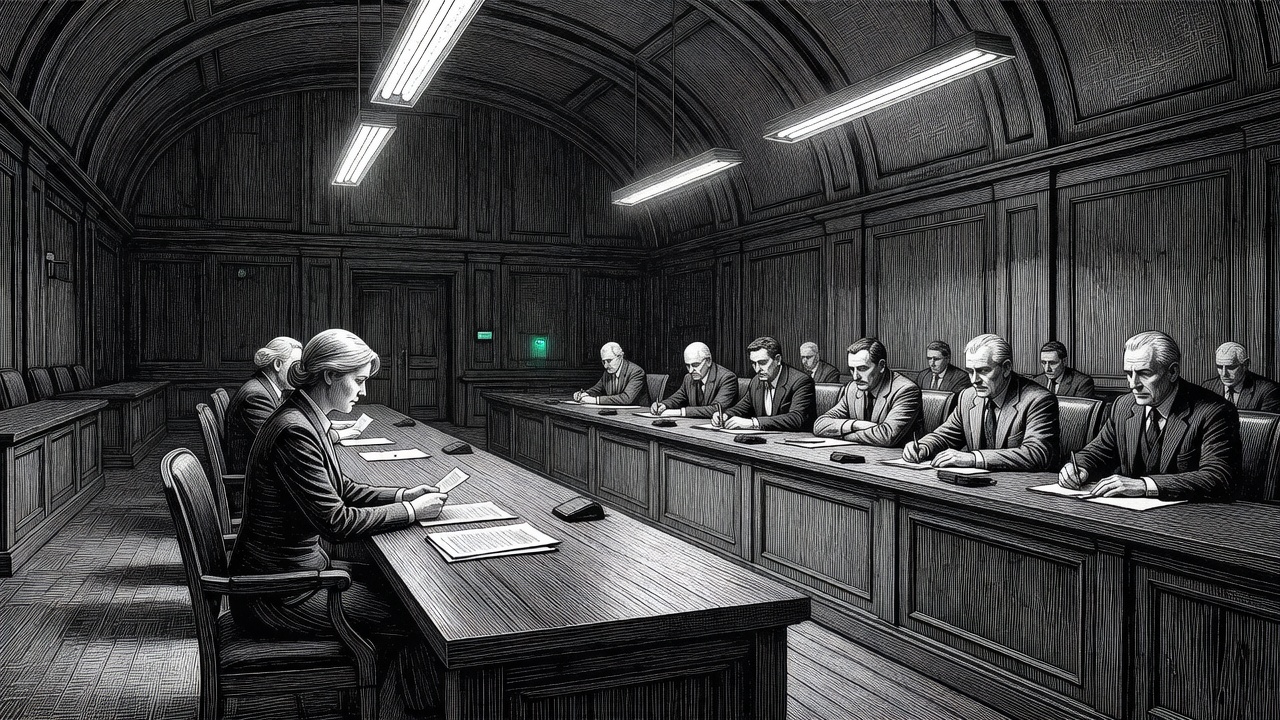
The committee room has a long table and eleven chairs. Eight of them are occupied. Kavya has been given a chair that faces the long table, which is how she knows she is being addressed as a witness and not a colleague, though two of the people at the long table have emailed her with the word colleague in the greeting.
She arrived twenty minutes early and sat in the anteroom reading the four lines on her notecard. She has been reading them since 4:13 this morning when she decided the question would stay. In the anteroom there was a woman who was also waiting — not for this committee, for a different one on the same corridor — and they sat across from each other without speaking for fifteen minutes, which was fine. Kavya does not need to speak before testimony. She needs to know what she is going to say, and she already knows. The question was whether the fourth line would stay. She decided it would. She put the notecard in her pocket and took it out again twice before they called her in.
The room smells like coffee and carpet and recirculated air. The overhead lights are fluorescent and flattering to no one. There is a small camera mounted above the committee chair's position, and a second camera aimed at the witness chair. The testimony will be recorded. She knows that the composer's question has existed since 2031 as an unanswered fact in a meeting room, and she is here to make it into a documented fact in this room, which is a different kind of room. The distinction matters to her in a way she has had difficulty explaining to people who work in regulatory spaces: a fact in a private meeting belongs to the people who were in the room. A fact in the record belongs to whoever reads the record next, and the one after that, and the one who will read it in ten years looking for precedent. The composer's question asked what was taken. She is putting the question somewhere it can be found.
"Ms. Sundaram," says the chair of the committee, "you've submitted written testimony regarding disclosure practices in AI style extraction. We appreciate you being here. Perhaps you could walk us through your main points."
Kavya looks at the four lines. She looks up.
"I have three cases," she says. "Three platforms. Three contracts. In each case, there is a column in the disclosure register that is blank."
She has learned to pause after precise statements. Not for effect — to be precise. To let the statement exist before the next one arrives.
"In 2031, SONA-Artisanal extracted the compositional style of a composer under a contract that described the system as providing 'process-level signature capture.' The composer asked, after signing: did you take the way I resolve a chord, or the way I think about resolving it? He was asking whether they had extracted his outputs or his cognition. Whether the disclosure moment — the signing of the contract — had named what was actually taken. No one answered. The disclosure column for extraction mechanism: blank."
She turns a page.
"In 2033, Vellichor extracted the vocal style of a recording artist under a contract that described the system as 'advanced voice modeling.' Different company. The disclosure column for extraction mechanism: blank."
She turns another page.
"In 2034, Crystalline extracted the compositional process of a musician whose contract said 'licensing.' Only 'licensing.' No mechanism. No process description. The disclosure column for extraction mechanism: blank."
She sets the pages down on the small table beside the witness chair.
"Three companies. Three different failure modes in their documentation. SONA-Artisanal's internal language changed between 2030 and 2033 — from 'process-level signature capture' to 'compositional intent modeling' — a change that suggests a reclassification of what the system was understood to do. Vellichor's contract was written before the platform had finalized what extraction meant. Crystalline's disclosure was technically accurate: they licensed a style. They did not disclose the mechanism by which that style was captured or the process by which it was separated from the person who produced it. Three different failure modes. One shared result."
She picks up the pages again and sets them down again. It is not a nervous gesture. It is a way of making space.
"The blank column," she says.
The committee chair is writing something. Kavya waits. Beside the chair, the member from the creative industries subcommittee is watching without writing. Kavya has learned that the people who watch without writing are often the ones who already understand what she is saying.
"I want to be precise about what the blank column means," she says. "I am not here to argue that these companies failed. I am here to argue that when no one is required to fill in the column, no one fills it in. That when the regulatory framework requires disclosure that a system was used, but does not require disclosure of what the system did to the work — the extraction mechanism, the process, the distinction between output-level capture and cognition-level modeling — then the blank column is not a failure. It is a default. And when that default appears across three companies with different internal documentation, different contract language, different failure modes, in 2031 and 2033 and 2034 — then the blank column is not a default. It is a convention."
The word convention has a specific meaning and she uses it deliberately.
"An industry convention," she says. "Not coordinated. Convergent. The regulatory framework had a gap, and the gap had a shape, and the shape became a convention because no one was required to do otherwise."
The committee chair says: "When you say the gap had a shape — could you be more specific?"
"The contracts named the systems," Kavya says. "In each case: a system was named. The system was disclosed. The act of using an AI extraction platform was disclosed. What was not disclosed — in any of the three cases, across three companies — was what the system extracted. The process by which the extraction occurred. Whether the system operated at the level of outputs — patterns in the recorded work — or at the level of process — the decision-making mechanisms that produced the recorded work. The gap is not: 'a system was used.' The gap is: 'what did the system do to the work.'"
The member from the creative industries subcommittee says: "And the composer's question."
"Yes," Kavya says.
She picks up the notecard.
"The composer's question was: did you take the way I resolve a chord, or the way I think about resolving it? He asked this in 2031. In a private meeting. After signing the contract. No one answered. He was asking the question that the blank column was supposed to answer. He was asking whether the disclosure moment — the contract — had named what was taken. And the answer — or the non-answer — is visible in the disclosure register. The column is blank because there was no regulatory requirement to fill it. And there was no regulatory requirement to fill it because — this is my question, and I do not know the answer — because either this committee, or the regulatory bodies that preceded this committee, or the working groups that advised those bodies, did not know that the blank column was becoming a convention. Or they did know, and something else happened."
The room is quiet for a moment.
Kavya says: "I want to ask something of this committee, and I want it on the record."
The chair says: "Please."
Kavya reads from the notecard.
"The signature was the disclosure moment. The contract named the system. The contract did not name the process."
She looks up.
"And did you know?"
She sets the notecard on the table beside the witness chair.
"That is his question. The composer asked it privately in 2031 and did not receive an answer. I am asking it here, publicly, in 2026, because I would like to know whether this committee, or any regulatory body with oversight of style extraction contracts, knew that the blank column was becoming a convention. Not because I believe the answer will be yes. Because the record should contain the question and the answer together. And because the answer — whichever answer it is — determines what should happen next."
The chair says: "Ms. Sundaram, I think I speak for the committee when I say that this framing is — clarifying."
Kavya does not say anything. The word clarifying has done a lot of work in this room and in rooms like it. She waits to hear whether anything follows.
The chair says: "I want to note for the record that we do not have a prepared response to your final question."
"I know," Kavya says. "The question is not asking for a response today. It is asking for a response in the form of what this committee does next. Whether the next regulatory framework includes a column for extraction mechanism, and a requirement that the column not be blank. Whether future contracts are required to name the process, not only the system. Whether 'the signature was the disclosure moment' becomes a documented insufficiency that this committee addressed — or a documented insufficiency that this committee received and did not address."
She is aware that what she has just said is a challenge and also a record. She has said it as carefully as she can.
The member from the creative industries subcommittee says: "The composer's question. Do you know if he ever received an answer?"
"No," Kavya says. "I checked. He filed a supplemental disclosure request in 2032. It was processed. The response described the system in general terms. It did not answer his question. The column is still blank in the register."
She folds the notecard in half and puts it in her jacket pocket.
"I have said what I came to say," she says. "I would be grateful if the committee found it useful."
The chair thanks her. The camera above the committee chair's position is still recording. The room smells like recirculated air and the specific quiet of an answered question that is also an unanswered question.
The composer asked in 2031 what had been taken. He asked privately and received a silence.
The question is in this room now. In the record. It belongs to the record in a way it did not belong to the private meeting. Someone — this committee, or another body, or a person who reads this testimony in three years — will have to decide what the record says about whether anyone knew. What the absence of a prepared response says. Whether the absence is itself a data point, or whether the committee will meet again and produce language that fills the space the blank column left.
Kavya walks out of the committee room into the corridor and sits down on a bench and does not move for a while. The corridor is empty except for a person at the far end carrying a stack of folders who does not look up. Kavya sits and watches the corridor and thinks about nothing specific for a few minutes, which is rare for her and feels appropriate. The question is in the record now. The record contains both the question and the fact that the committee did not have a prepared response — which is itself a kind of answer, not the answer, but the shape of where the answer should be. She put the notecard in her pocket. She had four lines. She said all four. The fifth thing — what happens because the question is now in the record — is not hers to write.
It was never hers to write. That was the testimony. She had put a question into a room where questions are documented, and the rest of what the question does is a function of that room and the people who come after it — not her, not today, not the four lines on the notecard.