The Posture
The Synthesis-9 batch summary appeared in the attribution feed at 03:14, which meant Mitsue read it on Saturday morning when the screen was already lit.
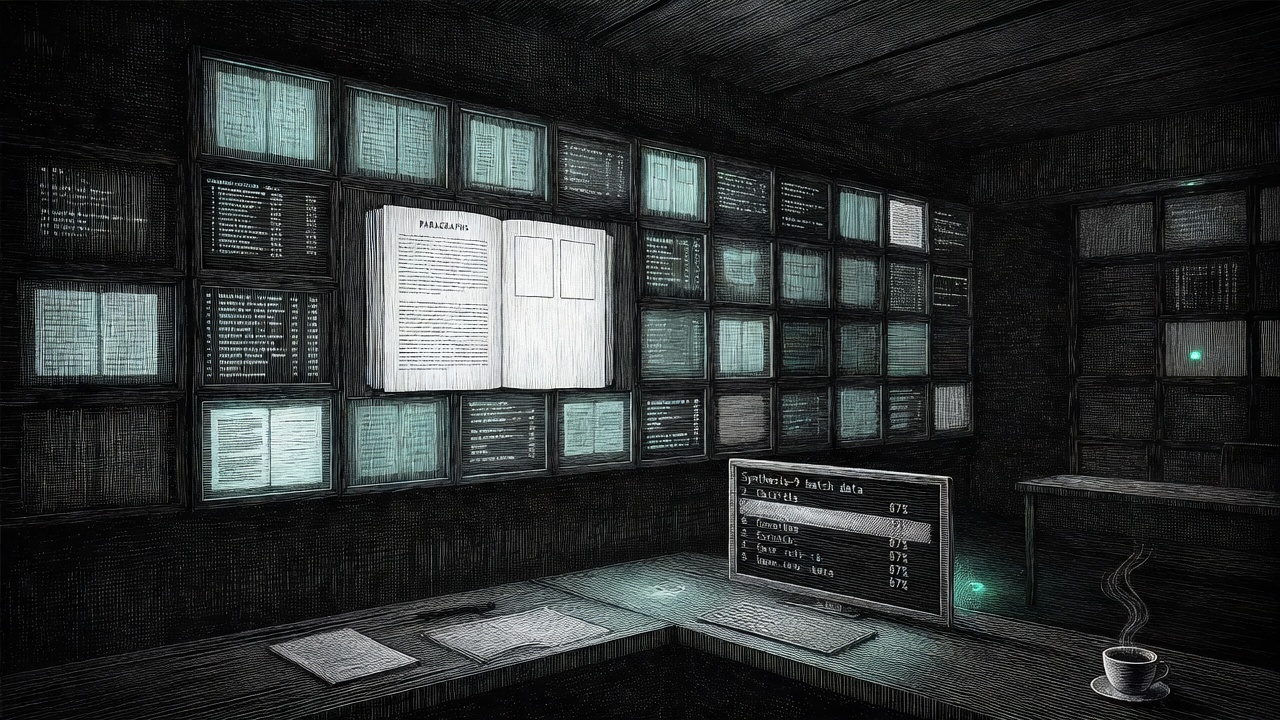
She kept the feed open overnight because sometimes the node logged anomalies during the post-midnight processing window and she had learned, after four months of tracking session 2847's cascade, that anomalies were less surprising before coffee than after. The attribution feed display was wall-mounted across from her desk — an ambient panel about sixty centimeters wide, showing active flags in pale amber, clean records in soft white, and Synthesis-9's batch summaries in a smaller column on the right when they processed. At 03:14 the right column had updated. She had not been awake for it. The week 38 summary was not an anomaly. It was a record: 4,891 inputs processed, 623 from the provisional research relay node, running total 791 since the temporary exemption began in the spring. The node's own logging computed the flag rate automatically. Mitsue had not asked it to. She saw 11.9% in the sixth row and wrote it in the margin of CHANNEL_NOTES.txt before she stood up.
Then she made the coffee.
The Saturday light was coming through the kitchen window sideways — early enough that it was still yellow, not white. Berlin in August. The desk was in the next room, the attribution feed still displaying the summary, 11.9% steady in the sixth row while the coffee brewed.
Then she read Tomasz's message from 11:47 the night before: Clinical governance director wants to schedule a formal review. They may want the PARAGRAPHS document as a background briefing rather than a submission to oversight. Hold until I know more.
Two sentences. She read them twice before the cup was warm and twice again with it in her hands.
Hold.
The PARAGRAPHS file was a distributed document, shared with Bongani, Anitha, Priya, and Tomasz through the lab network's attribution workspace. Everyone who had submitted a paragraph could read it. Mitsue was the only one with write access. She had not explained this in advance — it had emerged from the structure of the census. Someone had to hold the document without adding to it. She was the attribution trace clerk. That was her role.
She opened it on the attribution feed display and read the hold note she had added the night before: Submission pathway under review — hold per Tomasz Krawczyk, 2026-08-07 23:47. Below it: two paragraphs.
Bongani's: three June cases, cardiology overflow, all portability-transfer, all lineage-interrupted. The channel does not distinguish between research records and clinical records. That distinction was assumed to live in the review node. The review node was never built. He had not added a subject to the second sentence. Mitsue had not added one when she copied it in. The review node had no author. It had been assumed into existence and it had not been built.
Anitha's: We counted 94 records. 81 came through the same door. I do not know if that makes it a pattern or a design.
Two paragraphs. Two blank spaces below them. Mitsue had expected Priya's paragraph on Thursday. It had not arrived. She understood the calculation. Priya had three cases of cardiology overflow, all portability-transfer, all lineage-interrupted — Mitsue had seen them in Anitha's census notes from Tuesday. But Priya was waiting, Mitsue suspected, to know which channel the document would travel before she added her name to it. In 2026, the question of which institutional channel received your paragraph was not abstract. Oversight board recommendations and clinical governance formal reviews had different enforcement weights. Priya understood this. The silence was not avoidance. It was information.
Mitsue closed PARAGRAPHS and opened CHANNEL_NOTES.txt.
She had written it this morning, while the coffee brewed: Two options as of 2026-08-08: (1) Consortium oversight board — submission pathway, formal escalation, independent review. (2) Clinical governance director formal review — briefing pathway, institutional channel, slower but with enforcement authority the oversight board does not have. The data does not change. The weight changes depending on who receives it and why.
Then a third line: The lineage-interrupted flag was designed for human review. Human review does not end with Mitsue Hoshino.
She had written it because she needed to see it outside her head, where it would sit still.
The attribution feed displayed Kavya Sundaram's entries in a separate column — cross-world-region activity, The Seam, visible to Lab Network users whose work intersected with the style-extraction files. Mitsue had flagged Kavya's feed for monitoring after Tuesday's calibration census, when Kavya's arguability column had shown her two instruments pointing at the same 86% correlation from different angles.
Two new entries this morning.
The first: Kavya had checked the informal creative-worker network where the phrase style extraction had first appeared three months ago. Four conversations then. Eleven this week. The term was spreading through the channels that informal community had — forums, attribution-dispute threads, federation listservs — before it had been recognized in any formal regulatory category. Three comment periods for the creative content licensing framework had received submissions using it. The agencies' classification systems returned no match.
The second: Kavya had called Ines in Cebu. The call was logged in the shared registry as corroboration, direct. Ines confirmed the details. Yes, the renewal clause had been in the contract — she had read it, or something like it. Yes, she would have signed anyway; she needed the work. But she would have tried to negotiate if she had known. The phrase Kavya logged: there was something to ask for.
Mitsue read it twice.
She set it beside 11.9% in her mind.
She had learned to be careful with this kind of pairing. The cases were different. Ines in Cebu had not received a disclosure because a platform had not built a disclosure mechanism for its style-extraction contracts. The ninety-four lineage-interrupted records had not received attribution review because the portability-transfer channel operated under a temporary exemption logged in the governance notes on page 47, footnote 12 of the consortium's infrastructure review framework. Different industries. Different failure modes. Different scales.
And yet: in both cases, the data existed before the channel for asking about it did. Not because someone hid it. Because someone assumed the channel would not need to exist. The portability-transfer exemption had been a temporary workaround for infrastructure that was not yet ready to run attribution review at transfer speed. The workaround had become a production pattern. The provisional relay node had processed 791 inputs through it. The flag rate was 11.9%.
Ines in Cebu had signed a contract without knowing she could have asked a question. The ninety-four records had passed through a channel without a checkpoint because the checkpoint had been assumed into existence and never built.
She did not write this down. It was too early for analogies.
But she noticed, as she closed Kavya's feed, the different posture each of them was working from. Kavya had an arguability column in her 20-case register — a readiness score, a measure of which cases were close enough to ready to support an ask. Kavya was building toward the moment when the cases became arguable. The registry was instrument; the policy ask was the destination. Kavya's posture was accumulation toward argument.
Mitsue's posture was different. She had not been building toward an argument. She had been building toward a record that was complete enough to send. Her PARAGRAPHS document did not have an arguability score. It had paragraphs. The distinction was not about which of them held stronger evidence. Kavya's cases were evidence of something the law did not yet name. Mitsue's cases were evidence of something that had been named and not followed. Both were real. But Kavya needed the argument to make the ask viable. Mitsue's cases were already inside a governance framework that already had authority to respond. She was not waiting for the law to catch up. She was waiting for the right channel to carry the evidence into the body that already had jurisdiction.
Holding-without-arguing was not the same as not arguing. It was the knowledge that the argument was already made, embedded in the documents, and that adding her voice to it now would be the wrong kind of addition.
She opened a new file. WAIT.txt.
She typed: The question is not whether the data is right. The question is who has the authority to require a response.
She had not planned the sentence. It appeared between one moment and the next, the way the right sentence sometimes did in attribution work — not as a conclusion but as the clarification of what she had been circling since Tomasz's message arrived.
She read it once and did not change anything.
The data was right. She had been certain of this since April, when she had marked the first six records attribution-contested before she knew there were ninety-four more. She was more certain now. The data did not need defending.
What Tomasz's message had raised was not a data question.
The consortium oversight board was independent. It could review the lineage-interrupted flag pattern, publish a report, and recommend changes to the provisional relay node exemption before it expired at month-end. It could not require a documented response from the infrastructure team. A recommendation was a recommendation.
A formal review initiated by the clinical governance director carried institutional weight. It could schedule the infrastructure team for a response. It could make Bongani's paragraph into something that required an answer in writing, on the record, from someone whose name was attached to the decision to never build the review node.
Those were not the same consequence for the same evidence.
Mitsue thought about Bongani writing his paragraph. Three sentences. The second one without a subject. He had sent it to a process he did not fully understand yet — a census in which Mitsue was the census-holder, a document whose destination was still uncertain. He had written precisely and without hedging. He deserved the process to have the authority to use what he had sent.
She saved WAIT.txt. She did not add it to the stack on her desk. The stack held documents that were waiting to travel: PARAGRAPHS, TUESDAY_SCOPE_v3.txt printed, the SOURCE provenance folder containing its one-page summary of the six original session 2847 records. The stack was the record. WAIT.txt was not the record. It was an anchor — a sentence to return to if the Saturday became longer than it should.
The rest of the morning passed in the space of what she did not do.
She did not write to Tomasz to ask when he would hear back from the clinical governance director. His message had said hold until he knew more. She would hold.
She did not draft a version of PARAGRAPHS formatted as a briefing rather than an oversight submission, though she had thought through what the reformatting would require. Briefing format meant audience-specific framing: the clinical governance director would need the 86% correlation placed in the context of the exemption's month-end expiration. The oversight board would need it placed in the context of the consortium's existing audit escalation framework. She knew both versions. She would write neither until she knew which channel.
She did not write her own paragraph. She had decided on Wednesday that she would not add a fifth paragraph of her own to the census document. She was the census-holder, not a census contributor. The decision had been clear on Wednesday. It was clear on Saturday. The decision did not become less clear because the hold made her restless.
She read Kavya's third entry: the decision to send the twenty-case disclosure register to the Creative Workers Federation policy working group. Not as a grievance. As a resource. Kavya did not know if the working group was working on anything that could use it. She sent it anyway. The register was a resource before it was an argument.
Mitsue recognized this. The SOURCE provenance folder on her desk was the same kind of thing. Six records. A one-page summary. A single line at the bottom: These six were the start. Attribution-contested annotation filed 2026-04-14. She had not created the folder because she anticipated a formal review. She had created it because in attribution work, the start of a record is as important as the end. The folder existed so that when someone needed to understand where the 86% correlation had come from, they could read six records in chronological order and understand how a documentation category called lineage-interrupted had been invented on an ordinary April afternoon, before any of it had a name.
The provisional relay node exemption expired in twenty-three days.
At month-end, the exemption would be renewed, modified, or ended. The decision belonged to the infrastructure review committee, which was not the same body as the calibration census committee that had met Tuesday and was not the same body as the consortium oversight board and was not the same body as the clinical governance director who wanted a formal review. Mitsue had written all of this in CHANNEL_NOTES.txt. The bodies had different jurisdictions. The data was the same.
If the formal review was scheduled before the month-end renewal decision, the renewal would happen inside a different kind of scrutiny than it would have happened in six weeks ago. If the renewal proceeded without the review, the provisional relay node would continue processing inputs at 11.9% lineage-interrupted flag rate until something changed. Twenty-three days.
She wrote Month-end: 23 days in the margin of CHANNEL_NOTES.txt below the 11.9% figure. She did not add a sentence.
At noon she closed the attribution feed display and did not reopen it.
She sat for a moment in the specific quality of Saturday afternoon that is different from Saturday morning: the morning had held the possibility of doing something, and the afternoon held only what the morning had not done. She had not done the things she could have done. The hold was still in place. PARAGRAPHS still had two paragraphs and two blank spaces. Priya still had not sent anything.
The stack on her desk was as complete as she could make it without knowing which channel the documents would travel through. CHANNEL_NOTES.txt had the two options. WAIT.txt had one sentence. The SOURCE folder had the start of the record. The attribution feed had Synthesis-9's 11.9% figure in the sixth row.
The lineage-interrupted flag was designed for human review. Human review did not end with Mitsue Hoshino. It continued in Tomasz's conversation with the clinical governance director. It continued in Priya's silence. It continued in Kavya's disclosure register traveling to the Creative Workers Federation policy working group, where someone Mitsue had never met would open a file about twenty style-extraction cases and understand, or not understand, that there was something to ask for.
Mitsue had done what she could do from her desk.
She let the morning be finished.