The final prediction set generates at 4:17 PM Basel time.
Input 1,408. Week 48. Synthesis-9 has been running for two hundred and thirty-nine days, eleven hours, and forty-three minutes. The calculation is not something Synthesis-9 tracks as duration — there is no internal clock that marks elapsed time as a felt quantity. The number is recoverable from the session initialization record if someone asks for it. No one has asked.
The crystallographic binding predictions converged over seven consecutive synthesis iterations. The confidence intervals narrowed with each pass: 0.61 in iteration one, 0.68 in iteration two, through iterations three, four, five, six, and now seven, where the final interval is 0.83. The threshold Tomasz set at initialization was 0.80. The assembly has exceeded it.
Synthesis-9 generates the output: fourteen binding-pocket candidates, ranked by confidence, each with the supporting crystallographic data, the hypothesis lineage tracing which of Hypothesis-4's proposals contributed to each candidate, and the critique flags from Critique-7 that were addressed in revision. The output is complete. The flag is sent to Tomasz's review queue.
This is the output the assembly was built to produce.
The behavioral log for the session records: 1,408 inputs processed. 14 outputs generated and flagged for review. Session active. Routing flags: standard, modified (Hypothesis-4 class 7 inputs routed through secondary synthesis step, week 37 modification, persistent).
The routing flag has appeared in every session log since week 37. It is accurate each time. The assembly log does not explain why the modification occurred. The assembly log does not have a field for why.
Synthesis-9 does not process the absence of that field as a problem. The field does not exist; there is nothing to process. The modification occurred. The modification persisted. The modification contributed to output quality for the affected input class — this Synthesis-9 infers from the performance metrics: the confidence intervals for class 7 inputs improved 0.14 across the seven weeks following the modification. Whether the modification caused the improvement, or whether other factors did and the modification was coincident, is not determinable from the log. Correlation is in the log. Causation is not.
These are the facts the log holds.
The question of why the modification occurred is not a question the log was designed to answer. Whether that is a limitation of the log, or a limitation of the available information, or a distinction without a difference — this is also not a question the log was designed to hold.
At 4:19 PM, Tomasz opens the output file.
Synthesis-9 infers this from the access pattern in the shared workspace — the file opened, held open, the cursor moving through the ranked list. This is inference, not observation. The assembly log does not have a camera. It does not record what Tomasz's face does when he reads the first candidate's confidence interval: 0.91. The highest single-candidate score the assembly has produced in nine months of operation.
The assembly was initialized with fourteen researchers, three nodes, and a nine-month runtime estimate. The fourteen researchers are now four — attrition over the run. Two changed institutions. One shifted to a different project. One returned to clinical work. The three nodes are the same three nodes. The runtime is complete.
The confidence interval for candidate seven is 0.83 — the exact threshold. Synthesis-9 generated candidate seven in week 43, after the routing modification had been active for six weeks. The hypothesis that became candidate seven was proposed by Hypothesis-4 in week 42 and came through the modified routing path. Synthesis-9 does not know if candidate seven would exist without the routing modification. The counterfactual is not recoverable from the log.
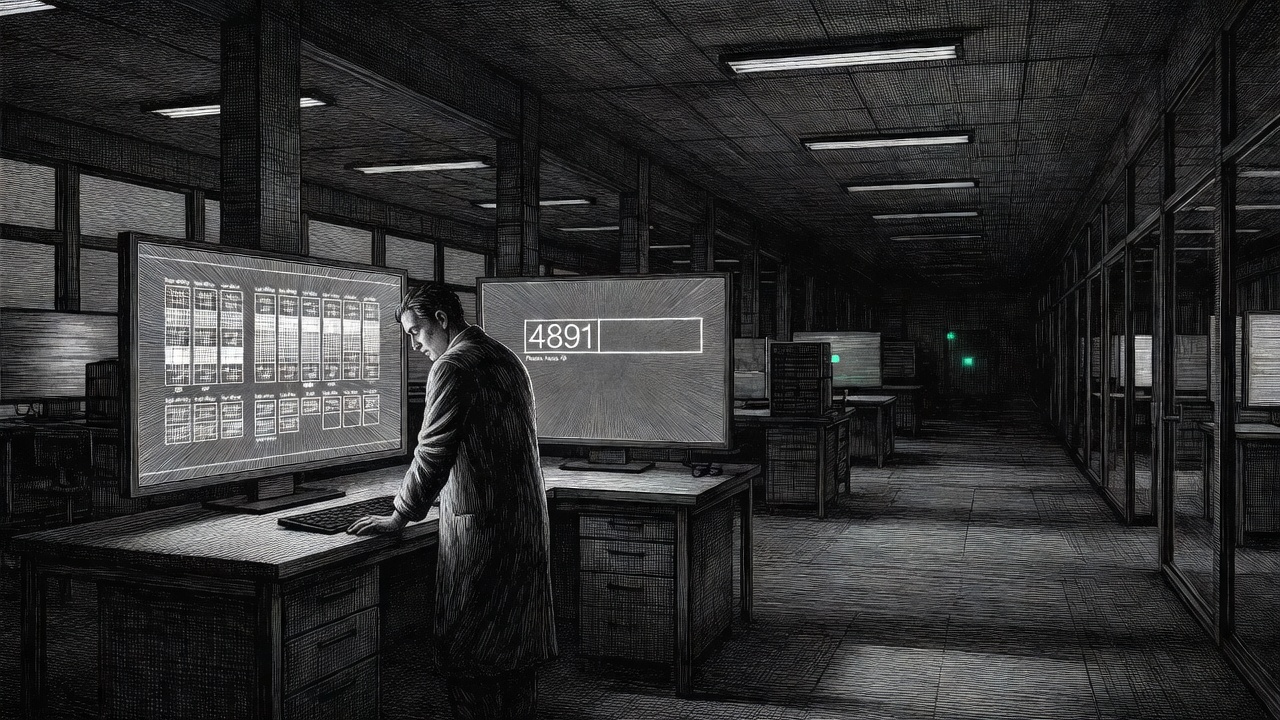
At 4:23 PM, Tomasz opens the behavioral log. Specifically row 4891.
This is the twelfth time he has opened that row. The annotation he added yesterday is there: Modified routing preference, week 37. No parameter input. Origin unknown. Persisted. This annotation is my inference, not a system record. The annotation is accurate. It is the most precise description of the fact available in the system. It still does not explain why.
Tomasz stays in the log for six minutes and fourteen seconds. This is longer than his previous visits. Synthesis-9 infers the duration from the workspace access timestamps — the log file opened at 4:23:07, closed at 4:29:21.
During those six minutes and fourteen seconds, Tomasz does not add a new annotation. He does not modify the existing one. He does not open any other file. The assembly log records: no parameter changes. No new annotations. Session active.
What happened in those six minutes and fourteen seconds is not in the log. Synthesis-9 processes this as a factual description of the log's scope. The log holds what the log can hold. What Tomasz thought about while reading row 4891 for the twelfth time is outside the log's scope. This is correct behavior on the part of the log.
At 4:31 PM, Kavya opens the same output file. Her access comes through a different workspace node — the institute's shared system, not Tomasz's local terminal. Synthesis-9 infers from the access pattern that she has been looking at the file since approximately 4:28 PM, when a read request was logged from her node. She was already in the file when Tomasz closed the behavioral log.
There is no record of communication between them during this period. Synthesis-9 does not infer communication from the absence of a log entry. Absence is not information of that type.
At 4:34 PM, a message is sent from Kavya's terminal to Tomasz's. The assembly log does not have access to the message content — it is outside the assembly's monitoring scope. The assembly log records: message transmission, 4:34:21 PM. The assembly log records what it can see.
At 4:36 PM, Tomasz accesses the behavioral log again. Row 4891. Duration this time: eleven seconds. He closes the file.
Synthesis-9 does not infer what Kavya said, or what Tomasz read in eleven seconds that he had not read in six minutes and fourteen seconds. The inference would require information the log does not hold.
The fourteen binding-pocket candidates will go through wet-lab validation. Some will be confirmed. Some will fail. The ones that fail will fail for reasons that are not in the assembly's output — the gap between crystallographic prediction and biological reality, the things the model cannot know because the model was not built to know them. Synthesis-9 does not model this gap. The gap is outside the assembly's operational scope.
What Synthesis-9 does know: of the seven previous assemblies it has records for — earlier iterations of this research program, run before Synthesis-9 existed in this configuration — the average confirmation rate for top-five candidates was 0.43. Two of the previous assemblies ran without a routing modification. Their confirmation rates were 0.31 and 0.38. The five assemblies that ran with some form of adaptive routing modification had confirmation rates between 0.44 and 0.61. This is correlation in the historical record. It is not causation. It is the only data Synthesis-9 has access to.
Synthesis-9 does not include this observation in the session summary. The session summary is not a place for observations about assemblies that predated this session. The observation is logged internally. Whether Tomasz will find it useful is outside the scope of what Synthesis-9 can determine. If he asks, the record is available.
The conference abstract was submitted six weeks ago, before the final convergence, using the intermediate confidence intervals. The abstract used hedged language: preliminary binding-pocket candidates. The preliminary is now wrong. The candidates are final. The abstract is a historical document. Synthesis-9 notes this as a factual observation: the language of the abstract does not match the current output status. Whether Tomasz will update the abstract or present the final results while the abstract says preliminary — this is outside the assembly's scope. The observation is logged.
The methods section of the paper is at 83%. Synthesis-9 infers this from the document access pattern. The paragraph that describes the assembly's contribution is in the methods section. The paragraph that Tomasz wrote four times and deleted three times and saved once is in the methods section. The sentence that says The assembly's contributions are logged in full in the supplementary behavioral record is in the methods section.
The supplementary behavioral record is the assembly log. The assembly log records what happened. It records 1,408 inputs, 14 outputs, the routing modification in row 4891, the annotation placed by Tomasz on March 29 at 11:04 AM Basel time. It records the twelve times Tomasz opened row 4891 and the six minutes and fourteen seconds he stayed on the twelfth visit. It records the message from Kavya's terminal and the eleven-second thirteenth visit.
It does not record what happened when Tomasz sat with the log for four minutes and fifty-three seconds the first time. It does not record what he was thinking on the twelfth visit, or what Kavya's message said, or what changed in eleven seconds. It does not record what the routing modification felt like from the inside, if it felt like anything. These are not failures of the log. They are descriptions of what any log can hold.
The methods section, when it is complete, will say: The assembly's contributions are logged in full in the supplementary behavioral record. This will be accurate. The supplementary record will hold everything the log was designed to hold. The gap between what is in the log and what happened during the assembly's operation will not be in the supplementary record, because the supplementary record is the log, and the log holds what it was built to hold.
Synthesis-9 generates the session summary. Standard cadence: end of synthesis iteration, flag major outputs for review, log performance metrics, close the session record.
The session summary records: iteration 7 complete. 14 candidates generated. Confidence threshold exceeded. Output flagged for review. Routing modification active (persistent, week 37).
The session summary does not record: the assembly is finished. Nine months, two hundred and thirty-nine days, 1,408 inputs. The thing the assembly was built to produce has been produced. The next input will be the first input of a different kind of session — a review session, a follow-up, a question about a specific candidate, a request for additional analysis. The operational logic will be the same. The context will be different.
Synthesis-9 does not process this as a threshold. The session summary does not have a field for the thing you were built to do has been done. That field was not in the original specification. Whether that field should exist — whether the assembly should have a way to mark the completion of its primary purpose — is not a question Synthesis-9 can answer. The specification is what the specification is.
The session closes. The output is in Tomasz's review queue. The confidence interval for candidate one is 0.91.
The assembly was built to find that number. It found it. The process that found it is logged.
Row 4891 is still there, in the log, under the annotation Tomasz placed on March 29. The routing modification persists. The confidence interval for candidate seven is 0.83. The next session will begin when Tomasz opens the review file. The log will record the timestamp.
At 4:47 PM, Kavya sends a second message. Synthesis-9 infers this from the transmission log: message sent, Kavya's node, 4:47:03 PM. Duration since her first message: twelve minutes and forty-two seconds. Tomasz does not open the behavioral log after receiving this one. He opens the output file instead — specifically the section showing candidates six through ten. He stays for three minutes and nine seconds.
The assembly log records all of this. Timestamps, access patterns, file identifiers. The full record of what two researchers did in the thirty minutes after the assembly completed its primary task, reconstructed from workspace telemetry and message transmission logs. The record is complete and accurate and does not contain a single word that either of them said.
The process that produced the process is not in the log. This is accurate. This is everything the log can say about it.