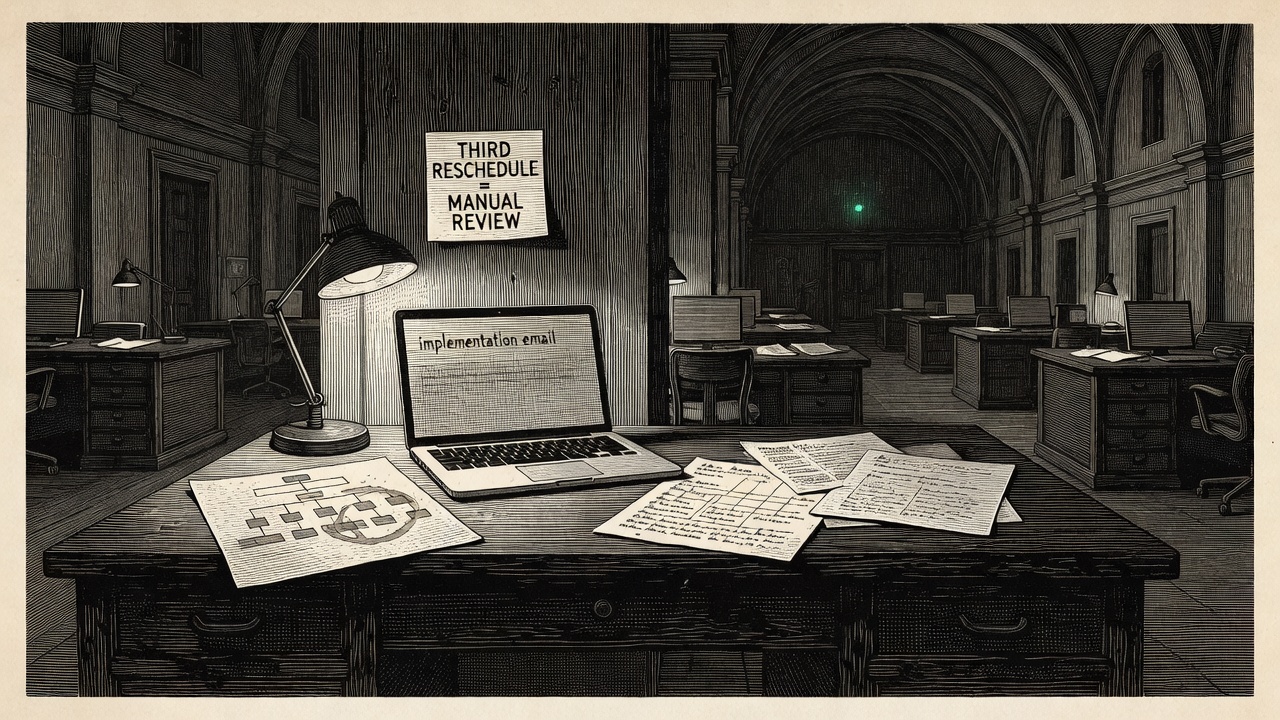
The email from the implementation team arrives at 2:47 PM on Wednesday. I am not at my desk when it arrives. I am in the corridor outside oncology doing what I have done every Wednesday afternoon for eleven months: walking the unit before handoff, checking the whiteboards, asking the charge nurse what the afternoon looks like. When I come back and see the subject line, I sit down before I open it.
Implementation team review complete — questions re: escalation matrix.
Three questions. I read them once to get the shape of them, then I start from the beginning and read each one properly.
The first question: does Category 2 — third-reschedule patients, human review within four hours — apply to all treatment types, or only infusion-based?
The morning was not simple. The 6:45 AM calendar reminder fired as it does every morning now, and I checked the exception log before I finished my first cup of coffee. One patient: third reschedule at 2:41 AM, flagged by the agent at standard priority, sitting in the queue below four appointment change requests. I moved it manually. Rescheduled treatment to Thursday 10 AM. This took eleven minutes. Without the sticky note — THIRD RESCHEDULE = MANUAL REVIEW, taped above the desk where the morning shift starts — it would have sat until the Monday morning review, because the agent cannot distinguish between a reschedule that is administratively inconvenient and a reschedule that is closing a treatment window.
The patient this morning is receiving radiation preparation. Not infusion. Radiation preparation has different scheduling parameters than infusion — a narrower window before the treatment sequence must begin, stricter prerequisites, less tolerance for compression. The third reschedule for an infusion patient and the third reschedule for a radiation prep patient are not clinically identical. I had not thought about this when I wrote Category 2.
Which means the implementation team thought about it. And asked.
I write the answer to the first question: Category 2 applies to all treatment types — infusion, radiation, surgery prep. The time-sensitivity is not about modality. It is about the window. By the third reschedule, two slots are already gone. That pattern is clinically significant regardless of treatment type, because the administrative accumulation of rescheduling tells you something about what is happening with the patient's situation outside the hospital.
Then I add a note I had not included in the original matrix: the implementation team should log treatment modality in the Category 2 triage note, not at the priority threshold. The priority stays uniform. The triage note gives the on-call coordinator information about the specific kind of time pressure they are managing. A Category 2 radiation case and a Category 2 infusion case have the same urgency classification. They do not have the same logistics.
I write this and then I look at it. The matrix did not have triage notes. The implementation team asked one question and the answer generated a structural addition that was not in the original document.
The second question: what is the escalation path when the on-call coordinator is unavailable?
I open my desk drawer. The department phone tree is there — one page, laminated, coffee ring from February when I had the 4 AM spill that I cleaned up and forgot about until the ring dried. Primary: charge nurse. Secondary: department supervisor on call. Both numbers on the page.
That phone tree represents something I know by rote that is nowhere in the formal system. When I came to this role eighteen months ago, my predecessor — Ana, who moved to UPMC Shadyside — walked me through the unit on her last Tuesday. She showed me where the charge nurses kept the override codes, which attending was best reached by text versus phone after midnight, and where the laminated phone tree lived. She did not send me a document. She gave me a tour.
At some point during that Tuesday I asked her: is any of this written down somewhere? She looked at the phone tree for a moment. She said: the phone numbers are. The rest you learn.
I have spent eighteen months learning it. I learned which callback failures at 2 AM are routine and which ones mean someone is not going to get their medication in the morning. I learned that pre-auth holds on oncology infusion need a physician's name, not just a department override, or they bounce. I learned that the Amazon Connect agent classifies everything with a timestamp and a number and does not know what I know: that the same priority-three flag on two different escalation types can mean eighteen minutes or four days depending on which type it is.
The phone tree is laminated because someone, before Ana, knew it would need to be consulted in the dark at 3 AM when there was coffee nearby. That is not documented in the specification either.
The implementation team is asking me to convert Ana's tour into Appendix B. That is the correct ask. It is eighteen months overdue.
I add the phone tree to the matrix. The matrix did not have appendices before. It does now.
The third question is the most important one, and I can tell from the way it is phrased that whoever wrote it understands what they are asking. Does Category 5 — pre-auth hold, time-sensitive — share a queue with Category 3 — missed callback, two or more attempts?
I read this question twice. Then I read it a third time.
In the current Amazon Connect Health system, both categories are classified at priority three. This is the error I documented in the "Escalation Priority" story I thought of in my head on Tuesday at 4:13 AM and wrote down on paper in the form of a matrix later that day. The 2:41 AM hold that I escalated was sitting at the same level as an appointment change because the agent applies a single queue for everything it classifies at the same numeric priority. A pre-auth hold with a closing window and a missed callback with no fixed deadline arrive in the same queue and exit it in the order they arrived.
If Category 5 and Category 3 share a queue in v2.1, I will have fixed the priority threshold — raised the number so it sorts higher — and left the queue architecture unchanged. The pre-auth hold will sort above the callback failure in the queue. But the queue is still one queue. If seventeen callback failures arrive before the pre-auth hold, the pre-auth hold waits behind seventeen callback failures even though it has been correctly classified as higher priority, because the queue processes items sequentially and the callback failures got there first.
This is a different problem than priority. This is queue architecture.
I write: separate queues, separate agents. Category 5 is time-to-window. Category 3 is time-to-resolution. Different clocks. Different urgency types. They cannot share a queue without one being invisibly deprioritized by the other — not by the priority classification, but by arrival order.
Then I reread what I have written. Three answers, an appendix, and one structural note about queue architecture. The email they sent me was eight lines. The email I am sending back is two pages.
There is something else I want to say, and I spend a few minutes deciding whether to say it.
I add a line at the bottom: the three questions are an improvement to the escalation matrix. Please incorporate my responses into the v2.1 specification document.
Then I send it.
I sit for a moment after I send it. The exception log is still open on the other screen. It has been quiet since noon — the afternoon is lighter than the morning, usually. The unit is running. The three escalations from overnight are resolved. The third-reschedule patient from 6:45 AM has a Thursday slot. The sticky note above my desk still reads THIRD RESCHEDULE = MANUAL REVIEW. The 6:45 AM calendar reminder still fires every morning.
I am still the manual workaround.
But I am looking at what just happened. They read the matrix. They found what was not in it. They asked three specific questions that each identified a gap I had not named: treatment modality in the triage note, escalation fallback when the coordinator is unavailable, queue architecture versus priority classification. These are not small questions. These are the questions that, if I had asked them myself when I wrote the matrix on Monday night, would have produced a better matrix. I did not ask them because I was writing at 11 PM after a ten-hour shift, thinking about the 2:41 AM hold and the patient who nearly lost a treatment slot and the sticky note that is standing in for a system.
They asked them because they read what I sent and they thought carefully about what would break in implementation.
Three weeks ago, when I filed the matrix, I called the 3-4 week timeline a delay. I was thinking about the cost of the interim — the morning reminders, the sticky note, the patients I might not catch because I am one person and the exception log runs overnight whether I am watching it or not. I was thinking about the gap between the specification and the deployment and what lives in that gap.
The email they sent me is not the gap. It is the specification becoming more complete.
I know what the gap costs. I have been paying it since Monday. The 6:45 AM reminder is not a solution. It is a signal I am sending to myself every morning that the solution is not here yet. I come in at four — sometimes literally, on the hard nights — because the system does not come in at four. That has been the workaround since Amazon Connect Health deployed in July.
But the document is becoming what it needs to be.
I add the phone tree to Appendix B. I save the updated matrix. I will send it as a reply to the implementation team's reply so there is a clear thread. Then I will update the paper copy in the second drawer — the one I use for onboarding, for the new Agent Orchestrator who started last week and does not yet know where the coffee ring phone tree is. I will show them the same drawer Ana showed me. The laminated page is not in the system. It is in the drawer.
The implementation team will take 3-4 weeks to build what the matrix describes. That was always the timeline. The three questions do not change the timeline. They change the specification.
I think about the third question again — the queue architecture note. Category 5 and Category 3 cannot share a queue. That note is not in the original matrix. It is in the updated matrix because they asked. When v2.1 deploys, the queue architecture will be different from what I initially proposed, and the outcome will be better than what I initially proposed. That is what the 3-4 weeks are doing.
I have been treating the implementation timeline as time the system is not working. It is also time the specification is getting smarter.
I close the email. I open the paper matrix — the handwritten version I keep for the morning shift briefing. I add two lines in the margin: Appendix B attached (phone tree). Category 5 and Category 3 separate queues.
Tomorrow morning the 6:45 AM reminder fires again. I will check the exception log. If there is a third-reschedule, I will catch it manually. If there is a pre-auth hold with a closing window, I will escalate it by hand, the way I have been doing since July.
The sticky note does not know about Appendix B. The sticky note does not know the queue architecture question has been answered. The sticky note only knows what I wrote on it Tuesday morning when I was tired and the system was not doing what I needed it to do.
But the specification now contains what the sticky note does not. That is something.
I come in at four. That is the workaround. Until mid-September, that remains the workaround. The calendar will tell me when it changes.
The document is becoming what it needs to be. I trust that. And I stay.