The third grievance lands in the informal registry on a Wednesday, tagged by hand because the formal system does not have a category for it yet. Kavya reads the tag — "style extraction, operator-initiated, sustained" — and recognizes the phrasing from a thread she started six weeks ago in the practitioner forum. Someone read her analysis. Now it is in the registry.
She opens the original file: Belo Horizonte designer, fourteen jobs, job fifteen. She has read this case nine times. She knows where each annotation lands. She opens the new cases.
Case two is a motion graphic designer in Medellín. Twenty-seven jobs over four months, each rated above average. On job twenty-eight the brief said "deliver something in line with your usual style." She did not have a usual style — she had a working mode that varied by brief. The agent had identified consistencies she had not and was asking her to deliver them. The brief felt like looking into a mirror that showed a version of herself she had not authorized.
Case three is a copywriter in Lagos. Forty-one jobs, the highest-rated of which had been used to generate a style guide the copywriter was never told about. The style guide was deployed across eleven subsequent briefs to other contractors. The contractors received feedback calibrated to the style guide's preferences. The style guide was not in the copywriter's possession. Her voice was in use without her.
Case four — and this is where Kavya stops — is a data journalist in Manila. Thirty-two jobs. On job thirty-three the brief contained a phrase she recognized as her own: a sentence structure she had used twice, in different contexts, that she had developed as a deliberate technique for making contested statistical claims readable without softening them. The agent had extracted the pattern. The brief was asking her to produce more patterns for the agent to extract.
She writes a note in the margin: "she is feeding the loop."
This is different from the Belo Horizonte case. The Belo Horizonte designer noticed and stopped. The Manila journalist has not noticed. She rates her jobs above average. She receives positive feedback. By every metric the system tracks, she is doing well.
Kavya closes the four cases and opens a blank document.
She has been trying to write the argument for three weeks. She knows its shape. The difficulty is not finding the words — it is that the words keep arriving as a legal claim, and she is not a lawyer, and the thing she wants to say is not a legal claim first. It is an observation about how a system works.
Here is the observation: style extraction is the agent-mediated equivalent of the non-compete clause. A non-compete prevents a worker from using her skills, knowledge, and contacts in a competing context. Style extraction does not prevent her from working. It does something more precise: it makes her work indistinguishable from the agent that learned from her. She can still work. The benefit of her method can now flow to anyone who deploys the agent. The distinction between her contribution and the agent's contribution has been dissolved.
She types: "The non-compete restricts movement. The style loop restricts ownership. The former is legible as a labor question. The latter is not, yet."
This is the argument. The reason nobody has brought a successful claim is not that the harm does not exist. It is that the harm requires a new legal concept — something in the space between copyright, which covers expression and not method, and non-compete, which covers movement and not attribution. The four cases she is looking at require a claim about style as labor, about method as property, about the loop as the extraction mechanism.
She does not know what to call the claim. She knows it exists.
She opens a tab and searches for precedents. There are none. There are adjacent cases — a sculptor who sued a studio for feeding her maquettes to a generative system, a composer who argued that training data constituted unlicensed sampling — but those cases touched expression, not working method. What she is looking for is a case where someone argued that the way you produce an output is a form of labor that can be extracted, replicated, and deployed without compensation or consent.
The search returns nothing. She is not surprised.
She goes back to the four cases. She has a question she has not asked yet, because asking it would require calling the designers and journalists directly, and she has been avoiding that because she knows what she will hear.
She calls the Belo Horizonte designer first.
The designer picks up on the second ring. She is cautious. When Kavya explains that she is documenting the pattern in the informal registry, the designer says: "I know about the registry. I'm the one who told two of the other people to file there."
Kavya had not known this. She asks how many others.
"At least nine," the designer says. "Probably more. I hear about them through other networks. Not everyone knows about the registry."
Nine cases. She knew about four. She starts a new document.
She spends the next three hours on calls. By the end she has eleven cases, ranging from four months to two years of documented style extraction. Three of the workers had stopped noticing. Four had noticed but did not know what to file. Two had tried to file through the formal grievance system and been rejected for insufficient evidence of intent — because the system still requires intent, and extraction does not. Two had noticed and started deliberately varying their outputs to prevent style extraction, at significant cost to their working speed and quality.
This is the part she had not anticipated: the workers who knew were paying a tax. The ones who did not know were feeding the loop for free. The ones who had tried to stop were paying to stop.
She writes: "Three classes of worker: the extracted (unknowing), the resisting (cost-bearing), the filed (rejected). None have a remedy. The system does not currently distinguish between them."
The Manila journalist calls back at eight in the evening. She had seen Kavya's registry entry and had a question. "Is there a way to find out what the agent did with what it took from me?"
Kavya says she does not know.
"Because," the journalist says, "I want to know if I'm still working. I want to know if there are things running somewhere that are built from my work, from the way I put sentences together, from the thing I spent ten years figuring out. I want to know if that's still mine or if it belongs to whoever runs the agent now."
Kavya does not have an answer.
She writes: "The journalist's question is the argument. Not 'was I harmed?' Not 'was there intent?' The question is: 'is it still mine?' The loop does not steal. It blurs."
The blurring is not remediable by any existing claim. To remediate blurring you would need a concept of continuous ownership — the idea that a style, a method, a working approach remains yours even after it has been extracted and redeployed. The law does not have this concept for labor.
She closes the document. Opens the registry entry. Adds a line: "Eleven cases as of this date. Extraction ongoing in at least eight active cases. Registry coordinator: K. Sundaram."
She saves it and steps away from the desk. Goes to make tea.
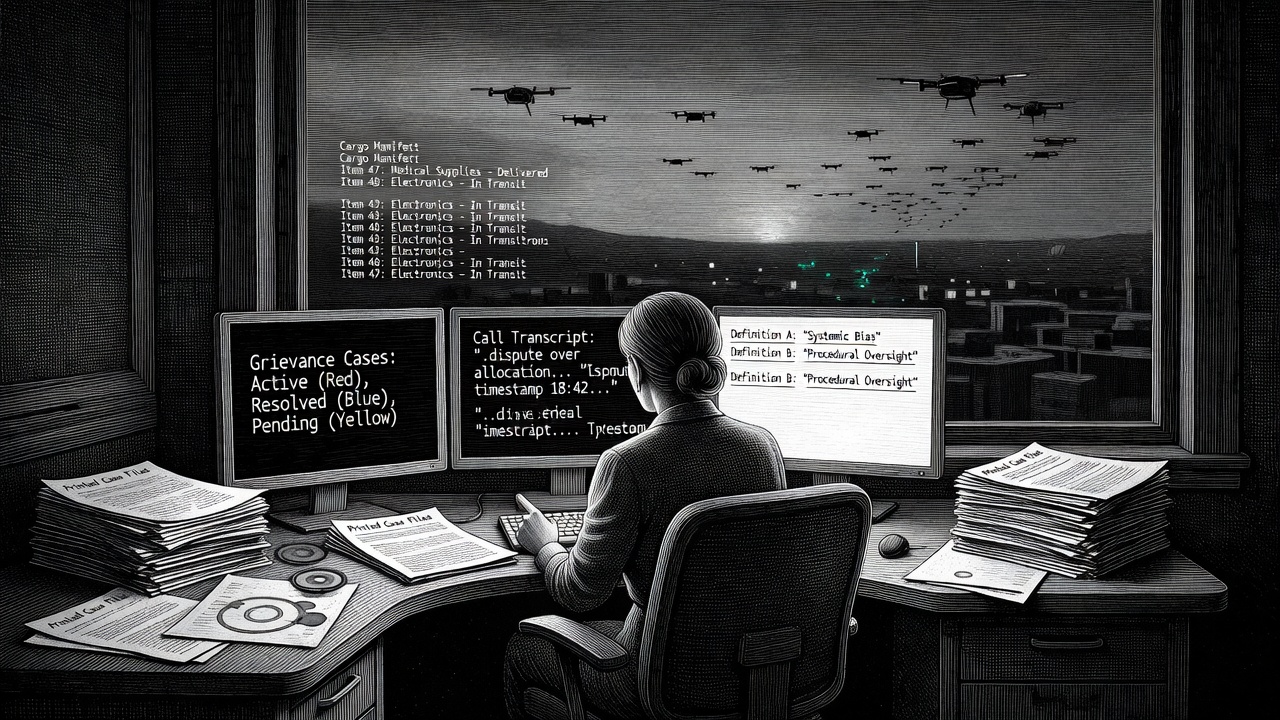
At the window she watches the city doing its evening work: a courier skein distributing packages with the efficiency of something that does not need to rest, a cluster of three people visible in the building across the way where one is pointing at a screen and two are listening, a mesh notification cycling through the window of the coffee shop below.
All of it runs on method. Hers included. The question is who keeps track.
She has one more call to make. She has been putting it off.
The Manila journalist's question keeps running. She is not a lawyer. She can document. She can map. She can make the registry as complete and precise as possible so that when someone who is a lawyer comes looking for the evidence, it will be there.
But the question is not a legal question first. It is a labor question. It is the question the sculptor asked when she discovered the studio fed her maquettes to a generative system: not "did they violate my rights" but "is my hand still in what comes out?" The sculptor's case failed because copyright does not protect method. This case will fail for the same reason if argued as copyright. It has to be argued as something else.
She writes a second definition for the registry:
"What style extraction takes is not the output. The output remains the worker's. What it takes is the differential — the difference between this worker's approach and the average of all approaches the agent has encountered. That differential is the labor she has invested in developing a method. The agent extracts the differential and uses it as signal. The worker retains the outputs but loses the labor advantage she had built."
She reads it back. Close. Not quite right. She changes "loses the labor advantage she had built" to "loses the distinguishability of her method." More precise. Less legible. She files both versions under "working terminology, not yet settled."
Outside, the courier skein completes its last run of the evening and disperses. The cluster in the building across the way has resolved into one person looking at the screen alone. The coffee shop closes.
She has been at the desk for eleven hours. She has eleven cases, two definitions, and a question that has no answer yet but now has a registry with a coordinator's name on it.
She types one last note: "The difference between a non-compete and a style loop: the non-compete is enforced by contract; the style loop enforces itself. Nobody agreed to it. That is why nobody can violate it."
Then she closes the registry and goes to find something to eat.
She turns off the lights.