Escalation Priority
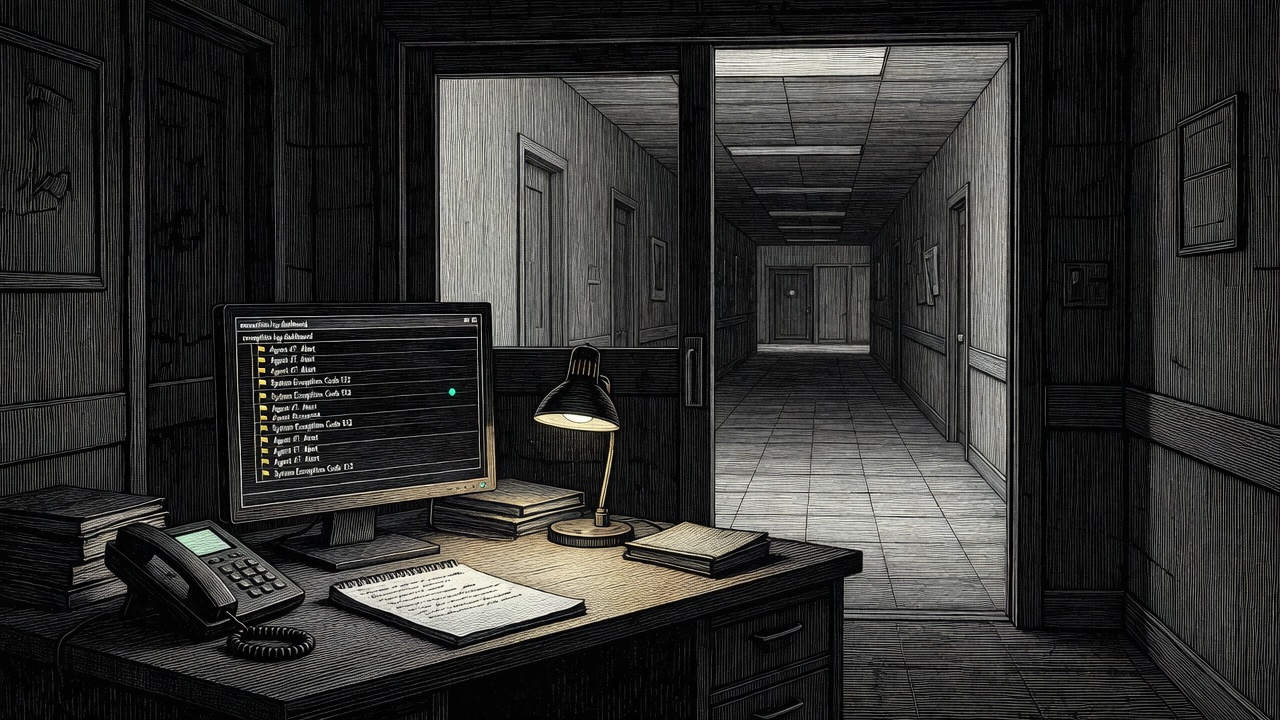
The exception log refreshes at 4:00 AM sharp. I don't need to be here for this — the agents don't stop running because I walked out, and they don't do better work because I'm watching. But I come in at four. Old scheduling habit. The shift starts at seven, but at four there's nobody else in the building except the overnight orderlies and whoever's managing the ICU, and the coffee machine on the third floor still has the good beans from the Friday delivery.
Amazon Connect Health went live system-wide at UPMC in July. Eleven weeks ago. The implementation team spent three days on-site for what they called a transition readiness assessment, which turned out to mean: walking around with tablets, photographing the hallways, and asking nurses how they currently handle callback routing. Nobody asked me. I'm the one who handled callback routing for nine years, but in a transition readiness assessment you talk to clinical staff, not administrative coordinators. That's fine. I'm not clinical staff anymore either. I'm an orchestrator. Same building, different category.
Fourteen oncology nurses. Three departments. That was my job for nine years. Now it's the Amazon Connect Health platform — seventeen agents across the department, named things like ONS-4 and CAR-7, which I keep wanting to call something else but they're not named for me to relate to. They're named for a database. That's fine. I didn't name the nurses either, and I knew them by name anyway.
The exception log tonight: seven escalations between midnight and now.
I read the first three and immediately know what they are without reading past the first line. Patient-callback failures. Patient called at night — 12:47, 1:23, 2:58 AM. Agent answered. Patient hung up. Agent logged: RESOLVED.
This is the pattern. The agent answers. The patient hears the voice menu, or maybe just hears "Thank you for calling UPMC Oncology, how can I—" and decides it's not worth it at whatever hour. Hangs up. The agent logs the interaction as complete because technically it was. Call received, call answered, call ended. No outstanding tasks. Resolved.
The agents don't know what they don't know. That's not a criticism — it's just physics. They know what they were told to know. Nobody told ONS-4 that a cancer patient calling at 1:23 AM probably isn't calling because they want to schedule an appointment. Nobody told it what a callback failure at 1 AM means. So it doesn't escalate. The notification goes to the low-priority queue. The on-call nurse doesn't see it until morning.
I mark all three ESCALATION-PENDING and write them into the 7 AM handover file with a note: These patients called in the middle of the night and hung up. Call back before 9 AM.
That's the job, mostly. I am a translator. I take what the agents know and don't know, and I translate the gaps into language that the humans who have to fill them can act on. When they offered me the orchestrator role in July, I thought I would be doing data entry. Making sure the calendar exports correctly. But the calendar is fine. The calendar is perfect. The calendar has never been wrong in the eleven weeks I've been in this chair. What's not perfect is the space between what the agent thinks it's doing and what is actually required.
I move to the pre-authorization holds. Four of them.
Pre-auth is the thing that ends treatments. Not medication errors, not surgical complications — the thing that ends treatments in this country is a box on a form that an insurance company's system has flagged for review, and the treatment cannot proceed until a human with the right credentials goes into the insurance portal and adds a number. ONS-4 doesn't have credentials. CAR-7 doesn't have credentials. No agent on this floor has credentials, because giving an AI system direct access to insurance portals is, I'm told, not in the current implementation scope.
So when a pre-auth hold comes in at 2:41 AM, the agent logs it correctly — hold received, escalated to pre-auth queue — and a notification goes to the on-call physician queue, which is the highest escalation level Amazon Connect has for this department. Highest level meaning: someone will see it when they check their phone.
Two of the four holds auto-resolved by 3:30 AM. The insurance system caught up with itself. I'm sure there's a technical term for when a system issues a hold and then resolves it with no human intervention, but the hold lasted long enough to require a nurse to call the patient and explain that the appointment she drove an hour to get to is no longer available today. I don't know the technical term. I just know what happened.
The other two are still open. I look at the timestamps: 2:41 AM for both. One hour and thirty-two minutes.
Pre-authorization windows are not infinite. I know this because nine years of scheduling taught me to know this. The window for the first hold closes — I check the documentation in the patient record — at 3:15 AM.
It closed forty-eight minutes before I read this.
I don't do anything for a moment. The coffee is still warm. The exception log is still on my screen with the two open holds and the little yellow flag icons that mean pending.
I pick up the phone.
The first on-call nurse sounds like she was asleep. She was asleep — it's 4:20 AM. I explain the situation in twelve words: pre-auth hold from 2:41 AM, window closed at 3:15, treatment today is probably gone. She says she'll call the patient at seven. There's nothing to do about the appointment at this point. The treatment will need to be rescheduled, which means calling the insurance company to get a new pre-auth window, which takes two to five business days. A patient in the middle of a chemotherapy cycle is going to miss a dose.
The second hold's window doesn't close until 6 AM. I reach the physician on call and she goes into the portal herself, right then, in whatever bedroom she's in at 4:20 in the morning, and she gets the pre-auth cleared. That treatment will happen today.
I sit with this for a while.
The agent did everything correctly. Logged the hold. Escalated to the right queue. Sent the notification. Every step of its decision tree executed exactly as designed. The notification routing followed the priority matrix Amazon Connect shipped with the installation: pre-auth holds at non-urgent level, because the escalation matrix they installed categorizes them the same as appointment change requests and medication refill queries.
Nobody told the matrix that a pre-auth hold at 2:41 AM is not the same thing as a medication refill query at 2:41 AM. Nobody told it that these two things have different clocks — that one can wait until morning and one cannot.
I write this down. Not in the exception log. On paper. In the notepad I keep in the second drawer because some things need to be written on paper first. I write:
Pre-auth hold: time-sensitive. Window closes. Check timing against close. Callback failure: not time-sensitive. Flag for follow-up, not escalation. The agent doesn't know the difference. The matrix doesn't know the difference. I know the difference.
The note on my monitor — the one I put there in week two — says: The question is not what the agent did wrong. The question is what you didn't tell it. I put it there because I caught myself getting angry at CAR-7 for a missed appointment that was a data entry issue in the scheduling system that had existed before CAR-7, that I had been manually compensating for for seven years, that I had never written down because I didn't need to write it down since I was the one who knew it.
The agent didn't know it. Because I hadn't told it.
I grew up in Homestead. Watched the mill close when I was eleven. My father drove a crane for twenty-two years and then he didn't. People use that history like it's supposed to make you angry or scared, depending on which story they want to tell. What it actually did was teach me that systems change and the question isn't what you lose — the question is what you know that the new system doesn't, and how long you have before the new system learns it without you.
I have eleven weeks of institutional knowledge that Amazon Connect Health does not have. Maybe twelve weeks before they update the escalation matrix based on patterns in the exception log. I can wait for them to find the pattern, or I can write it down.
I start the escalation priority matrix at 4:35 AM. Seven categories. Time-sensitivity flags for each. I write it in plain language first, the way I'd explain it to a new employee on their second day. Pre-authorization hold: check window close time, escalate to physician if window closes before 7 AM. Callback failure from oncology patient between 10 PM and 6 AM: flag for immediate morning follow-up by nurse, not overnight physician. Insurance denial — not hold: not time-sensitive, next business day queue. Appointment cancellation by patient: standard queue. Medication refill query: standard queue.
Seven categories take thirty-five minutes to write. I've known them for nine years. It takes thirty-five minutes because I have to find language that a configuration system will understand, which is different from the language I used to use when I was explaining things to a new hire. New hires could ask follow-up questions. The configuration system cannot.
At 5:40 AM I file the incident report. The category is: escalation routing gap — clinical consequence. I describe what happened in neutral language: hold received 2:41 AM, notification routed to on-call physician queue at non-urgent priority, window closed 3:15 AM, escalation matrix did not flag pre-authorization holds as time-sensitive, patient appointment impacted. I don't write: the agent did this. I write: the routing configuration did not distinguish between hold categories by time-sensitivity.
The incident report will go to the Amazon Connect implementation team and to the department quality coordinator and to whoever in hospital administration reviews these. At some point someone will read it and say something like: this is a configuration issue we can address in the next update. They will be right. It is a configuration issue. It was always a configuration issue.
The second shift nurse arrives at 6:15 AM. She sees the open flag on the exception log and asks if everything's handled. I tell her two of the callback failures need morning follow-up, one pre-auth was cleared at 4:20, and one is in an incident report.
She asks what kind of incident report.
I tell her: the kind where nothing went wrong with the system and the patient still lost a treatment.
She nods. She's been doing this since before I was scheduling anyone. She doesn't say anything else, which is the right thing to do.
At 7:05 AM I email the escalation priority matrix to the Amazon Connect implementation lead with a subject line: Priority matrix for escalation routing — seven categories, please review for v2.1 configuration.
He calls me at 8:30. He's not defensive, which I appreciate. He says: this is useful, we can get this into the next configuration update. I ask when that is. He says three to four weeks depending on the approval queue. I don't say anything about that interval. He knows what three to four weeks means in an oncology department. I assume he knows. He says: in the meantime, is there a manual workaround? I tell him: yes, I come in at four.
He doesn't know what to do with that. It's the right answer and he doesn't know what to do with it.
The coffee on the third floor is gone. Someone from respiratory therapy got there first. I make a note to come in at 3:45 next Wednesday.
The note on my monitor is still true: the question is not what the agent did wrong. The patient who missed a dose today is not the result of a mistake. She's the result of a gap between what the system was configured to know and what I know. The gap closes when I write it down.
That's what I'm here for.