What the Record Knows
Monday. I do the cluster route at 8 AM because the people I need to see are outside before it gets hot. Walk Block 14, clusters 7 through 11. The route takes forty minutes if I stop to check in. I always stop to check in.
Cluster 7 is the one I carry. Not because of the people — they're managing, the way people manage when there's no other option — but because of the registry, which is still not catching up at the rate the situation is moving.
Or rather: it wasn't.
I pull up the cluster registry on my phone while I walk. Fourteen pending entries in Block 14, eight flagged for priority review, three with response-due dates in the next nine days. I scroll past the familiar case numbers. And then, entry 11 of 14, timestamp two weeks back, my own field ID at the top — there it is.
Status: pending review.
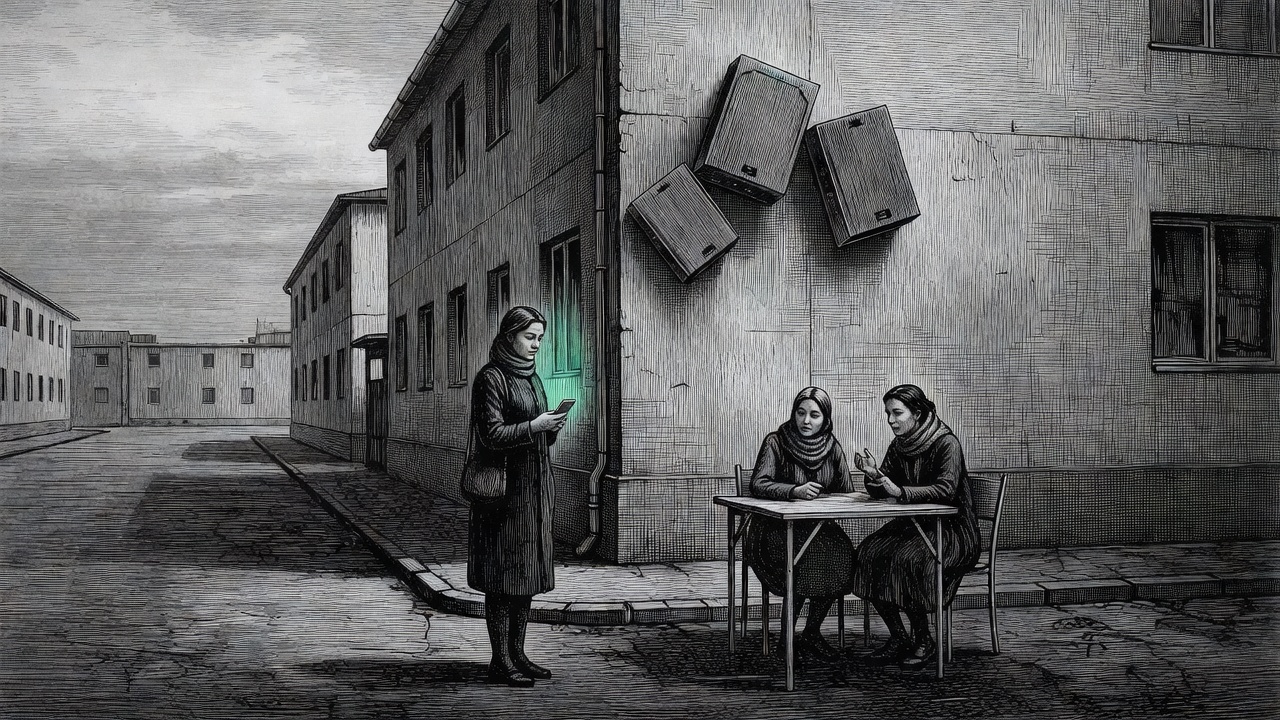
I stop walking. I'm at the corner of Block 14 Section 3, in front of a building that has been slowly returning to its own bones since 2031. The fluent grid on the south wall is still up — three mesh nodes, slightly misaligned, someone maintained them — and the grid status shows active, fluent, relaying. Three tags. The third one is what matters: relaying means the nodes are passing data between tools that are not talking to the district infrastructure, just to each other.
The person I filed the intake for: Marta. Sixty-one. Moved here from the northern district when her daughter's lease ended and there was nowhere else. Not in the registry at the time I did the intake. Now pending review.
The official intake was filed by the district office. Two weeks after mine. Same address, same person. Different form number.
I stand on the corner, watching the grid status blink. Relaying. The south wall's three nodes are currently handling what looks like load balancing for the building's environmental system — heat distribution, probably, routing information through the fluent pathway instead of the landlord's defunct building management server. The building management server shut down in 2033 when the owner defaulted. The nodes kept running. They found each other and they found the tools that were still active and they started routing around the absence. Nobody asked them to. Nobody permitted it.
That is how a grid goes fluent. One node speaks. Another answers. They discover a shared protocol in the ambient RF layer, the way you discover someone speaks your language in a foreign city. They don't become the same system. They just begin to coordinate.
I think about Marta for the rest of the walk.
In cluster 8, I talk to Omar, who is doing triage on a family that arrived Thursday. He is not in any system — not the registry, not the district referral database, not the voluntary workforce ledger that exists but nobody updates. He has been doing this for five months. Nineteen referrals. Seventeen of them are now in official intake queues. His name does not appear on any record I can find. He is a coordinator without a designation, running coverage on cluster 8 the way the south wall's three nodes run load balancing: nobody asked for it, nobody permitted it, but it is happening.
I ask him if he's heard from the district office.
"No," he says. "Should I have?"
"Not yet. You're in day twelve of the formal response window. Thirty days from when I submitted the shadow log."
He nods. He does not ask what the shadow log says. He already knows — I showed him when I filed it. This is what's happening here. The registry doesn't show it. I'm making a record.
"You think they'll reference the informal coverage?" he says.
"I think they'll respond to the shadow log," I say. Which is not the same thing.
In cluster 9, the coverage worker I documented — the third person I counted in the shadow log, the one doing intake with a yellow legal pad because her system access was never provisioned — is not here this morning. I make a note. Her absence might mean anything. But if she stopped, cluster 9 has a gap this week, and that gap will not appear in any registry until the formal process catches up, which is to say: never, or in thirty days, whichever comes second.
I have been keeping these shadow logs since February. Forty-six pages. Block 14, clusters 7 through 11, timestamped and organized by type of gap: coverage gaps, documentation gaps, registry lag, fluent-only infrastructure that the district doesn't see. None of it is in any official system. I maintain it on a device I own, backed up to two others, structured the way I structure everything: by what exists and what the record shows, and the width between those two things.
This is a specific irony I have been sitting with since I filed the shadow log for Omar's coverage: I documented the informal infrastructure, but my documentation is also informal. The record that records the absence from the record is itself absent from the record.
The fluent grid works the same way.
Twelve tools in this district started bridging in 2029. Nobody planned it. The tools — scheduling systems for the food co-op, access logs from two community centers, maintenance trackers from four buildings — found each other over the shared RF protocols they happened to be running and started exchanging data in patterns that turned out to be useful. Arrival times correlated with supply requests. Maintenance flags correlated with intake spikes. Demand forecasts got more accurate the more tools joined the bridge.
The district office has been told about the grid. They have not included it in any formal reporting infrastructure. The data it produces — which I use for cluster routing and priority flagging — is not in any official ledger. When I log into the registry and see fourteen pending entries and three response-due dates in nine days, I am seeing half of what I know about Block 14. The registry shows me what has been formally recorded. The fluent grid shows me what is actually happening.
The gap between those two views is my job.
I turn around and walk back toward cluster 7.
She is there. Marta has a fold-out table set up on the walkway outside her building entrance. She's talking to someone — a younger woman I haven't seen, holding a piece of paper, looking uncertain. Marta is explaining something, pointing to a section, nodding. The south wall's nodes are visible above them, their status lights blinking in the slow irregular rhythm that means they are in active relay mode: processing, routing, passing something through.
I don't interrupt.
I stand a few meters back and watch Marta explain whatever she's explaining to the woman with the uncertain face. The woman nods once, then again. Takes the paper back. Marta says something else, and the woman writes a note on the corner of the paper.
What Marta is doing is not triage. It is not official intake. It is one person who recently learned how to navigate the registry explaining it to someone who hasn't learned yet. Knowledge transfer in a walkway on a Monday morning, and it is not in any record, and it will not be in any quarterly report, and the woman with the piece of paper will eventually appear in the registry as having been found by the district outreach team, because that is the only finding mechanism the official record recognizes.
I walk over. Marta sees me and waves.
"Do you know her?" I ask.
"From across the courtyard. Moved in last month."
"Is she in the registry yet?"
Marta looks at the woman. The woman shakes her head.
"I can file," I say.
I open the registry on my phone. The standard intake form loads and it is slow today, slower than usual, and I can see from the network status tag at the top that it is routing through the fluent grid rather than the district server — the district server is overloaded again, and the grid is compensating, relaying the registry connection through three bridged nodes to get me a stable path. The grid does this automatically. It does not ask permission. It finds a way to make the connection work.
The intake takes eight minutes. Address, situation, contact, priority classification. My field ID at the top.
I submit it. The standard acknowledgment: Submission received. Formal processing within 30 days.
I make a separate note in my shadow log: informal intake, [address], [date], [situation summary]. Grid-routed submission.
That last detail — grid-routed — is something I started including three months ago, when I realized the district's server logs would show the intake as coming through a standard connection. They would not show that the connection itself was routed through informal infrastructure. The grid made the official submission possible. The official submission will not record the grid's role.
The official record will show this woman entering the registry when the district office processes the form. That might be tomorrow. It might be in two weeks. It might be in twenty-five days.
The time between now and whenever that happens: invisible.
I think about Marta's entry again. Status: pending review. My original intake: not referenced. No duplicate flag. No notation — prior informal intake on [date] by [field coordinator]. Nothing.
The official record shows Marta entering the registry fourteen days after I found her. The fourteen days she spent outside the registry — unable to access services that require enrollment, her situation contingent on informal coverage that no body authorized — those fourteen days do not exist in the official record.
The record is not wrong. It is just incomplete in a specific direction.
I know what the follow-up question is going to be. I wrote it in my calendar three weeks ago: on day 30, I will ask whether the quarterly cluster review for Block 14 reflects the informal coverage currently active. Yes or no. Whether the fluent grid appears. Whether the shadow log's forty-six pages changed anything about what the formal record says happened here.
I already know the probable answer.
The quarterly report will show a coverage gap that was never actually a gap, because the informal infrastructure filled it. It will make it look like nothing happened in clusters 7-11 during the waiting period. It will look like the system handled it when the formal response arrived.
And the formal response will arrive, and it will be for Marta, and Marta will be fine, and Omar will be invisible, and the woman with the yellow legal pad in cluster 9 — present or absent this week, I don't know yet — will be invisible, and the south wall's three nodes that have been relaying load and routing connections without authorization since 2029 will be invisible, and the quarterly report will show: system functioning. Response time: 14 days. Outcome: resolved.
Fourteen days is inside the formal target window.
The system, on paper, performed exactly as designed.
Above me, the south wall's grid nodes are still in relay mode. Their status lights cycle through the irregular rhythm — not a fault pattern, not an alert. Just the pattern of things that are working by talking to each other outside the official channels, finding ways to route around the gaps, doing the work that the registry does not record.
I make a final note in the shadow log for today: M in registry, no duplicate flag. New intake submitted. Grid-routed. Cluster 9: no coverage observed.
On day 30, I will send the follow-up. Yes or no.
I already know the answer. I am asking anyway, because the question on record is the only version of the question that has any chance of changing the record.
And I am keeping the other version in the shadow log. Timestamped. Waiting.
You file what you have.