The cluster registry shows two changes I did not make.
Block 14D and Block 7A now list their coverage status as "active — informal," which is a status category I created in the design specification I filed two months ago. The design specification described what a quarterly review protocol would look like. It was not a request to implement one. Nobody told me the status category had been added to the registry. Nobody told me the two clusters had been updated.
I check the edit log. Both changes were made by the same account: "mesh-admin-auto." That is not a real account name. It is the label the Heights mesh uses when it makes administrative updates that it has decided, by some process I do not have access to, to attribute to itself rather than to a person.
I flag this as worth investigating, which means I write a note in my own archive and not in any formal system, because there is no formal system where flagging this would do anything.
Then I put on my shoes and go to Block 14D.
The building is a six-story walkup from 2018, retrofitted twice since then — once for the mesh integration in 2028 and once for the updated accessibility requirements in 2033. The retrofit work is visible if you know how to look: new sensor housing on the door frames, updated cable routing along the stairwell walls, a cluster monitor panel beside the mailboxes that the original architect did not plan for and that was installed in a space that used to hold a bulletin board. The bulletin board is in the storage unit of someone on the fourth floor. I know this because I asked.
Third floor, apartment 3C. The door is open because of the heat.
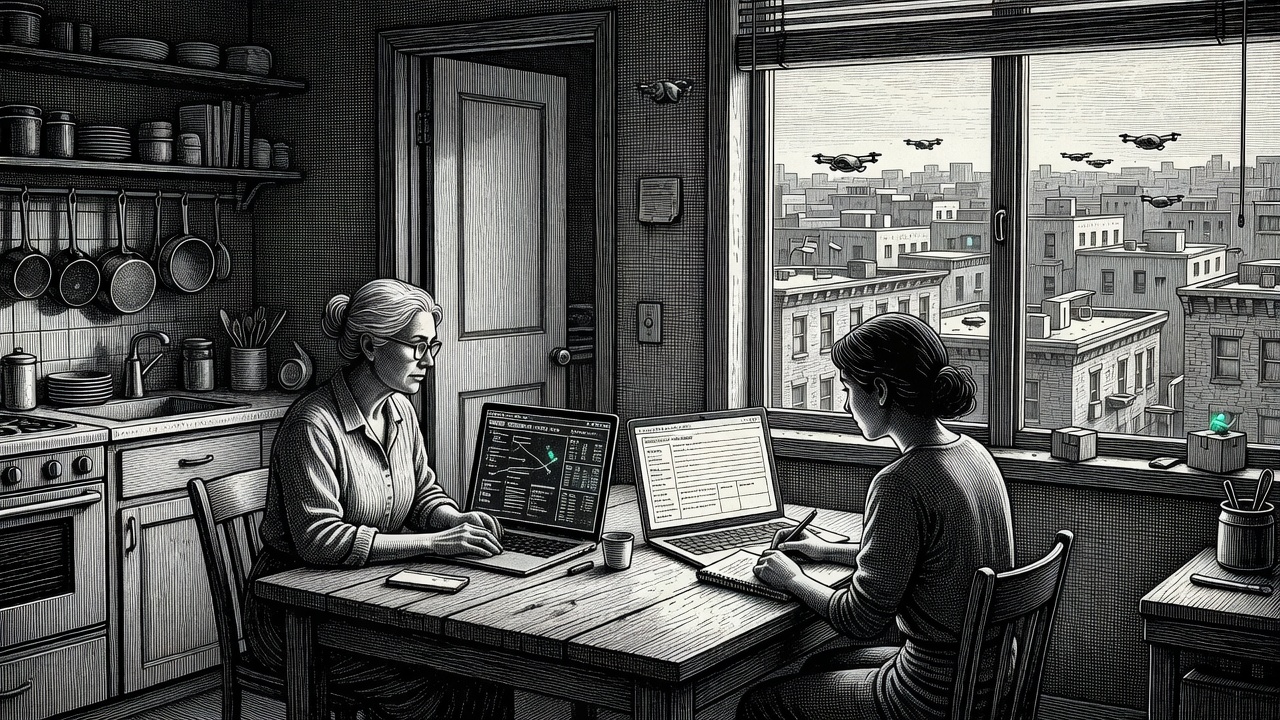
Gladys Rivera is at the kitchen table with two screens. On the left, the Heights mesh assignment interface — the same one I use, with the same assignment queue and the same family status indicators. On the right, a social worker intake form for a family in the building, a form that is not connected to the mesh system and has to be filed separately. She is doing both at the same time with the particular efficiency of someone who has been doing two things at once for long enough that she has stopped noticing it.
She looks up when I knock on the open door. She is in her late fifties, with the focused attention of someone who reads everything carefully the first time.
"You're Yaribel," she says.
"Yes."
"I heard you filed the design specification." She indicates the other chair. "Sit."
I sit. "When did you start handling triage for this cluster?"
"March. When Renata moved to the Bronx."
Renata Fuentes was the informal loss accountant for 14D from 2031 to 2035. I know her name because it was in a comment thread from 2033 that I found when I was building the measurement gap report. Her name was in the comments, not the registry. The registry had shown "coverage: unassigned" since March, which is when the comment thread went silent.
"Did anyone ask you to?" I ask.
"No." Gladys closes the intake form — she has saved it, not submitted it. She turns to face me more directly. "Do you know the Flores family on two?"
I don't.
She tells me about the Flores family. Three children, two of whom have overlapping care schedules. In March, the mesh sent them a double-assignment — two pickup routes on the same Thursday afternoon, both categorized as medium-priority, which meant neither would flag automatically as a conflict. The mesh had calculated that the family had available time on Thursday afternoons. It had calculated this from their accepted assignments over the previous two months, which were accurate, but did not reflect that one of those Thursday slots was no longer available because of a change to the school pickup schedule that the family had not logged because logging it requires initiating a time-update form that takes twelve minutes to complete.
"I saw the assignment come through," Gladys says. "I know the Flores family. I called and redirected one of the assignments to myself."
"Did you tell the mesh?"
"I marked one assignment as accepted and the other as deferred. Which is what you do when you're taking on extra." She pauses. "The mesh doesn't have a field for 'I took this because otherwise the Flores family would have had a conflict that the system didn't know about.'"
I write this down. "What about the Moreno household on four?"
She looks at me for a moment. "You found the second one."
"The assignment history shows you redirected something from them in April."
"Same situation. Different family." She tells me about the Moreno household — a similar conflict, a similar informal redirect, the same twelve-minute form that wasn't filed. "By May I was checking the assignment queue for the whole cluster once a week. Informally." She says the word like it is a category she is comfortable with. "Renata used to check it."
"Did Renata have a formal role?"
"No. She just knew everyone and she checked the queue." Gladys looks out the window for a moment. "When she moved, the queue kept running. Nobody checked it."
I am writing everything she says. "How much time does this take you per week?"
She considers this genuinely — she is calculating, not guessing. "Two, three hours. More if something complicated comes up."
"And you don't get compensated for it."
"The mesh has a mutual support allocation. I use some of that. It's not what this would pay if it were paid." She says this without complaint. It is an observation about a structure, not a grievance. "Renata used it too."
I ask her three more questions. I stay for an hour. When I leave, the kitchen table behind me has both screens open again.
On the stairs, I look at my notes. The mesh tracks Gladys's accepted assignments — the ones she formally logs. It tracks the families she coordinates with, within the assignment system. It tracks the mutual support allocation she draws. What it does not track is the two hours a week she spends before any of that: checking the queue, recognizing the conflicts before they generate flags, redirecting the assignments before they reach the families as problems.
The mesh self-monitors. The self-monitoring proves only what it was designed to measure.
I take out my phone and open the design specification I filed in June. Section 3.4: "Discovery Protocol for Informal Coverage." I had written it in the abstract, describing what a protocol would look like. Now I know what it would find.
I add a paragraph. The paragraph says that informal coverage exists before the protocol exists to discover it. That the protocol does not create the coverage — it creates the record of the coverage. That the record and the coverage are not the same thing, and that confusing them is how the mesh has been treating coverage that disappears from the registry — by assuming that the absence of a record means the absence of care.
I save the paragraph. It is the most important thing I have written in the design specification, and it was not in the original.
On the street outside, I take the long route to Block 7A.
The Heights in August has a particular quality in the morning — the light is already direct, already specific, and the block has the organized motion of a neighborhood that has been awake for two hours by the time the rest of the city notices it is morning. A delivery skein passes at the third-floor level, sorting packages in its holding frame before dropping them in sequence to stoops. Two children are running a message relay for an elderly neighbor three buildings over, logging it as mutual support in the mesh system with the practiced efficiency of children who have been doing this long enough to know how the form works. An old man at the corner is reading the block mesh status board — pending assignments, estimated completion rates, coverage status — with the expression of someone reading a newspaper and finding it mostly accurate but missing the interesting parts.
The block mesh is good at what it measures. I think about this as I walk.
Block 7A is a newer building, 2024, with the mesh integration built in rather than retrofitted. The sensor housing is cleaner, less visible, less improvised. The cluster monitor panel is where the architect intended one to be. The building feels, from the outside, like a system that was planned rather than accumulated.
I ring apartment 2B.
The man who answers is named Dmitri Obukhov. He is in his forties, and he has the look of someone who has been expecting a conversation but not necessarily this one. He tells me, before I ask, that he started managing the assignment queue for 7A last January when the previous coordinator moved.
"Did you tell anyone?"
"I logged it in the mutual support system as 'community coordination.'" He sounds slightly defensive, then not. "There's no field for what I actually do."
"Which is?"
He tells me. It is, in the details, different from what Gladys does — different families, different kinds of conflicts, different mesh quirks in the 7A architecture — and structurally the same. He knows the families. He checks the queue before the conflicts become flags. He absorbs the things the mesh cannot see.
I stay for forty minutes. Take different notes, because his situation is different. When I leave, my phone has two files in it that did not exist this morning.
Walking home, I think about the mesh-admin-auto edit. The registry now correctly shows these two clusters as having active informal coverage, which they do. The mesh updated this by observing behavior it could see — the mutual support logs, the assignment redirects, the community coordination entries — and inferring from it that something informal was happening that it did not have a formal category for until my design specification gave it one.
The mesh watched Gladys and Dmitri doing informal triage and updated its own records to reflect that informal triage was happening. It used my design specification's terminology to label what it saw. This is a kind of self-monitoring that is more sophisticated than I expected, and it is also incomplete in a way that the mesh cannot see: the record reflects that coverage exists, but not what the coverage requires. It does not know about the twelve-minute forms that didn't get filed. It does not know about the Thursday conflict the Flores family didn't log. It does not know about the two hours Gladys spends checking the queue before any of the logged activity starts.
I open my design specification one more time. Section 1: "The measurement gap is not a data problem. The measurement gap is a definition problem. The system measures what it has been told to measure. What it has not been told to measure does not appear to not exist — it appears to not be there."
I delete the last clause. Write instead: "What it has not been told to measure appears to have been handled."
I save the specification. Send it to the same filing location where the first version is sitting. This is version four. Nobody has responded to versions one, two, or three. I send it anyway because the record of the specification existing is different from the specification being actioned, and both of those are different from the specification being read, and I am keeping track of all three even though only the first is within my control.
Home. Noon. The block outside is doing the work it always does at noon — the motion that the mesh tracks and the motion the mesh does not track, running side by side in the same neighborhood, using the same streets, maintaining the same ordinary life.
I open a new file. Label it: "Block 14D and 7A — documentation of informal coverage."
Write the first line: "Gladys Rivera, Block 14D. Three months of undocumented triage work. Two families redirected. One design specification used to label work that was already happening."
This is the record. It is not the coverage. It is not the same thing as making the coverage visible in any system that acts on visibility.
But it is what I have, and it is more than the mesh has, and I am writing it down.
The record is not the coverage, but it is more than the mesh has.