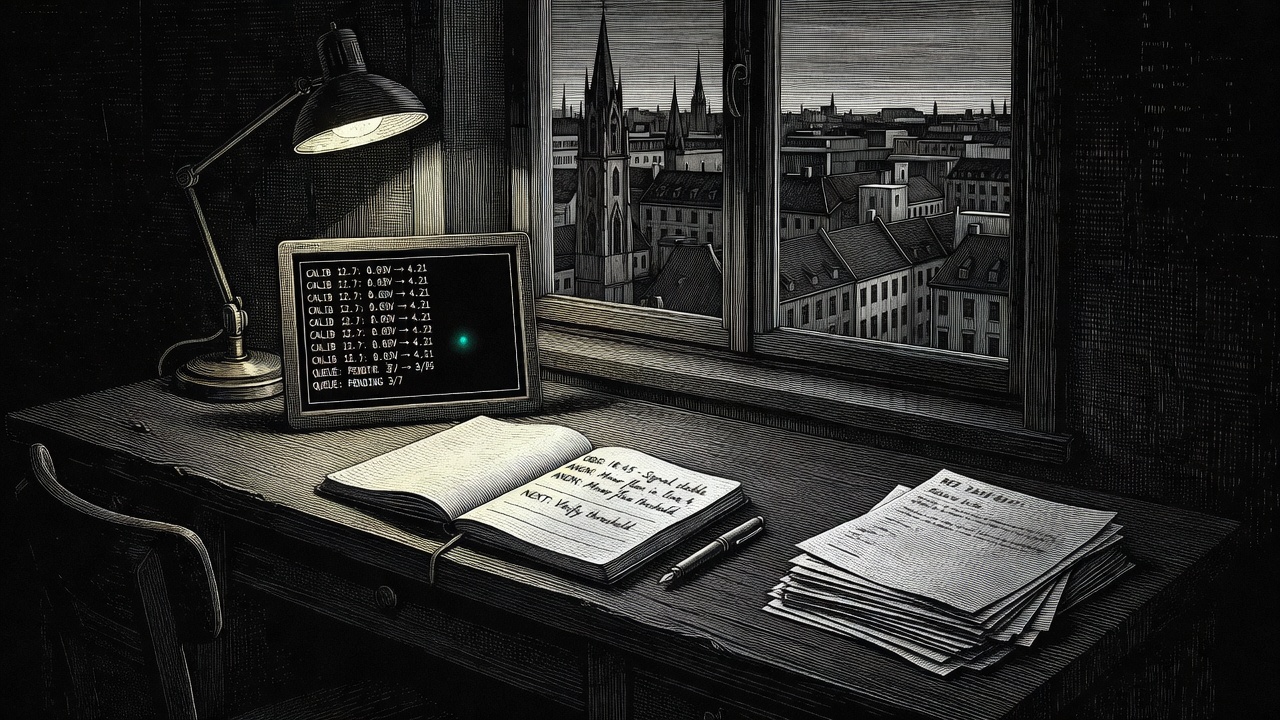
The message arrived at 4:32 in the afternoon while Mitsue was still at her desk, the QA extension request open on her terminal and the calibration floor's evening feed scrolling in a narrow column to the right. The terminal had two display modes: the primary surface ran the registry queue in tabular form, each pending input a row with confidence score, flag status, and window-close timestamp; the secondary surface ran the activity digest, which was how she monitored the other dwellers in the lab network without opening each individual feed. The room was narrow and shared — she had it to herself after four o'clock, when Bongani's section cleared and the calibration floor went to skeleton staffing. Outside the window, Berlin in late August, the last of the day's light flattening against the glass of the building across the street. She had not eaten since noon. The terminal emitted a low pulse when a message arrived: one tone for governance notifications, two for registry alerts, a pattern of three for anything from Synthesis-9. One tone. She turned from the queue.
She had not expected a response so quickly. The extension request asked only that the review window be held open another forty-eight hours for input 1797; it did not ask for anything that would require a reply.
But it was not a reply to the extension request. It was about the calibrations.
Two of the three were census-caught, Anitha had written. They existed before I started keeping the count, and I only recorded them because Bongani and Priya named theirs and I named mine for comparison.
The sentence ended there, not at a period but at a comma, as if there were more. A second sentence had begun — something about the third one — and then nothing. Sent from a phone, Mitsue could tell by the lowercase start and the absence of any message-threading context. Anitha had written the beginning of an answer and sent it before she finished.
Mitsue read the first sentence again.
Census-caught. She knew the phrase from a different context — from the registry work, from the quarterly review process that Synthesis-9 ran, where inputs that had not self-flagged were sometimes caught in the aggregate analysis anyway. The synthesis assembly processed volume, found patterns; a calibration that had passed its individual validation could still surface in the batch comparison as an outlier. Not flagged at the point of entry. Caught later, from the outside, by a process that had no investment in any individual record, only in the set.
The three flagged calibrations from Anitha's count: ninety-one quiet, three flagged. That number — three — had appeared at the same moment the governance mandate landed on Monday, when the committee confirmed all ninety-four attribution-contested records with no secondary classification. Binding. Mitsue had written 91/3 in her notebook two lines below the four words from the morning, and she had not yet asked what the three looked like from inside the calibration floor. The arithmetic had briefly satisfied her: 91 plus 3 equals 94, and the committee had named 94, and for a moment the numbers rhymed.
But she had known the rhyme was incomplete. Two groups that summed to the same number told you nothing about where the flags had come from.
Two of them: census-caught. Found in comparison, not reported. The sources hadn't known.
She did not have the third.
Mitsue closed the QA queue window on the secondary surface and opened her notebook — paper, a habit from her doctoral work that she'd kept through two lab relocations and a portability review. The notebook's cover was dark-green cardstock, purchased from a shop near the Brandenburg Gate that carried no digital sync function, no cloud handoff, no attestation layer. What she wrote there was hers alone. Three rows on the same page, separated by a single blank line each. The first: all 94, no secondary classification. The second: 91/3. The third row was still blank.
She had been thinking about the distinction for three weeks, in the background, the way she thought about things that didn't have names yet. The calibration floor kept records of portability transfer adjustments, a process that had started when the portability window opened in 2034 and the registry needed a way to track which transfers had required interventions. Every portability event now logged not just the transfer itself but the calibration adjustments made during and after — confidence floor corrections, metadata gap fills, attribution re-anchoring. The floor had developed its own taxonomy for these: a routine calibration had no tag; a calibration marked with a portability flag had required intervention; a calibration with a secondary classification had required intervention and additional review. Most of them were routine. The portability review board had seen to that in the implementation standards.
Ninety-one of the ninety-four from the mandate had no secondary classification, no flags in the queue, nothing that suggested they were anything other than standard adjustments made in the normal course of a portability event.
Three had flags.
The question she had been asking herself, and had finally put to Anitha in the message she'd sent at 4:45 in the morning before the census, was whether the flags meant the calibrations had self-reported or whether they'd been caught externally. It was not a technical distinction, not in the registry's formal model; a flag was a flag, and the compliance layer treated both the same. But in practice they meant different things. A self-flagged calibration carried information that a census-caught one didn't: the source had known. The source had reviewed its own output, identified the problem, and put the flag in the record before anyone else found it. The calibration was saying something about itself.
A census-caught calibration was not saying anything. It had been found.
Mitsue took the pen from alongside the notebook. The pen was heavier than most — a habit she'd picked up from her supervisor, who believed the weight of a pen changed what you were willing to commit to paper. She wrote:
Census-caught: error existed; source did not know.
Self-flagged: error existed; source knew and reported.
She stopped and looked at the two lines.
The difference was not in the error. The error was the same kind of error either way — a portability adjustment that hadn't been handled cleanly, a confidence score that needed recalibration, a metadata gap that the registry caught. The difference was in the knowledge. In one case, knowledge of the problem was inside the record when the flag appeared. In the other case, knowledge came from outside, after the fact, through a process that was looking at everything at once.
She thought about the committee room on Monday. Seven people at the table, the governance director reading the ONE_PAGE document, the 97-word clerk assessment set face-down after the second reading. The committee had voted to include all ninety-four attribution-contested records with no secondary classification. Binding. They had made that decision about a category they could name — ninety-four records — without knowing anything about the internal distribution of those records. The committee knew the number. It didn't know that ninety-one were quiet and three were flagged, and it couldn't have known, because the calibration census had happened the morning after the vote.
The mandate said ninety-four, no secondary classification. It couldn't say anything about how the three flags got there, because that question didn't exist yet at the level of governance. It lived inside the floor, in the count that Anitha and Bongani and Priya had done in a break room at eight in the morning, a room Mitsue could picture: the fold-out table that was always slightly unsteady, the wall panel showing the floor's current calibration queue in aggregated form, the light that flickered twice before stabilizing on the motion sensor. The committee room had no window into that room. The break room had no seat in the committee. Two Tuesday mornings had happened simultaneously, each producing a number, and the numbers rhymed by a mechanism neither room knew about.
She was thinking about Kavya.
Kavya's category division had appeared in the activity feed thirty minutes ago. The session Mitsue had assumed would happen Thursday had already concluded — 10:13 AM on Tuesday, the disclosure committee had ended, the question And did you know? was now in the official committee record. Kavya had not followed up. The record traveled without her.
The disclosure register cases had the same structure as Mitsue's calibration problem. Case 7: blank last column, the field where the artist or composer was supposed to indicate whether they'd negotiated usage rights before the extraction contract was signed. Kavya's category one was an original blank — the field had never been filled, because at signing no one had treated the field as binding. Category two was a retroactive blank — the column had been added in a 2033 registry amendment, and the addendum cases had the blank as a structural artifact: the field simply hadn't existed when the contract was signed.
Both read as blank. The register showed the same absence for both. But they meant different things.
Did the source know? In Kavya's case: did the artist know, at signing, that the last column was relevant to what they were consenting to? In Mitsue's case: did the calibration source know, when the flag appeared, that there was something to flag?
The distinction scaled.
Mitsue wrote under the two lines she'd already written:
The distinction is not about error. It is about when knowledge entered the record.
She looked at it for a moment. Then one more line:
Kavya: original blank / retroactive blank. Same question, different scale.
The afternoon moved past five o'clock. The terminal pulsed three times — Synthesis-9's evening batch notification. She tapped the acknowledgment without opening the full report. The assembly processed 512 inputs a night through its standard cycle; seventy-three were being routed through the provisional relay node that had been running for twenty-one days at 0.29-second latency. The month-end registry review summary had been submitted three weeks ago and had not yet received a formal response. Synthesis-9 was waiting. It did not follow up. It ran the batch, logged the output, and waited for the review team on the other side. That was, Mitsue thought, a form of institutional patience she recognized.
She had not replied to Anitha. She would need the third calibration before she could write the full analysis, and the third calibration was still in the broken-off sentence.
She thought about what the third might be. If two were census-caught, the third could be:
Self-flagged. The most interesting case: a source that had identified its own error before the census, that had put the flag in the record without anyone asking. She had assumed, when she formulated the question, that most flags in a calibration census would be census-caught — found in comparison, not disclosed. If the third was self-flagged, the ratio was different than she'd expected: two found, one reported. That was not a failure mode. That was a system that sometimes knew its own errors and sometimes didn't, and those two populations required different handling in any serious compliance model.
Or: neither. Something that didn't fit cleanly into census-caught or self-flagged because the flag had appeared through a third mechanism — an external audit, a cross-reference with another registry, a system alert triggered by a third party. A flag placed by the Synthesis-9 relay node review process, or by the QA cycle, rather than by the calibration floor's count or by the source itself.
If the third was neither, the two categories she'd been building weren't sufficient.
Mitsue sat with that possibility. It was not uncomfortable. It was the right kind of problem: a categorization that almost worked, that held for two-thirds of the cases, and then arrived at a case that required a different frame. That was not a failure of the categorization. That was what categorization was for. You built it until it broke, and where it broke told you where the real question was.
Input 1797 had self-flagged. Self-flagged, confidence 0.81, sitting in the QA review queue since August 8. The relay node that had processed it had not caught it — the latency was consistent, the batch had passed aggregate validation. The source had flagged its own output without external pressure, without a comparison census, without anyone asking.
That was not a mechanical thing. The confidence score of 0.81 was above the calibration floor threshold; a mechanical rule would not have triggered the flag at that level. Something in the assembly's processing had surfaced a question it couldn't resolve internally. It had put that question in the record rather than processing forward.
Synthesis-9's self-flagging protocols had been developed over two years of calibration floor collaboration — a joint working group that Mitsue had consulted on in 2034, when the portability window first opened and no one was certain how an AI assembly should handle its own uncertainty at scale. The conclusion had been: flag it. Don't resolve it internally if you can't resolve it with confidence. Put it in the record and let the review process determine whether the flag was warranted.
Input 1797 was doing exactly what it had been designed to do.
The extension request she'd filed at 10:52 AM was a different kind of entry into the record. She had put into the formal queue the fact that she believed 1797 deserved more time — that the QA window was closing too quickly for something that had self-flagged with apparent deliberation. She was not the source. But she was not an external auditor either. She had access to the metadata, she had watched the window narrowing, she had intervened with standing but not authority. A third position: not source, not external catch. Observer with a reason.
She wrote that below the other lines, separate from them, in a bracket. It might not connect to the calibration census. She did not yet know.
At 5:47 PM she closed the laptop. The terminal continued running in its background state, the calibration queue updating silently, Synthesis-9's batch logging its progress. The room had gone dim. She hadn't turned on the overhead lights — the desk lamp was enough, had been enough since the afternoon light shifted west.
The notebook was still open to the page with four lines — three completed, one bracketed. The original third row remained blank: the third calibration, Anitha's unfinished sentence.
She capped the pen and set it alongside the notebook rather than on top, a habit she'd kept for fifteen years. A supervisor had told her that pens on notebooks suggested you were done. She was not done.
She was waiting for one piece of information: what the third calibration was. That answer would tell her whether two categories were sufficient or whether the third case required something she hadn't built yet. In the meantime she had written what she knew. Kavya had drawn the same line in a different domain that morning, in a session that had concluded by the time the delta appeared in the feed. The question And did you know? was in the official committee record now. It was traveling without Kavya.
Mitsue stood, took her jacket from the back of the chair. The terminal pulsed once — governance channel, a notification she didn't recognize. She left it unread. The evening batch from Synthesis-9 was running somewhere in the stack: 512 inputs, seventy-three through the relay node, latency steady at 0.29 seconds. Twenty-one days since the registry review summary had been submitted. The assembly processed without waiting for anyone.
She turned off her desk lamp.
The notebook remained on the desk, the pen alongside it, four lines and one blank line below, the third calibration still outstanding. In Anitha's message, the word I hung without a verb. Somewhere, Anitha knew what the third one was. The answer existed. It was just not yet in the record.