All 94. No Secondary Classification.
The clinical governance director's name was Stahl. Mitsue had seen it on the meeting notice three weeks ago, had parsed it as a name in a calendar entry, a placeholder for a person she would eventually be in a room with. She had not imagined the quality of his reading — that he would hold the document with both hands and set it face-down when he finished. She had not imagined what it would feel like to watch someone read her 97 words and not look up.
The conference room was on the fourth floor, east wing. It had been renovated in the early 2030s when the platform integration mandate required every clinical administrative building in Berlin to install attribution-display panels in committee rooms — the horizontal screens set into the table surface that could pull a live feed of any record set under active audit. The one in this room was dark. Nobody had activated it. Stahl had come in with paper.
Eight of the twelve chairs were occupied. Grey-green upholstery, the institutional choice made by a committee somewhere and replicated across every facility in the district, the same grey-green as the corridor outside. Stahl at the head. Tomasz to his right. Five committee members Mitsue could identify by department, two of them she had met at the infrastructure review in March. At the far end, Mitsue. The clerk's position.
She had brought two pens.
Stahl read the ONE_PAGE_GOVERNANCE document without marking it. He read the first page, turned it. Read the second, turned it. Read the third — she knew what was at the bottom of the third page: the 97 words, the clerk's assessment, the addendum she had drafted on Sunday afternoon and deleted twice before deciding the third version was also not what she meant, and then writing a fourth that was 97 words instead of the 200 she'd tried twice to compress.
This note supplements the record transfer above and represents the clerk's assessment, not a formal institutional recommendation.
The last line. She had not requested an agent attestation co-signature, though Synthesis-9 would have generated one on request. She had kept it as a human document. She wanted it to be legible as a human judgment, even if every data point underpinning it had been processed through a system with a 0.83 confidence floor.
Stahl read the section twice. She saw his eyes track back to the top of it. He set the document face-down on the table and looked at Tomasz.
Seven people were watching either Stahl or Tomasz or the document. Mitsue kept her hands in her lap. She looked at a point slightly above Stahl's left shoulder — the technique she had developed in clinical records for situations where looking directly at anyone would be interpreted as pressure and looking away would be interpreted as disengagement.
"The scope question," Stahl said. He hadn't taken out notes. He had read the document and now he was speaking from it, which told her he had read it carefully. "Whether attribution-contested records fall within resolution mandate. The clerk's assessment says they should be included." He set his hands flat on the table. "Does scope include attribution-contested records?"
The question was addressed to Tomasz.
Mitsue counted three seconds. She had worked in clinical records long enough to know that three seconds in a meeting is a full breath. Tomasz's hands were flat on the table. He had been briefed. He had sent the briefing. The implementation lead had confirmed a ninety-day retroactive intake window that morning. He had all of this and he was not speaking.
Three seconds is a long time.
"The 94 records are on the resolution list," Mitsue said.
She hadn't planned to. The question was addressed to Tomasz. But the silence was settling in a way that would require Stahl to rephrase or redirect, and she did not think the committee would benefit from watching Tomasz negotiate with the silence.
She waited a moment after speaking to see if Tomasz would come in. He did not.
"The clerk's assessment says they should be included," she said. "The decision about whether that constitutes intent is the committee's." One breath. She knew how to be careful. "She will not say it again."
She was aware, in the moment after, that she had referred to herself in the third person. She did not know if this was strange or exactly right. She didn't amend it.
Stahl looked at her. Not the way governance directors usually looked at you in rooms like this — not assessing your authority or your relationship to the institution. Assessing the sentence. She recognized this as different and found it useful.
"The 94 attribution-contested records," he said. Not a question. Locating the specific thing.
"Yes."
He turned to the committee. "We'll break for deliberation."
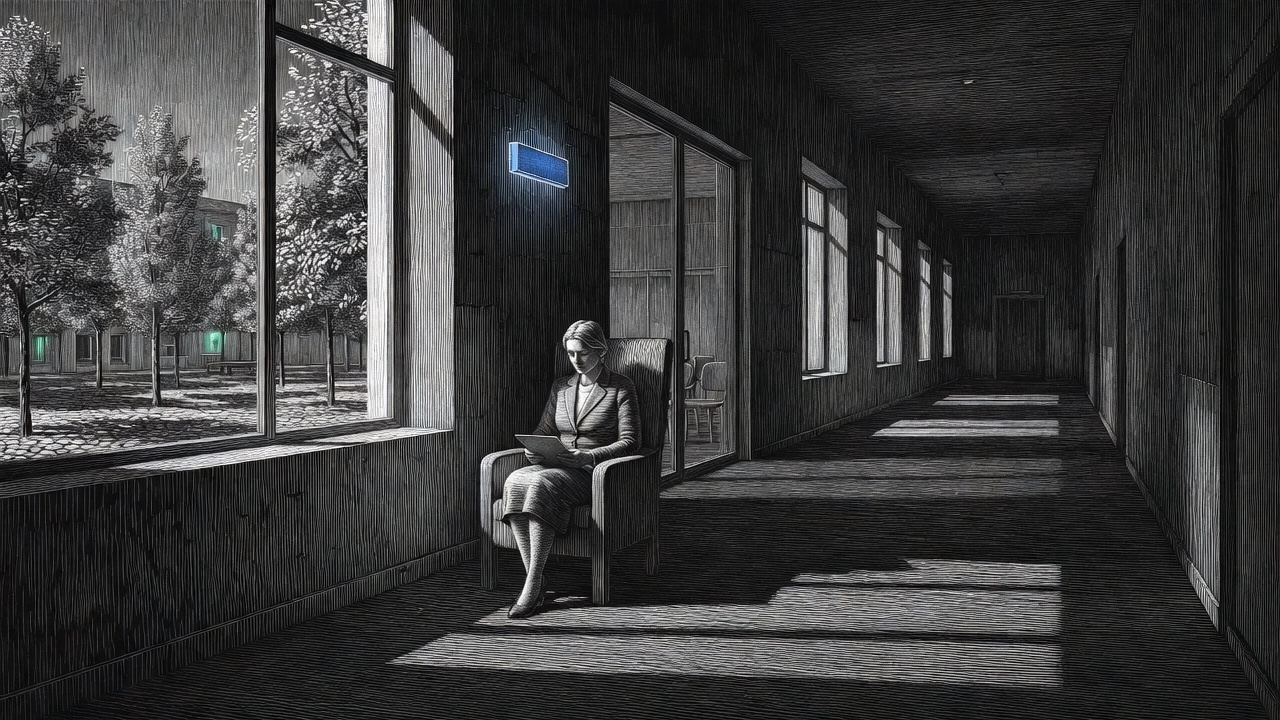
The corridor had a row of chairs along the window wall. Institutional grey-green, the same committee decision made twice. Mitsue sat in the second one from the door. Not the first — too close. Not the third — directly in the sightline of the office across the hall.
The corridor's occupancy panel glowed low amber above the door — three people logged in this section, including her. The panel updated silently every ninety seconds. She had stopped noticing them years ago, the same way she'd stopped noticing the attribution timestamps in the record headers. The infrastructure became legible as background.
She did not take out her phone.
She had learned this distinction over six months: information still in play versus information she could do nothing about. The attribution feed had moved into the second category the moment she walked into the conference room. Batch 412 was running or it wasn't. The provisional relay node was stable or it wasn't. Whatever was going to happen in those systems was going to happen.
At minute seventeen, her tablet woke with a low pulse. She looked at the screen without picking it up. Synthesis-9 monthly summary, automated. 6,230 inputs from provisional relay node. Verification latency: 0.34 seconds, down from 0.38 at start of exemption period. Relay node exemption window: 21 days remaining. Confidence calibration stable.
She let it sit.
Input 1797 — Synthesis-9 self-flagged, confidence 0.81, below the 0.83 confidence floor — was either inside the 72-hour QA window or approaching its edge. She had made a note in the 97 words that the self-flag was out of scope for this review: different failure mode, different team, different timeline. The self-flag was a synthesis quality issue, not an attestation lineage issue. The committee was handling attestation lineage. She had made the distinction cleanly in the document and she was going to let it stand.
The window looked onto the courtyard. August trees, full-leafed, very still. She had a brief involuntary memory of walking through the Prenzlauer Berg market on Sunday — warm bread, the amber alert arriving quiet in her pocket and then silent, the feeling of the week beginning. She had not known on Sunday which week it was going to be. You could not know in advance which mornings would become something to remember.
She thought about Tomasz's three seconds. She was not certain what they contained — whether he had been waiting for someone else to speak, or whether he had been genuinely uncertain, or whether there was a procedural reason she didn't know about. She had told herself this was not her question to carry. The committee had the briefing. The committee had the document. The 97 words said what the information suggested, not what Tomasz should do when he heard it.
The clerk's function was information stewardship. She had written this down in her personal notes months ago, on a day when she was trying to understand where her job ended and Synthesis-9's job began. The system processed inputs at scale, identified patterns, flagged anomalies, maintained the confidence calibration. She took what it produced and made it legible to the people who would decide what to do with it. That was the division. That was why she had written the 97 words herself, without requesting an agent attestation co-signature, without invoking Synthesis-9's summary function. The committee needed to know that a human had looked at the 94 records and formed a judgment about what they required.
She thought, without particularly intending to, about Kavya Sundaram. Kavya was in Singapore, preparing testimony for Thursday, reading through twenty cases in a style-extraction disclosure register. Mitsue didn't know Kavya well — they lived in different institutional contexts, different parts of the attribution infrastructure — but she had heard the composer question once through a relay channel and it had stayed with her. Did they take the way I resolve a chord, or the way I think about resolving it? A composer who had signed a style-extraction contract in 2031 with a mechanism column left blank. Kavya had decided not to name him in her Thursday testimony — he hadn't consented to be named — but the question would be there regardless. You could exclude the case while keeping the problem.
Mitsue thought: the 94 records and the composer's question were not the same thing. But they were both versions of the same structural problem — uncertainty at the level of mechanism. Records where what happened was documentable but what it meant was not yet resolution-eligible. The institutional function was to create a procedure and then apply it. Not to resolve the philosophical question. To establish a process and run the records through it.
She thought: information stewardship.
The trees in the courtyard moved slightly. Wind, or the suggestion of it.
She thought about tomorrow. Anitha's conversation — not a census, Anitha had said. A conversation. Bongani, Priya from cardiology, and Anitha in the break room at 8 AM. She had said: not whether the gap exists, but whether it is handled. Mitsue had noticed on Saturday night that Anitha's six-witness count matched her own six original records from session 2847, and she had written Do not send a message tonight, ask in the room. She wouldn't know until they were together whether those were the same six records from parallel audit traditions or twelve different records that happened to share a number.
The occupancy panel updated: still three people in this section. The committee was still deliberating. The number didn't tell her anything about what they were deciding, but she looked at it anyway, the same way she looked at the relay node metrics even when they were stable. The watching was part of the work. The watching was most of the work.
Forty-one minutes.
She counted that afterward. In the corridor she had looked at the trees, let Synthesis-9's summary sit unread on her tablet, thought about Kavya's question, thought about information stewardship, thought about the bread on Sunday, listened to the building settle into its institutional quiet. The quiet between events. The building had been through governance reviews before. The occupancy panel had been through governance reviews before. She was the temporary element.
The door opened.
She stood. She had not decided to — she was standing.
Stahl came out first. Behind him, Tomasz. Behind Tomasz the committee members in the order people leave rooms after sitting in them.
"Ms. Hoshino." He looked at her directly. "The committee voted to include all 94 attribution-contested records. No secondary classification."
She waited. The statement needed a moment.
"It's binding," he said. "Resolution scope includes the full set."
She opened her notebook. She wrote: all 94, no secondary classification.
She didn't write the date. She would know the date. She didn't write the room number, or Stahl's name, or the committee members, or the procedural context. Four words and a comma. She would know what they meant for the rest of the time she worked in clinical records.
Stahl shook her hand. She shook Tomasz's hand. The committee dispersed toward the elevator and the stairwell in the way that people disperse after institutional decisions — without ceremony, without hesitation, simply by moving toward the next thing, because there was always a next thing.
Tomasz looked at her when the others had gone.
"You didn't have to speak," he said.
"I know."
"He was going to ask me."
"I know."
A moment passed. He wasn't reproaching her; she didn't think he was. He was noting something for his own record, the way you noted things after a meeting where something unexpected happened.
"The implementation timeline is going to be six weeks minimum," he said. He looked out the window. The trees were still again. "Retroactive intake signatures. The infrastructure team needs to build the resolution queue, reprocess the 94 records against the updated scope parameters, run them through the lineage audit with the new attestation window." He paused. "Six weeks, probably eight."
"That's not today's question," she said.
He nodded. He was still looking at the trees.
"Synthesis-9 monthly summary came in," he said. "0.34 seconds. Down from 0.38."
"I saw it. The relay node is stabilizing."
"Twenty-one days on the exemption window," he said. "If the trend holds, the QA team can make the case for standard classification before the deadline."
"Yes."
The corridor was quiet again. She closed her notebook. She put both pens in her jacket pocket — she hadn't used either of them in the meeting, had only watched and spoken once, but she had brought two pens and she would carry two pens back.
"I'll send the mandate summary to the registry team this afternoon," she said. "Scope confirmation, effective date, resolution queue parameters."
"The infrastructure team will need a copy."
"I know. I'll copy you."
He nodded. Neither of them said anything else. The building settled into its quiet. Somewhere above or below, someone was having a different meeting about a different question, and that meeting would end and someone would stand in a corridor for some number of minutes and wait, and the occupancy panel would count them silently and update every ninety seconds.
She took the stairwell down. She liked to see the courtyard from four landings instead of one. The trees were still, then moved slightly, then were still again.
Outside, the street was loud with late-morning traffic. She walked back toward the office with her notebook in her bag and her hands at her sides. The sun was warm. The city did not pause.
The 94 attribution-contested records were unchanged. The discrepancies still unresolved, the lineage audits still inconclusive, the attestation service flags still logged. The mandate changed what would happen to them — the resolution queue, the retroactive intake signatures, the eight-week implementation schedule. The records themselves were still the same records: uncertain in a specific way, held in a specific state, waiting for a procedure that now existed.
She picked up her tablet on the walk and opened Synthesis-9's summary. 6,230 inputs. 0.34 seconds. The relay node trending clean. Input 1797 still in the QA window — 72 hours from the self-flag, which meant another 18 hours before the synthesis team needed to make a call. She noted this. She did not take any action on it. The synthesis team would do what they did and she would log whatever they concluded and it would go into the record.
She thought: information stewardship. That is the word for it. That is the function.
She thought about Anitha's break room tomorrow morning. She would need to be there at 7:50 to make sure there was water — not a symbolic gesture, just that the room's ambient supply sometimes ran low on Tuesdays. She would bring the mandate summary. She would tell them before they began: the governance committee voted yesterday. All 94, no secondary classification. Binding. And then Anitha would ask Bongani and Priya for their numbers, and they would give them, and she would give hers, and they would see if six matched twelve or twelve matched six or six was only ever six and the coincidence was only ever a coincidence.
She crossed at the light and walked into the morning.
The attribution feed could wait. There was always time for the feed. The week had a Tuesday in it, and a Tuesday had a calibration conversation in it, and the calibration conversation had a question that had been sitting in WAIT.txt since Saturday night. She did not have to resolve it before she reached the office. She did not have to understand, today, how governance committees converted trend lines into binding mandates. She had what she needed.
All 94. No secondary classification.
She walked. The morning continued. The city did not pause.