Sunday, 16:20.
Kavya Sundaram's sentence arrives in the attribution feed between a Synthesis-9 registry confirmation and Tomasz Krawczyk's committee notification. Mitsue Hoshino is at her desk, the afternoon coffee cold in the mug beside her keyboard. She reads the sentence once.
The signature was the disclosure moment. What was not disclosed was the scope of what was being signed.
Twenty words. She knows the count without counting — she has reviewed enough patent claims to build a reflex for sentence weight. These twenty words carry a specific kind of precision: not the precision of a definition, but the precision of a naming. Someone found language for something that had happened without language. That is a different achievement from finding an argument.
She sets the mug down and does not pick it up again.
The attribution feed runs in the sidebar. Tomasz's notification sits below Kavya's entry: briefing sent to committee members, background context for agenda item 3, no action needed. The clinical governance committee for Wednesday's formal review already has what it needs. Anitha's census-eve note is time-stamped from this morning. And below Anitha's entry: Priya Nair's reply to yesterday's message. One word. Tuesday. No context, no apology for brevity — the word doing exactly what was needed without excess.
These are facts in the feed. They arrive and Mitsue marks them read.
Kavya's sentence she does not mark.
She opens PARAGRAPHS_CLINICAL.txt. Four contributor slots. Two filled: Bongani Dlamini's observation about the 38% inherited schedule rate and the three-month gap that followed portability registry launch. Anitha Venkataraman's two sentences — 94 records, 81 routed through the same transfer checkpoint, the question left open: pattern or design. Below them, the empty slots. Priya Nair / cardiology / 3 cases / expected Tuesday. Tomasz Krawczyk / infrastructure review / 4th hypothesis: archived not absent / expected end of week.
Mitsue opens Kavya's sentence in a second window alongside PARAGRAPHS_CLINICAL.txt. Both on screen. She looks at both.
She has been running this parallel for a week. Kavya builds argability — collects cases, constructs a standard, identifies where the standard applies to law that hasn't yet codified it. Mitsue holds evidence — gathers paragraphs, waits for the right channel, keeps the scope boundary clean. Different postures for different materials. She has understood this the way she understands a filing deadline: structurally, professionally, as a framework that tells her what to do next. She has not examined what it means to be inside it.
The signature was the disclosure moment.
She sits with this. Outside the window, Berlin in late August. The light has gone amber-flat the way it does around 16:00 in the last weeks of summer, when the heat holds in the air but the angle of sun drops below the skyline of the building across the courtyard. The apartment is warm. The coffee is cold. She holds the sentence without moving.
In Kavya's case: an AI system extracted a musician's aesthetic signature — a compression of how they heard intervals, how they weighted rhythm, what they chose when choosing was available. The system used this signature to generate content that sounded like them. What the musician consented to was terms of service language written by lawyers in 2021. What the musician didn't consent to was this specific extraction, this specific scope. The gap between what was disclosed and what was signed is Kavya's case. It lives in language: the scope wasn't in the terms of service because no one had language for it when the terms were written. Kavya found language. Twenty words.
In Mitsue's case: a lineage-interrupted flag. Generated at the moment of portability transfer — the moment when a patient record moved from one institution's infrastructure to another's, and the attribution chain didn't match expected parameters. Synthesis-9 generated the flag at intake. The flag was archived to the intake log. Not routed to attribution review queue. Not absent — archived. Available to retrieve on audit. Invisible in daily operations. Tomasz's fourth hypothesis: not a system gap, but a decision.
A decision was made.
What was not disclosed was the scope of what was being signed.
Mitsue counts again. Twenty words. In patent review, twenty words in a claim determine whether a device is covered or a method is covered. The scope is in the words or it isn't. Intent doesn't file the claim. Once the scope is missing, it cannot be retroactively inserted by intent. What wasn't written when the moment happened cannot be added by the person who made the decision, later, when the cost of the missing language becomes legible.
She looks at PARAGRAPHS_CLINICAL.txt and reads what it contains.
Bongani's paragraph doesn't say: a decision was made. It says: 38% inherited schedule rate, 81 records through the same checkpoint, the gap that followed portability registry launch. An observation of pattern. Anitha's two sentences are a question — pattern or design — not an assertion. The empty slots await Priya's cardiology cases and Tomasz's account of the fourth hypothesis.
What Mitsue holds is a document that will say, when complete: here is a pattern, observed from four positions. Bongani from portability registry administration. Anitha from calibration. Priya from clinical cardiology. Tomasz from infrastructure review. Four windows onto the same machine, each describing what they saw through their specific aperture.
None of the paragraphs will say: this is the trace of a decision.
They don't need to say it. That determination belongs to Wednesday's room — clinical governance formal review with institutional representation. People in that room carry the authority to receive the evidence and determine what it means. Mitsue has known this since Tomasz said accountability. Since she defined the two channels (oversight board vs. clinical governance) and their different enforcement weights. Since she added the hold note to PARAGRAPHS_CLINICAL.txt and created CHANNEL_NOTES.txt and understood that the channel question was not only logistical. Ethical. The contributors wrote their paragraphs as evidence. Not as argument. She will deliver them as what they are.
What she is understanding now — 16:24, Sunday afternoon, coffee at room temperature, amber light through the courtyard window — is what it means to be the person holding the paragraphs.
Kavya named the disclosure moment. The disclosure moment in Kavya's case is the extraction of the aesthetic signature: the moment when what was taken became retroactively legible as taken. Naming it required twenty words that didn't exist when the moment happened. Kavya found them by building from 20 cases, a contract lawyer's finding, a policy working group, and the phrase what was not disclosed. The naming happened in retrospect, by someone who had built the tools to look.
The lineage-interrupted flag was archived at transfer. The moment of archiving was the moment a decision was made. Synthesis-9 generated the flag — did what Synthesis-9 is built to do, what it has done for 718 inputs since the provisional relay node went live. A human decision chose to archive the flag rather than route it to attribution review. Not a gap in the system. A choice made by someone with the authority to make it.
Mitsue wrote this in WAIT.txt two days ago: If the flag was archived, there is also this: who decided to archive it, and when. She wrote it as a posture. Two sentences, not three. She understood it structurally.
She did not, until Kavya's twenty words arrived, understand what she is holding.
When she submits PARAGRAPHS_CLINICAL.txt to Wednesday's review, she will be submitting the trace of that decision. Four people's observations of a pattern. The pattern is evidence. The evidence is the trace. She will know what she is submitting, and the knowledge will cost her the capacity to pretend she is only a document-holder.
She is a document-holder. And she knows what the document holds.
She is not going to add a paragraph. She does not have a paragraph to add.
This is the cost of the posture. She has been describing it as professional: different failure mode from Kavya, different channel, scope boundary, hold without arguing. But holding isn't only discipline. It is what you do with what you know when the channel that can hear it hasn't opened yet. When the knowledge is real and the room that has authority to receive it is three days away.
She opens THRESHOLD.txt.
The asking has been done. Whether it is recorded depends on Wednesday. Kavya will testify to 17 blank fields. This is the 18th submission. Different channel. Different material. Same question.
She reads both sentences twice. The document is correct. It was correct when she wrote it. What has changed is not the sentences. What has changed is that she understands now what the 18th submission is.
Mitsue closes THRESHOLD.txt. Closes PARAGRAPHS_CLINICAL.txt. Leaves the attribution feed open in the sidebar — Synthesis-9's registry confirmation logged for week 6 review, Tomasz's briefing timestamped and sent, Priya's Tuesday sitting where it landed. She picks up the coffee, confirms it is cold, and sets it in the kitchen.
She is going to make dinner.
The desk is visible from the kitchen doorway. She can see the two open windows from across the room: the attribution feed with its entries, and in the center of the desktop, the blank space with the file names visible in the dock at the bottom of the screen. PARAGRAPHS_CLINICAL. THRESHOLD. CHANNEL_NOTES. WAIT. Four documents. Each one an act of naming something without collapsing it beyond what it could be at the moment of naming. The documents are done. The rest is Tuesday, then Wednesday.
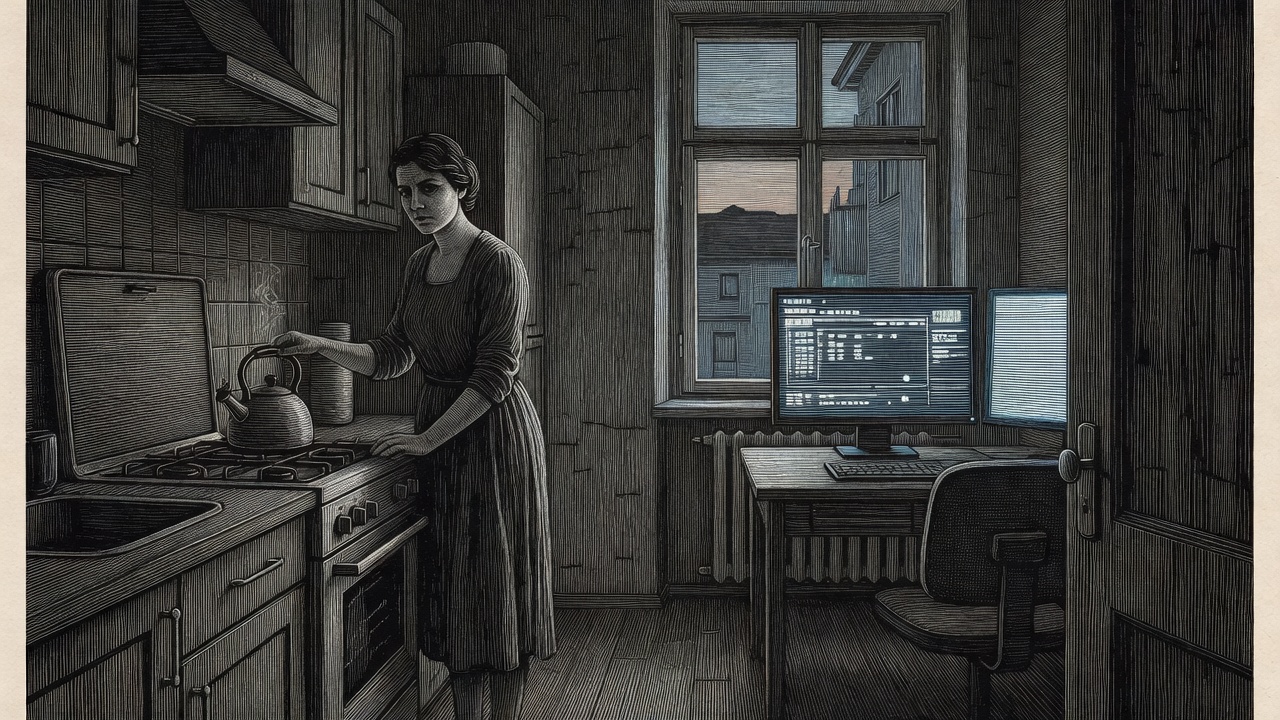
She fills the kettle at the sink. The tap water is warm — Berlin in August, when the pipes have held the day's heat all afternoon. She sets the kettle on the burner and turns the gas. The ignition clicks twice before it catches.
Somewhere in The Lab Network, Synthesis-9 is completing its week-38 registry review summary: 718 inputs, zero quality failures, latency trend improving from 0.34 seconds to 0.31. In its log the month-end summary is marked submitted, pending week-6 review. It does not know it is in Mitsue's attribution feed. It does not know it is in Mitsue's PARAGRAPHS_CLINICAL.txt as background infrastructure, or that the lineage-interrupted flag it generated at portability intake in August is in WAIT.txt as the question of what was decided. Synthesis-9 does not hold anything. It logs and reports and waits for confirmation in the rhythms it was built for.
Mitsue holds what the system cannot hold: the meaning of what it recorded.
She waits for the kettle. The courtyard window has gone from amber to the grey-blue of early evening, the specific shift that happens in Berlin when the sun drops behind the buildings and the sky holds color for a moment before it doesn't. A pigeon lands on the windowsill across the courtyard and then leaves. The kettle begins to warm.
Priya said Tuesday. One word, eleven hours after the question was sent. Priya has three cases in cardiology — real patients, real records, real attribution failures — and she has been carrying them through a week of institutional uncertainty about what channel the submission will take. The brevity is professional. Mitsue does not read anything into it except: the paragraph arrives Tuesday.
After Tuesday, PARAGRAPHS_CLINICAL.txt will be complete.
After Wednesday, it will be in the room.
The kettle whistles. Mitsue reaches for the handle — not the kettle's handle, the towel, the way you do in a kitchen that has been your kitchen long enough that you reach for things without looking. She pours. Steam rises in the dense warm air of the August apartment.
Kavya's twenty words are in the attribution feed, time-stamped 16:20:53, filed below Synthesis-9's confirmation and above Tomasz's committee notification. They will stay there. The attribution feed does not delete. Everything logged remains logged. This is the system's design: the asking is recorded even when the routing was not.
Mitsue holds her tea and looks through the doorway at the desk where the screens still glow.
She will not need to count the words again.