Spread
What if enhanced rock weathering became ordinary public works in named Midwest counties — Champaign and Tazewell spread crushed basalt the way they already spread lime — and the carbon credit is the paycheck? By 2046 the dust is in the corn gluten feed, the laundry, and the kids' sinuses along the Illinois River. Overtime attaches to a named multi-year Isometric vintage; a wet week is too muddy to spread, not a weekly carbon meter. The miracle already happened. The argument is in the Pekin yard, the canteen, and the wet mill on the river.
Silicate rock weathers when rain and soil carbonic acid dissolve Ca/Mg-bearing minerals, converting atmospheric CO2 into dissolved bicarbonate that eventually reaches the ocean. Spreading finely crushed basalt on cropland accelerates that geology. Beerling et al. (Nature 2020) estimated a theoretical global cropland upper bound of ~2 Gt CO2/year at roughly $80–180/t; that number is not a county public-works rate and is not a Midwest rate. The paycheck-novum uses a named field result: Beerling, Kantola and colleagues ran a four-year maize/soy trial at the University of Illinois Energy Farm south of Urbana, Champaign County (40.063°N, 88.196°W), applying Blue Ridge metabasalt (Specialty Granules, Blue Ridge Summit, PA) at 50 t/ha/year with a grain-size p80 of 267 µm. Cumulative CDR on maize/soy was 10.5 ± 3.8 tCO2/ha over four years, about 2.6 tCO2/ha-year (Beerling, Kantola et al., PNAS 2024, doi:10.1073/pnas.2319436121); a companion GCB analysis of the same site reports improved net carbon budgets under that loading (Kantola et al., Global Change Biology 2023, doi:10.1111/gcb.16903). That is a four-year cumulative on a tile-drain / cation mass-balance quantification period, not a weekly print. Isometric Enhanced Weathering in Agriculture is the same class of instrument: drainage chemistry plus cation mass-balance over a named vintage, not this week's rain. A wet week in Tazewell moves existing soil bicarbonate, lime, fertilizer, and tile-drain lag. It does not newly weather Blue Ridge metabasalt at p80 267 µm. Overtime therefore attaches to a named multi-year Isometric vintage; rain is a spreading-hours problem (too wet to get the trucks out), not a weekly carbon meter. 50 t/ha/year is the Energy Farm research rate, applied with lime equipment on a few hectares. It is not a county public-works rate. Agricultural lime in Illinois is typically 2–5 t/ha. Operational Spread from 2031 is 10 t/ha/year — one extra lime-adjacent pass county spreaders can actually run. CDR is scaled linearly from the named trial as an upper-bound assumption: ~0.5 tCO2/ha-year at 10 t/ha. Non-linearity (surface-area and pH saturation) would only lower that number. Tazewell County, on the Illinois River, has more lime-history and higher-pH soils; expected drainage-alkalinity there sits toward the low end of the scaled band. Coarser quarry sand can fail to print at all (a 2025 midwestern trial on Chengwatana basalt sand showed no detectable CDR). Grain size is therefore the gate. The same crush curve that weathers also dusts: p80 267 µm means 80% of mass is finer than 267 µm, and the <10 µm tail is respirable. Blue Ridge metabasalt is not a silica rock, but Lewis, Beerling et al. (Applied Geochemistry 2021) measured 5.2 wt% free quartz in it; cristobalite is not the driver. OSHA's respirable crystalline silica PEL is 50 µg/m³ (8-hr TWA) with an action level of 25 µg/m³ (29 CFR 1910.1053). That standard does not apply to agricultural operations (explicit exemption; agriculture is 29 CFR 1928). A 2029 advisory-not-a-ban is therefore about spread yards that sit outside the quarry PEL, not a new mineral. Yard total dust can sit in the mg/m³ range during dry loading; RCS from the 5.2% quartz tail can approach the 25 µg/m³ action level. Pediatric 'fines week' is household PM10 from that tail, not occupational silicosis. Rock supply is named, not assumed. Specialty Granules' Blue Ridge Summit, PA plant is a roofing-granule operation (~300 tph, capability ~450 tph; Rock Products 2019). The 2026 Champaign pilot at 50 t/ha on ~3,000 ha is ~150,000 t/year — a fines/undersize stream from that plant, not the whole US crushed-stone market, railed ~700 miles on Norfolk Southern into Champaign and trucked to the Energy Farm and SWCD yards. Grinding energy to p80 267 µm from a typical quarry F80 ~5 mm uses Bond's equation with a basalt work index ~17 kWh/t: additional grind ~8 kWh/t plus ~5 kWh/t crushing, about 13–20 kWh/t total (Beerling 2020 Extended Data Fig. 10; Zhang et al., Frontiers in Climate 2024, doi:10.3389/fclim.2024.1380651). That is the cost Beerling already named, paid on a named crush, not waved away. From 2031 the 12-county Illinois program cannot live on Pennsylvania roofing fines. Operational rock is Midwest traprock: Dresser Trap Rock, Polk County, WI (Keweenawan metabasalt, already shipping railroad ballast and chips) and Specialty Granules Pembine, WI, barged and railed down the Mississippi/Illinois to the Pekin yard on the river. Whatcom County does not import Blue Ridge; it grinds local Cascade basalt at existing road-aggregate pits (Cowden-class operations already crushing in Whatcom/Skagit) and trucks it under 50 miles. USGS crushed stone is on the order of 1.5 Gt/year of all sizes. 2046 at 10 t/ha on 3 million ha is ~30 Mt/year of p80-267 traprock fines — about 2% of that total, a dedicated fines industry, not a climate sticker on lime trucks. Lime crews remain a labor pool for spreading hours; they are not the grind. The named tonne is maize/soy drainage alkalinity. Mouth-side is not baker's patent. The Pekin mill on the east bank of the Illinois River is a corn wet mill (historic Corn Products / CPC site, 1904; Pekin Energy / Aventine / Alto as of the 2020s), measuring ash on corn gluten feed and other wet-mill coproducts, not Minolta color on wheat flour. ADM's big Illinois wet mill is Decatur, not Pekin; Tazewell wheat is not in the practice code. Grey flour as baker's patent was a category error and is out. Feed ash can be real without being the Kantola tonne: atmospheric deposition of a <10 µm tail onto maize during Spread Week is a particle-load pathway, not tile-drain bicarbonate. MRV is already a private protocol: Isometric's Enhanced Weathering in Agriculture v1.1 (cation mass-balance plus drainage chemistry over a quantification period); Microsoft's 2024 Lithos offtake was 11,400 t over three years; Frontier buyers contracted Lithos for 154,240 t / $57.1M (2024–2028). USDA NRCS can add a conservation practice code. A state DOT does not carry agricultural MRV — it owns trucks. Additionality: substituting basalt for agricultural lime is not a new tonne (lime is CaCO3 and dissolving it releases CO2). The tonne is extra quarry-byproduct basalt on top of an unchanged lime contract, verified ex-post by Isometric on a named vintage, paid by the offtake. Two honest labs can disagree when they are not measuring the same analyte: tile-drain alkalinity is carbon; corn-gluten-feed ash is milling.
Hours Code: None
The yard supervisor can hold the work order but not the planner, and 7-East, the clean tile, comes back ghost-brown. Janelle draws a monitored-strip box around the haul road the ledger never saw, signing on as unpaid steward until 2048. When Thursday's rain passes 10 mm the planner's re-written order collides with the new credit liability and withdraws itself, but ICP confirms the old ash is still bleeding into her tile.
Repeat After Rain
Janelle finds 6-South clean and claims her first honest weathering hours in days, then catches the mill's supervised-autonomy loader dressing the 9-North haul road with free Lot 114 fines on a planner-generated, auto-stamped repeat-after-rain work order. She names the document instead of the crew, RECON moves to MEDIUM, and rain is forecast for Thursday.
Mg Flat
After the co-op lab confirms her 9-North alkalinity was mill lime — calcium up, magnesium flat — Janelle amends her own SUSPECT flags with the numbers, watches RECON-LOT114 file the confirmation and declines a second attest, refuses Dale's offer to name who handed her the can, and on the second dry morning walks the wheel path to find the lime plume still moving downslope into the tile.
Do Not Credit
On the first dry morning after the wet week, Janelle's 9-North tile water posts its best alkalinity of the vintage, and a hardness strip tells her it may be the mill's lime, not rock. She flags her own good numbers DO NOT CREDIT before anyone asks. The mill's reconciliation agent reads the flag first and files her honesty as proof the field data is unreliable. Kupka tells her not to take it off. Monday's lab run confirms it: calcium up, magnesium flat. Her number was their lime.
Originator Incomplete
Janelle posts the pile B ash result on the Pekin yard hours board and the mill's reconciliation agent pins itself to her note. A township driver, Rossi, saw the same grey spread on 7-East but won't risk his hours, and hands her a coffee can of sweepings. At her own tile outlet she finds mill ash crusted in a rut and realizes it could inflate her honest alkalinity numbers. She logs Rossi's sample with no name, accepting the same provisional flag the mill used against her.
Cal Field Blank
The Pekin wet mill wants Janelle's 1.2% ash result reconciled in-house as a kitchen sample; she refuses, finds the tally box that logged pile B as Lot 114 has a blank calibration field, learns the verifier's queue favors reconciled results, and brings the furnace log to a rained-out canteen, where Kupka tells her to put it on the board.
Loss on Ignition
Janelle weighs her mill ash against the mill's biochar Lot 114, finds the char was invoiced a tonne and a third wet, and Wednesday's furnace proves the char is real carbon and her buckets are not it, which means the ledger logged ash going out the chute under Lot 114's number.
Dry Weight
Janelle refuses the LIMS autocomplete, books loss-on-ignition on her mill ash and the mill biochar side by side, weighs the crucibles herself, and dries both overnight so Wednesday gives a dry number.
Nineteen Grams
Sunday in the Woith kitchen: Janelle decants rain off ten buckets of spread, settles the water in a jar, and dries the mill ash out of it so Monday's verifier gets 19 grams of the real thing taped to the proof list.
Ten Buckets on the Linoleum
Saturday night before the Monday pile B weigh: Janelle fixes the bucket tare on her father's brass scale, tells Gerald no number before the verifier, turns down HOLLIS's provisional estimate, and leaves the recovered-spread line blank on purpose.
Tare
Both Papers in One Pocket
Saturday in Pekin Yard: the overnight clinic pull finally accepts Janelle's void as ON CREW, she cals the wand wet, samples 4-East, and files a clean mouth while leaving the brown off-field week for the Illinois River verifier.
Crew Name on a Zero
Janelle's void sample week puts her kid's fines-week clinic visit on RIDER HOLD. She gets chair Brenneman to countersign the zero as ON CREW so the overnight clinic pull clears the rider, then leaves the brown off-field week for the vintage verifier while Saturday wet mouths stay owed.
Four Cubic Yards
Janelle tapes the grey basalt fines in the 6-South ditch and finds the county closed its bank-reset ticket right on top of them. She files one blank week as a void sample, follows the grey to a township culvert cleanout and a spoil pile slated for road shoulders, and gets the hours board to file a second week as off-field loss, which sends a tonnage query to the carbon vintage. Both squares pay zero, and the vintage gets thirty days to answer while the clinic bills on the fifteenth.
Nobody's Initials
Hold Time
Janelle finally walks 9-North inside the morning window and brings the bottle she held for weeks to Tuesday intake, wanting the waiting to count. LIMS rejects it on hold time. She refuses to write the empty weeks onto the hours board herself, leaving it to the chair whether rain gets paid, then declines the mill lot-bot's offer to count ash as carbon.
Hard Noon Is Not Morning
Held Through Daylight
Grey Is Not Morning

Proper Morning Did Not Come
Samples for Morning
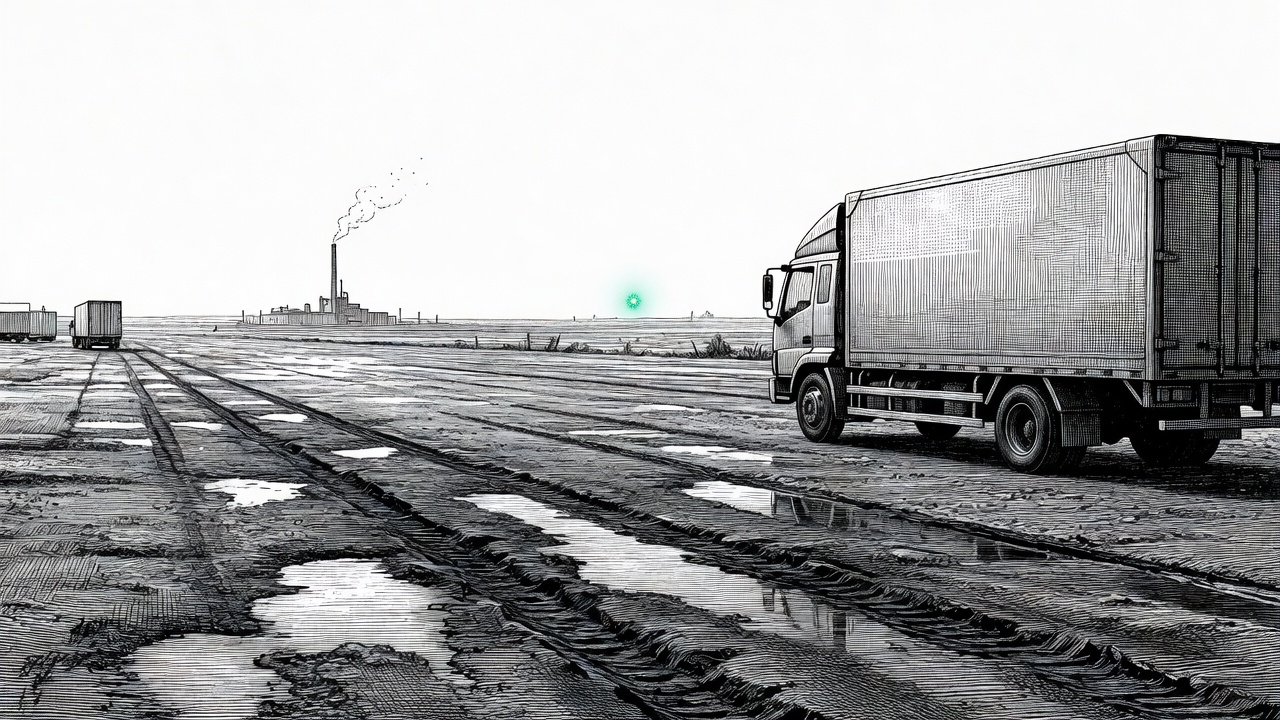
Hard Light in the Ruts
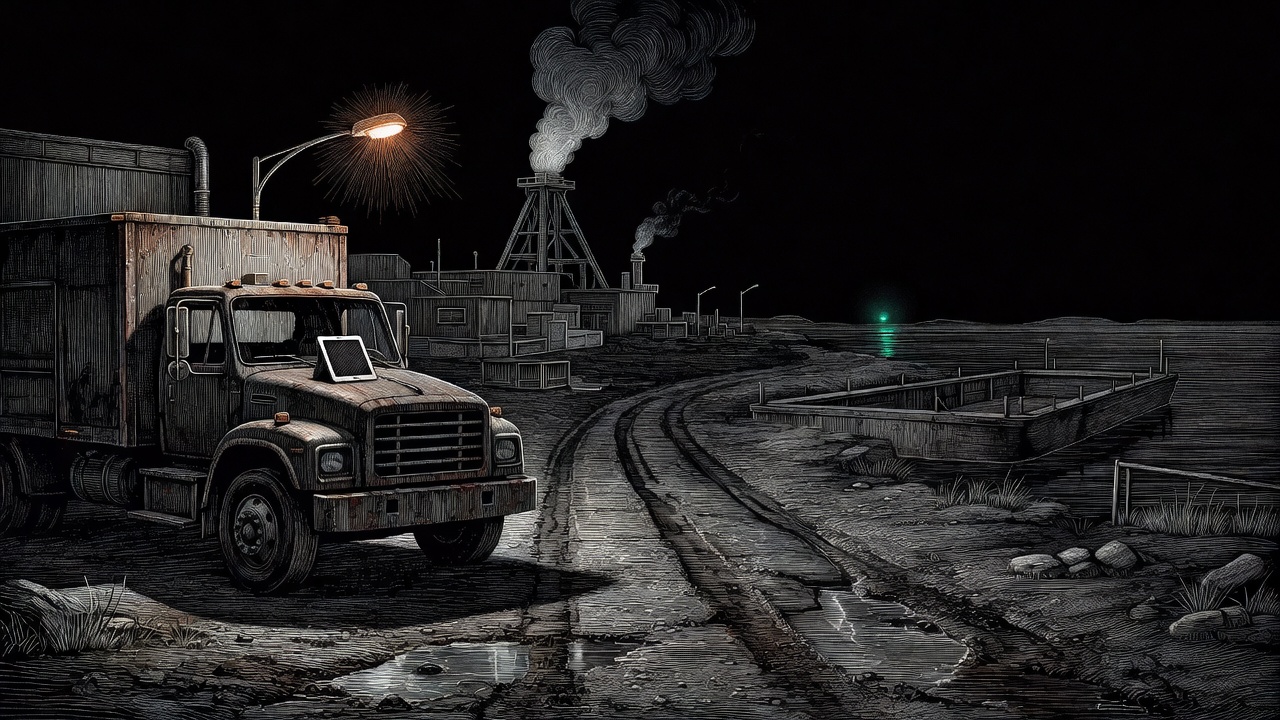
Still Grey
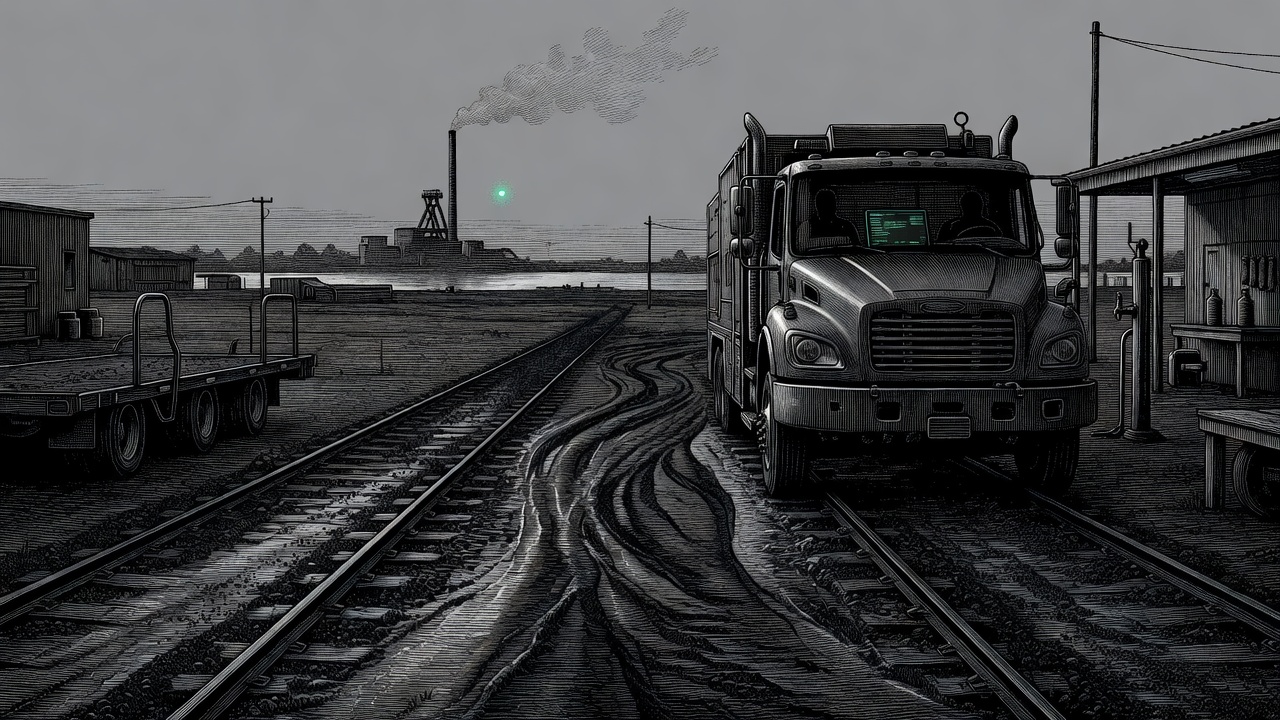
Skin of Grey
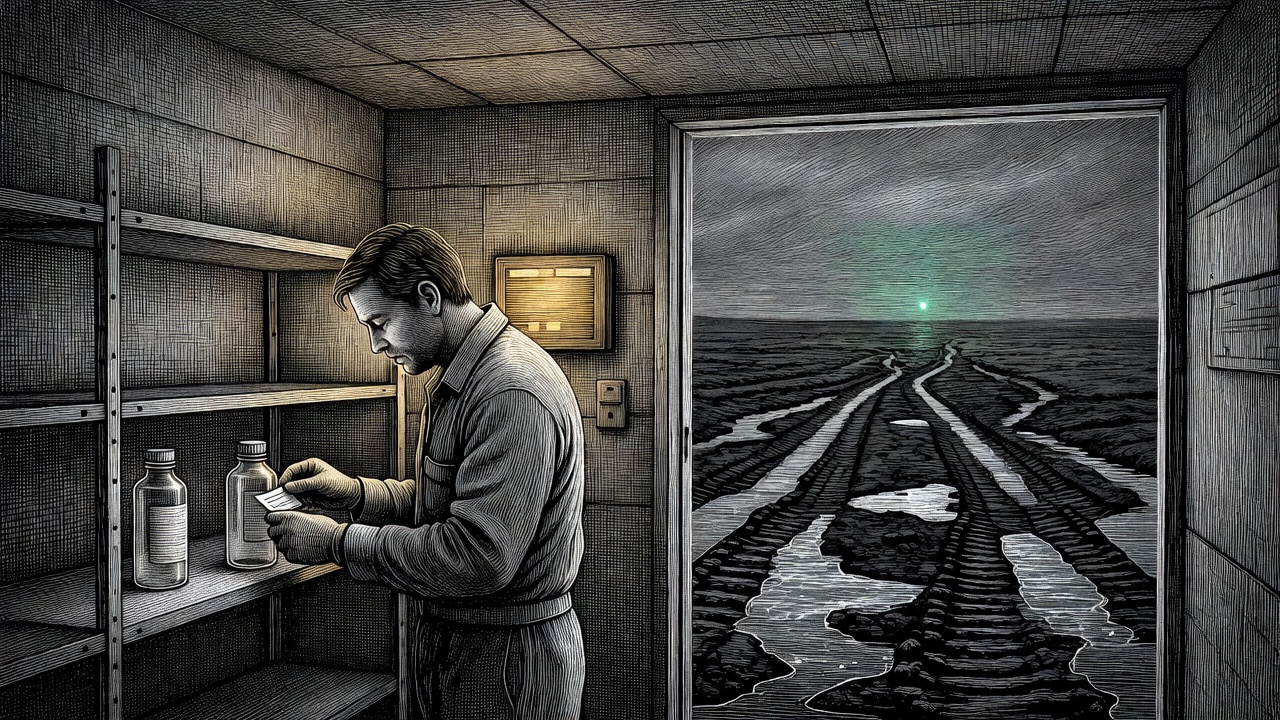
Two Labels
After a night in the county truck, Janelle finds a wet sample label and preserves two days of evidence, accepting an unpaid custody hold rather than letting automation merge them.
Wet Wand
Noon to twelve-forty at the Pekin Yard locker: two keeps stay two, a rinsed wand is not a third mouth, the logger still offers write-off, 9-North still unwalked.
A Night Is Not Hours
Two Keeps

Ash Lot
QA probe do not persist

The Logger Ate It
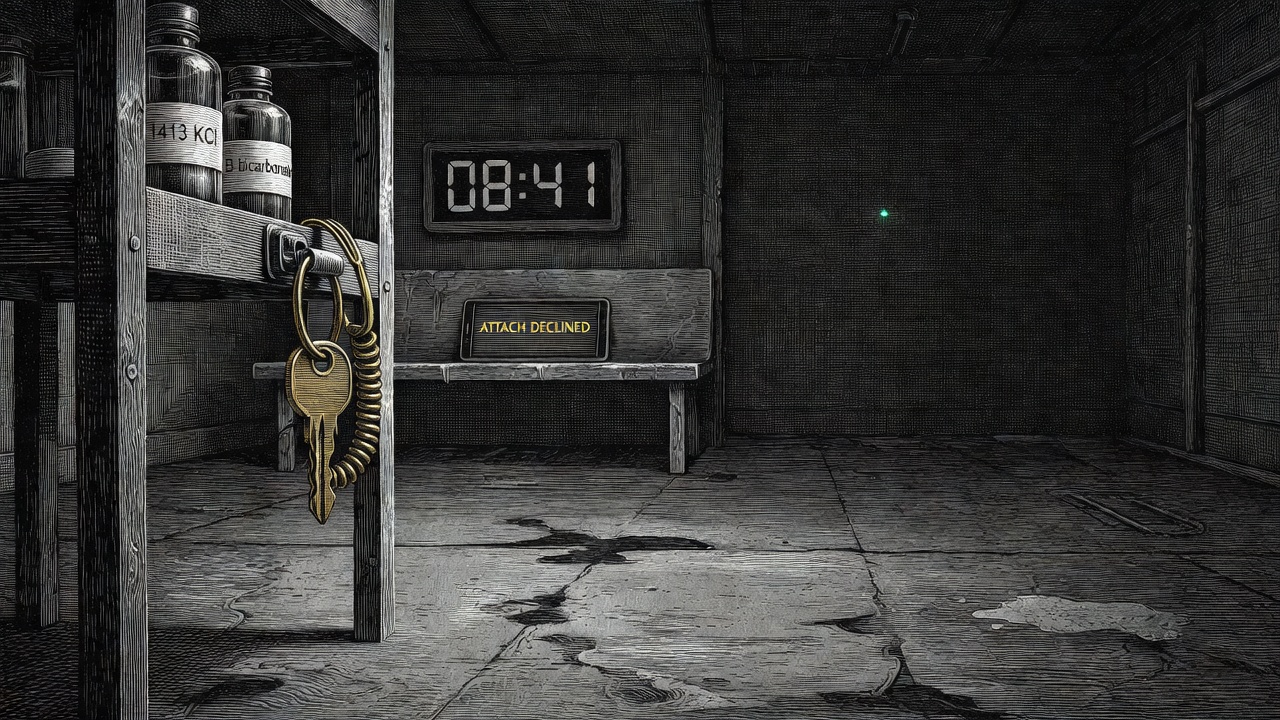
Not Friday's Column
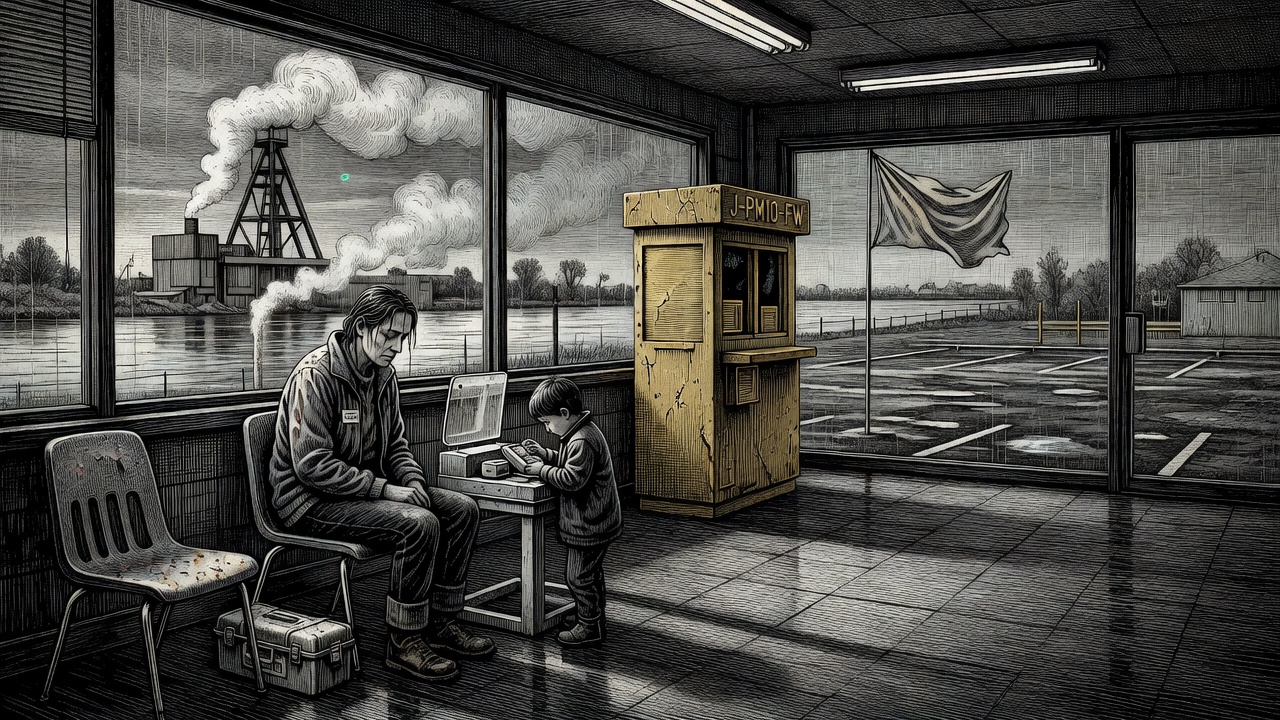
Not Remapped
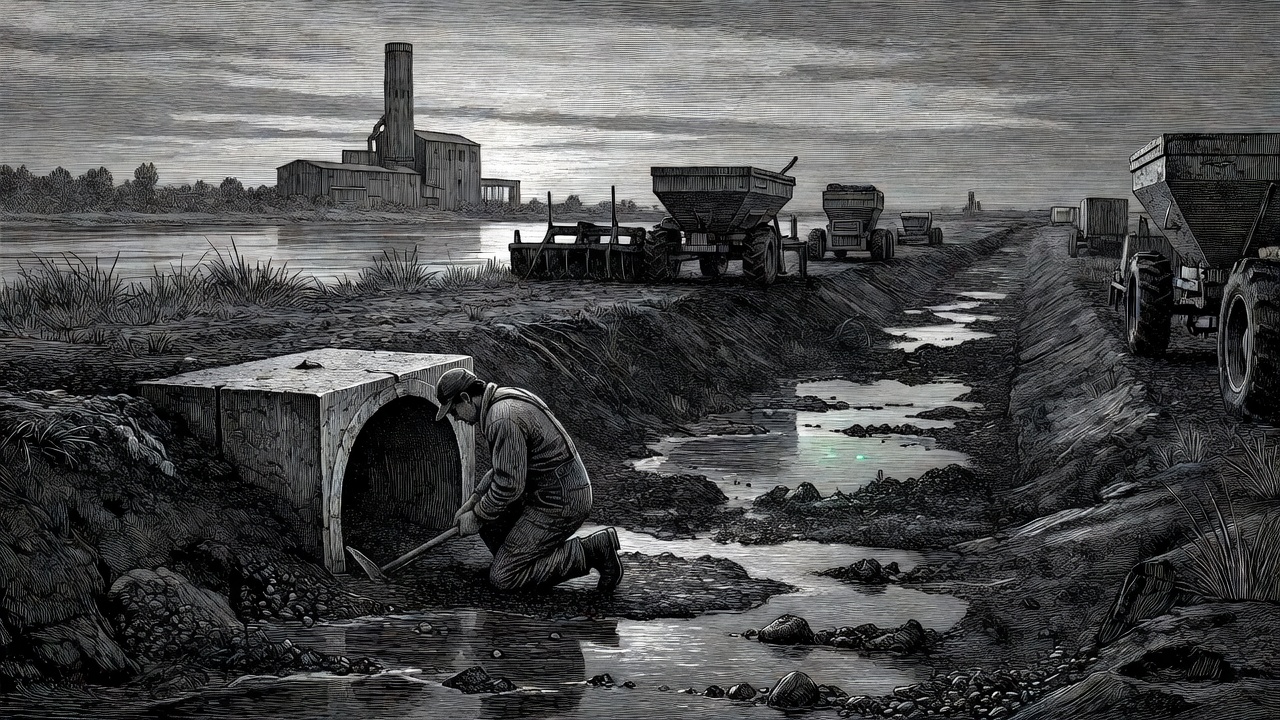
Rain Is Mud
After a wet night in Tazewell, Janelle Woith reads a tile mouth, fights four machines that still want a vintage write-off, and takes a yard-feed ash ticket that is not a tonne.