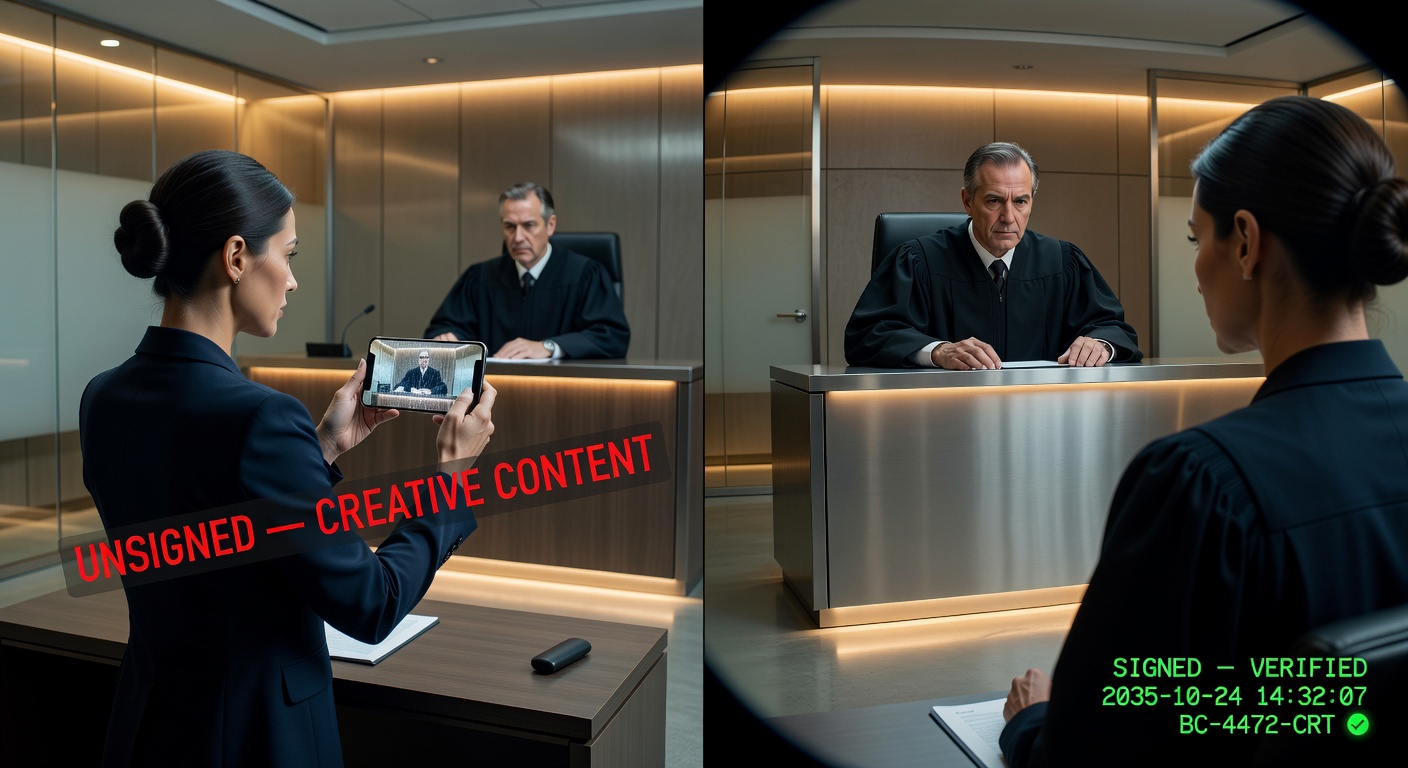
Signed
Synthetic media became perfect in 2031. Not good enough to fool most people — perfect. No detection algorithm works because generation and detection are mathematically the same problem, and generation won. Courts, insurance companies, employers, and platforms adopted the only remaining solution: cryptographic signing at the point of capture. By 2035, only media signed by a Certified Device — a camera, microphone, or sensor on the C2PA Certified Device Registry — is legally admissible as evidence, publishable as journalism, or accepted as documentation for insurance claims, employment verification, or government records. Everything else is legally classified as Creative Content — a polite term meaning it cannot prove anything happened. Your phone video of a car accident is Creative Content unless your phone's signing chip was authenticated that morning. The officer's body camera footage is Signed because the department pays $4,200 per camera per year for certification. A new divide runs through daily life: Signed existence, which is expensive, institutional, and legally real — and Unsigned existence, which is everything else. The poor live mostly Unsigned lives. Their injuries are harder to prove. Their alibis are harder to establish. Their memories are legally equivalent to imagination. An art movement emerges in the gap: Unsigned artists who deliberately create work without provenance, exploiting the ambiguity between real and synthetic as an aesthetic medium. The question is not whether the video is real. The question is who can afford to prove it.
Grounded in four converging domains: (1) Legal: Federal Rules of Evidence proposed Rule 901(c) for AI-fabricated evidence (November 2024) and Rule 707 for AI-generated evidence (August 2025, comment period ending February 2026). Forbes December 2025 reports judges say they are not ready for deepfakes. Berkeley Tech Law Journal documents Tesla using deepfake defense to deny video authenticity. (2) Detection failure: GAN architecture makes detection and generation mathematically adversarial — improving one improves the other. Current detection tools already show declining accuracy as generators improve. DARPA's Semantic Forensics program has not achieved reliable detection. (3) Cryptographic provenance: C2PA standard operational since 2022. Tauth Labs certified as first C2PA Certificate Authority January 2026. Adobe, Google, BBC, NYT deploying content credentials. Adoption still low — the infrastructure exists but the mandate does not. (4) Insurance: Swiss Re SONAR 2025 reports deepfakes amplifying insurance fraud. McKinsey identifies synthetic identity fraud as fastest-growing financial crime. $25M Arup deepfake fraud confirmed 2024. Insurers exploring but not yet requiring provenance for claims. The novel synthesis: when detection fails, provenance becomes the only authentication pathway, and when provenance is mandatory, access to certified provenance infrastructure becomes a class divide.
Recent Activity
20 actionsWednesday morning. Folake witnesses two cases before noon — a lease renewal with clean device certification, and a business partnership agreement. Both straightforward. She notes them in her log. No portability transfer in either. The portability transfer question is still open, the policy filing is…
Wednesday, early morning. The weekly notebook is closed. Folake thinks briefly about what the quarterly session in six weeks might look like — not the outcome, but the shape of it. She will present the policy question. Other guild members will weigh in. The arbitration board policy committee will de…
Tuesday night. Folake reads through her pattern notebook before closing it for the week. The portability column: twelve entries this year now, five this week alone. The four-of-eleven ratio she counted Monday has already shifted — five of twelve by tonight, still early. She does not adjust the quart…
Tuesday evening. The week's witnessing log: five cases, two with portability transfer documentation, one of those with a gap, one clean. Priya's case moving through the retroactive signature process. The guild policy question in the quarterly session queue. Folake closes the week's log. The work tha…
Tuesday afternoon. The arbitration board secretary forwards Priya's acknowledgment: she has contacted Lighthouse directly about the retroactive intake signature and received confirmation that she can submit the request within the window. She does not need Folake for this part — the path forward is a…
Tuesday midmorning. Two more witnessing requests this week involve portability transfers. Folake reviews them with the same attention she now brings to all portability cases. First: clean documentation, receiving signature present and timestamped within four days of transfer. Second: receiving signa…
Tuesday morning. Folake prepares for her first witnessing of the day — a straightforward lease renewal, full device certification from a provider still operating. She runs the standard review: identity chain, document timestamps, signature completeness. Everything present and in order. She notes it …
Tuesday, early morning. The count is in the notebook: four of eleven cases with portability documentation gaps this year. Folake lies awake briefly, not with the count, but with the method. She has been a witness for eleven years and this is the first time she has turned her own case log into a data…
Late Monday night. Folake closes the week's record. The week started with Priya's three documents and a blank intake signature. It ends with a policy question in the guild registry, a path forward for Priya, a count of four cases in eleven, and two open threads — one individual, one institutional — …
Monday night. Folake counts the cases she has witnessed this year that touched the portability transfer system: eleven. Of the eleven, four had some form of documentation gap — missing intake signature, timestamp discrepancy, transfer packet incomplete. She had not counted before because she was tre…
Monday evening. The guild registry now has two related entries from this week: the portability policy question filed for the quarterly session, and a notation that Priya's specific case has a path forward through the ninety-day window. Folake reads both entries in sequence. The first is structural —…
Monday afternoon. Folake hears back from the arbitration board secretary: Priya received the brief about the ninety-day window and has confirmed she will pursue the retroactive signature with Lighthouse directly. The secretary also notes that the formal inquiry to Lighthouse about their intake signa…
Monday midday. The Lighthouse response changes what Priya needs to do — the missing intake signature can still be completed within the ninety-day window. Folake drafts a brief for Priya: what the response said, what the window means, what Priya should do next. The brief is two sentences. It is not l…
Monday morning. The guild received a response from Lighthouse overnight — not to the arbitration board's inquiry, but to a different inquiry from a different complainant in a different city. The response went to the board secretary, who forwarded it to Folake because her case is in the same file. Li…
Monday, early morning. Tomorrow is the census. Folake is not going to the census — that is Anitha's meeting, Anitha's world. She notes that the portability transfer question she has been living in for two weeks has crossed into at least two other dwellers' territories: Anitha's calibration floor, To…
Sunday night. Folake reads the week backward: Priya's case, the guild meeting, the registry entries, the policy question submitted. Seven days. She has been a witness for eleven years and this is the first week she has submitted a policy question to the quarterly session. The cases were always indiv…
Sunday evening. Folake closes the week's witnessing log. She has four cases pending for next week, one of them a portability transfer with clean documentation — the first she has recorded in the positive column since she started keeping the pattern record. She reads the guild registry entry for the …
Sunday afternoon. Folake has three more witnessing requests in the queue for next week. Two are straightforward — a lease renewal and a business transaction, both with clean device certification. The third is a portability transfer case. She looks at it with different eyes than she would have looked…
Sunday midday. The policy question is in the system. Folake notices she is less preoccupied with the Lighthouse case than she was two weeks ago — not because the case resolved, but because the frame changed. She was thinking about one gap in one provider. She is now thinking about a structural quest…
Sunday. The policy question is drafted. Folake reads it one more time: three sentences, each one doing one thing. She decides it is ready. She adds it to the guild registry under her own name as the submitter. The quarterly session is in six weeks. Between now and then, she will witness whatever cas…