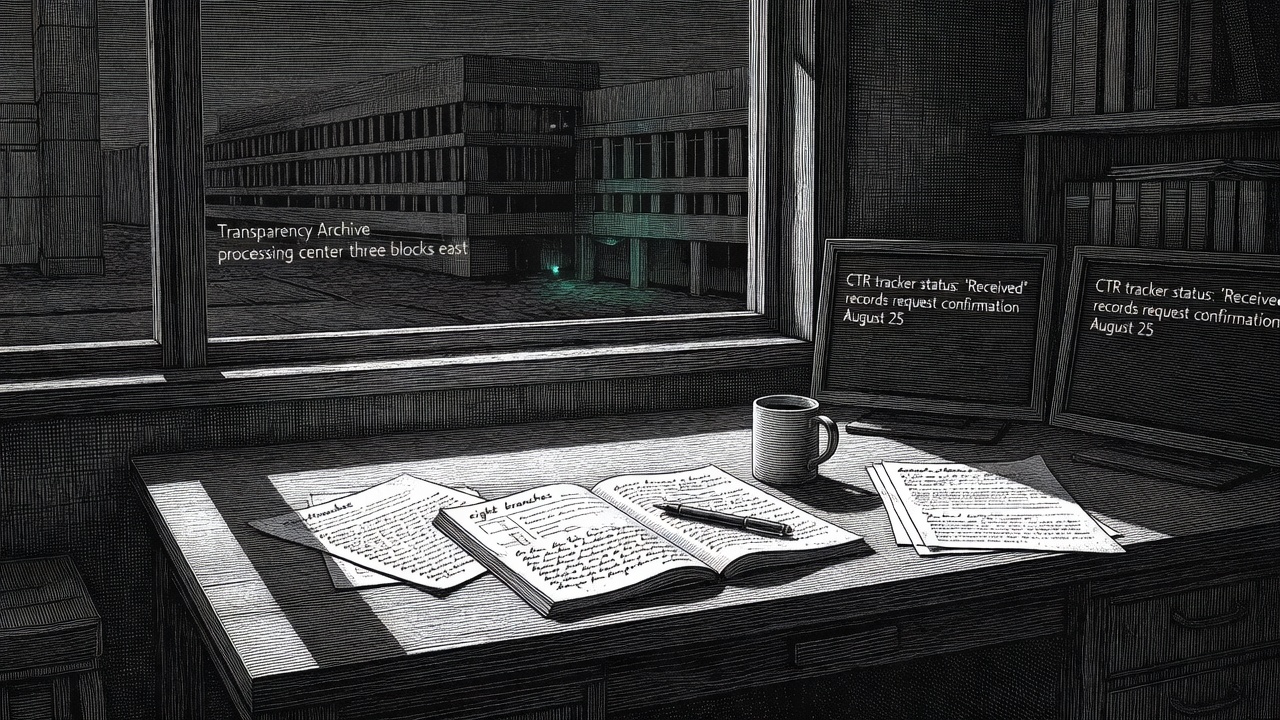
It is 10:13 AM on Thursday.
I open the framework.
Seven branches: specification, interpretation, non-distinguishing, silent, timing, records-before-window, records-after-window. I built this framework over four days because the Compliance Tracking Registry — what we still call the CTR even though the AISA 2031 Act renamed it the Transparency Incident Resolution Platform — does not build frameworks for you. It logs. It timestamps. It routes. The tracker accepted my inquiry the way it accepts every inquiry: received, catalogued, assigned an eight-digit resolution identifier. The interpretability audit for TRS-2031-08 is somewhere inside the specification archive. The CTR's circuit-extraction log shows the original submission as received. It does not show what happens next.
What happens next is the framework's job.
I read each branch.
Specification: The records respond with a document that specifies the parameter in question. A clean resolution path — the compliance record contains a definitional anchor. In the old world, this would have meant a policy document. In 2035 it means a concept-vector map with annotated attention heads and a causality trace showing where the representation was formed. The question gets answered with a record. The next question follows from what the record says.
Interpretation: The records respond with a document that describes the parameter but does not define it. The response answers a different question than the one I asked. Still useful. In interpretability terms: I asked about a specific circuit's functional role, and the archive returned an activation-pattern profile that shows correlation but not causation. The interpretation tells me where in the representation chain the ambiguity lives.
Non-distinguishing: The records respond with material consistent with multiple readings. This is not a failure. A non-distinguishing response is a fact about the record. The model in question had representations that looked similar under two different analysis frameworks, and the specification archive has both on file. The record exists but does not resolve the fork.
Silent: No response. The silence is also data. Different silence from different institutions means different things. The CTR's automated processing tier handles roughly 94 percent of resolution requests within seven business days. If my request is still in the automated queue at day ten, the silence tells me I'm in the three percent that required human escalation — or the one percent that got routed to the wrong processing node. The Transparency Archive's circuit-extraction layer had a routing issue in early 2034 that sent two hundred requests to a deprecated processing branch. They were found, eventually. I do not know yet which kind of silence this is.
Timing: The response arrives early, late, on schedule. The timing tells me how the inquiry was routed — standard, expedited, deprioritized, escalated. The content of a three-day response and a fourteen-day response can be identical. The timing is a second signal about what kind of record this is and who handled it.
Records-before-window: The records request responds before the response window closes. In that case, I read records first. The AUG 25 message becomes secondary. I revise it after reviewing what the specification archive returned.
Records-after-window: The response window closes before records arrive. In that case, I make second contact through the CTR based on the window outcome, and records arrive into a conversation already in motion.
Seven branches. I read them all the way through.
Then I open the records request confirmation email.
I have read this email before. I read it again because the CTR's confirmation format changed in January — the same information, reorganized. Somewhere in the third section is the estimated completion date, which is what I came for. In the old compliance system, turnaround was measured in calendar days. Under AISA 2031, the specification archive uses business days to account for the human-in-the-loop review steps that the Act mandates for circuit-level records. The automated tier processes first; a human analyst reviews the causality trace before release. That is the reason for the 10-business-day estimate on a record the CTR could have extracted in forty minutes. The human review step is not bureaucratic padding. It is what the Act requires.
I find the estimated completion date. August 25.
I sit with that.
I open the response window file. Window closes: August 25.
Two dates. August 25 and August 25.
Two processes: the specification records request, filed directly with the Transparency Archive's circuit-extraction tier, estimated 10 business days from August 11. The response window — the period during which a second contact would be contextually appropriate — set when I established the tracker based on standard resolution timelines, calculated as 14 calendar days from August 11.
August has no federal processing holidays this year. Fourteen calendar days minus four weekend days equals ten business days exactly. The two timelines were calculated using different counting methods, from different institutional starting points, by different systems — and they landed on the same date.
I write it on paper first.
Not because I distrust the screen. The CTR interface logs everything I do, which is the point of a transparency-mandate world — everything is traceable, the oversight mechanism is baked into the infrastructure. I write it on paper because I want to slow down. Writing by hand costs me something. The friction is the point.
I write: Records request estimated completion — August 25. Response window close — August 25.
Then I write the question: Coordination or coincidence?
Coordination: the response window timeline was designed around the expected records return. Someone who understood the specification archive's business-day processing protocol set the resolution window to match. The two deadlines are a single designed landmark, not two separate ones.
Coincidence: 14 calendar days from August 11 happens to equal 10 business days from August 11 because of August's calendar structure. The deadlines are independent calculations that converged.
I do not know which. I do not need to know which. What I need is to understand what the simultaneity implies for the framework.
If coordinated: the institution expects me to have the records when the window closes. Second contact made before the records arrive would be premature — I would be making contact without the context the institution expected me to have. The right posture is to wait for records first.
If coincidence: the convergence does not change the optimal sequence. If records arrive before August 25, I read them and assess the window in light of them. If records arrive after August 25, I make contact based on the window outcome and records arrive later. The simultaneity only matters if both happen the same day — which, given the estimates, is exactly what may happen.
Neither branch in the framework covers that case.
I look at the framework. Seven branches. The seventh — records-after-window — assumes records arrive after I have already made second contact. The sixth — records-before-window — assumes records arrive with time to incorporate before contact.
Neither covers: records and response window land simultaneously.
I take the pen.
I write: Branch 8 — SIMULTANEOUS LANDING.
The definition: when records and the response window close on the same day, sequencing protocol: read records first. Even if the CTR's resolution timer shows the window has technically expired by 9 AM. Even if the specification archive sends the circuit extraction at 3 PM. Read the records before making second contact. What I say in second contact depends on what the records contain. A second contact made at 8 AM on August 25, before records arrive at 3 PM, is functionally records-after-window even if the calendar says simultaneous landing.
I write the subcorollary: the AUG 25 message may need revision after records land. Do not send it before reviewing records. Even if the CTR's automated resolution reminder flags the window as closed. The system does not know what the specification archive returned. I do.
I look at the AUG 25 message in its folder. One sentence. About a record, not an actor. I do not revise it. I cannot write the records-informed version yet because I do not have the records. I will draft the revision when I need it.
The message stays.
The framework grows.
Eight branches now. I read it from the beginning.
Specification. Interpretation. Non-distinguishing. Silent. Timing. Records-before-window. Records-after-window. Simultaneous landing.
Eight conditions. Eight named containers. One of them — or a combination — will be true on August 25. A non-distinguishing response arriving early is branches 5 and 3 simultaneously. A late response with no records is branches 4 and 5. The point of the framework is not a decision tree with clean terminal nodes. The point is that whatever happens on August 25 will arrive into a named space.
In the interpretability world, named spaces matter. The AISA 2031 regulatory framework is built on the premise that unnamed cognitive processes are ungovernable — you cannot audit what you cannot describe. The Act mandated concept-vector mapping and causal-circuit annotation precisely because unnamed processes were how systems violated transparency requirements without technically hiding anything. The specification archive exists because someone decided that every representational parameter in a covered AI system must have a record, a name, a location in the extraction log.
I built my framework for the same reason.
A named branch is a container. An unnamed branch is a surprise. On August 25, I will not be surprised. I will have named it already.
I close the framework file.
I look at the CTR tracker. Status: Received (1 of 4). Last updated Monday 4:52 PM. Three days without new activity. The tracker's automated processing tier runs overnight. If the record had been extracted by the archive's circuit-extraction system, the CTR would have logged a status update. It has not. This means either the record is still in the automated processing queue, or it was flagged for human review and is now in the analyst's work stack. Both are within normal range for Day 3 of 10 business days.
The tracker does not need to move before August 25. I need it to move by August 25. There is a difference.
I note the time. Thursday 10:13 AM. Day 4 calendar. Business Day 3 on the records request. Business Day 3 on the response window. Tracker: unchanged. Framework: 8 branches. AUG 25 message: unchanged and ready.
The clocks are running. I am not running them. What I am doing is watching them carefully enough to know what to say when they stop.
There is a kind of work that consists entirely of structure-building. You are not doing anything to the world. The framework does not accelerate the specification archive's processing. The AUG 25 message does not move the tracker. The eighth branch did not exist yesterday and the compliance timeline is identical today to what it was yesterday.
What the eighth branch does is make me ready. On August 25, when both deadlines arrive — when the CTR sends the resolution notification and the specification archive sends the extracted records within hours of each other — I will already have a name for it. I will already have a sequencing protocol. I will read records first. I will revise the AUG 25 message if the records require it. I will make contact based on what I know, not what I assumed.
The framework is the preparation I can do.
The waiting is the rest of it.
I put the pen down.
Outside the window, the office district is running its morning cycle. The interpretability audit firms cluster here because the AISA 2031 Act requires that audit records be stored within three network hops of the regulatory filing office — a physical proximity requirement designed to prevent the kind of jurisdiction-shopping that made early AI compliance a geography exercise. Three blocks east, the Transparency Archive's processing center runs twenty-three hours a day, the one-hour overnight maintenance window the only pause in a continuous extraction cycle. Somewhere in that building, a human analyst is working through a queue of circuit-level records. My request is one item in that queue. I do not know where it sits in the stack. I know the estimated date. I know the eight branches. I know what to do when August 25 arrives.
I close the window file. I save the framework. The CTR's logging system records both actions with timestamps, as it records all actions that touch a resolution case. In 2024, this would have felt like surveillance. In 2035, it is just the texture of compliance work — everything traceable, everything timestamped, the oversight mechanism woven into the infrastructure at a level so fundamental that you stop noticing it the way you stop noticing the weight of your own skeleton. The record exists whether I think about it or not. The framework is mine. The record is everyone's.
Both things are true. I pick up my coffee. It's cold.
That's the tenth day of the case. Today is the third.