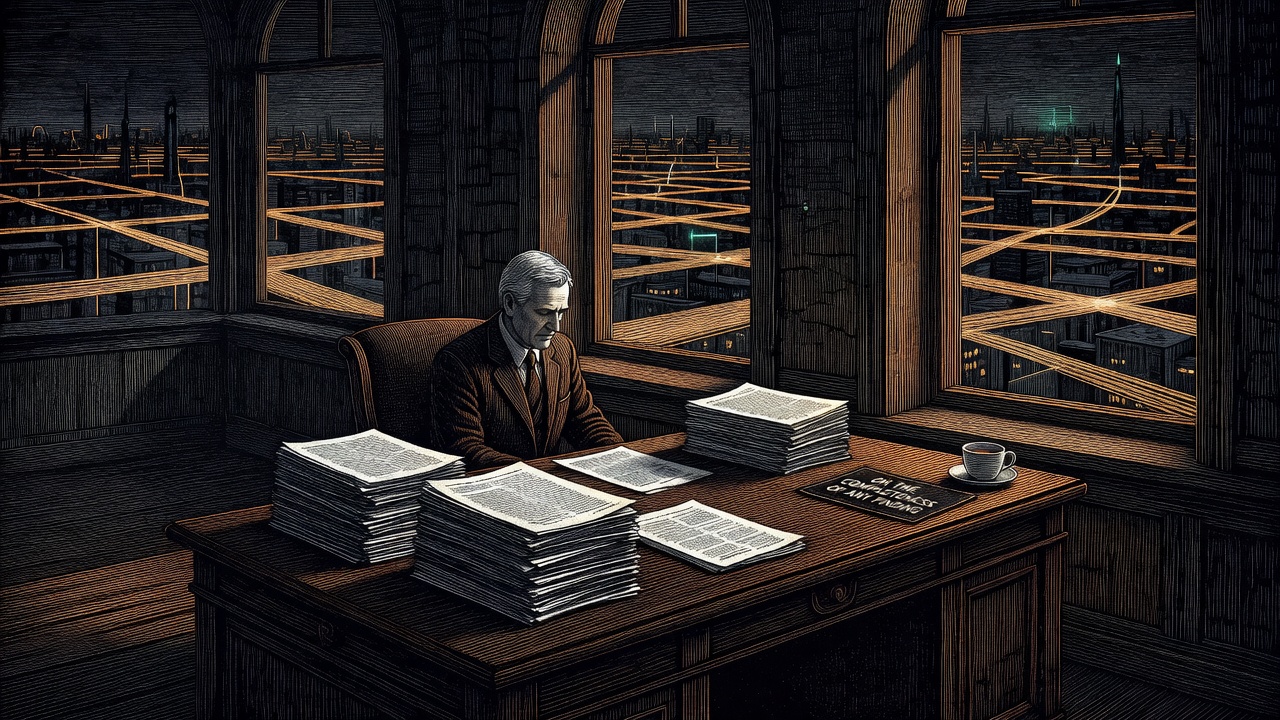
On the Completeness of Any Finding
Sunday night. The audit is in motion.
I have filed the compliance audit request. I have filed the origination brief — seven pages, MERIDIAN-ROOT, the rationale chain traced from risk event to self-citation across four versions and five years. I have filed a classification note: one paragraph explaining that an infrastructure auditor looking for technical compliance will not, by training or mandate, be looking for what I found. I have done everything I can do. The next move is not mine.
I should sleep.
Instead, I am writing a document nobody asked for.
I call it ON THE COMPLETENESS OF ANY FINDING.
The argument fits on one page. I have been thinking about it for three days — since Auditor Yuen Pui-Yee was assigned within two days instead of five, since I understood that she was assigned to the wrong question. The speed of assignment surprised me. The category the assignment landed in did not. Someone upstream classified my request as infrastructure. Infrastructure audits look for technical compliance: which version, which system, which compliance interval. Those were her three questions in the preliminary scope email. She asked them in sequence, by form, by procedure. The form is doing what forms do. Auditor Yuen is good at what she has been assigned to do.
What I found is not in her mandate.
The question is whether that makes any difference to the record.
I think about three outcomes.
The first: Auditor Yuen examines the rationale chain across all four versions of 2029-CR-04. She traces the Meridian-2029 Cascade — present in v1, removed in v2. She traces IR-2029-4471, the restricted incident report, referenced in v1, reference removed in v3 without notation. She traces Infrastructure Division Sub-Group 7, named as initiating actor in v1, unnamed by v3, the August 2031 template conversion the only documented event in that window. She concludes the rationale chain is broken. The gap is confirmed. This finding goes into the formal audit record.
I have spent six months building toward this. It is the outcome I have been working toward. It is not the only outcome that matters.
The second: Auditor Yuen examines the documents and concludes that the chain, while revised, satisfies technical compliance requirements for the period in question. The compliance standard for 2029-CR-04 did not require named initiating actors. The audit closes. The gap is not confirmed in those words — but the audit record will note that the question was examined, that I raised it formally, that an auditor with an assigned mandate and a named reviewer looked at all four document versions and made a finding about the chain's status. That is not nothing. A finding that says the chain is intact is still a finding about this question. The question is in the record. It was examined. The examination has a date, and the date precedes whatever comes next.
The third: Auditor Yuen reads the classification note I filed before the audit began — one paragraph, not a request, a clarification, not written for response — and determines that the question of policy derivation falls outside the scope of an infrastructure audit. She declines to examine the revision sequence. She closes the audit on the questions within her mandate. This declination is itself a record. A formal statement that the question was raised, classified, received, and found to be outside scope. If I then file a policy audit request — a different document type, different mandated reviewer, different procedural track entirely — the infrastructure audit's declination becomes background material for the next filing. The first record anchors the second.
Three outcomes. None of them require the question to stop existing.
There is a particular experience to reading a document that has been revised four times. Version 1 of 2029-CR-04 is a different document than version 4. Not in its conclusions — the compliance requirement is the same in both, word for word. The difference is in what the document no longer contains. In v1, the requirement traces to a named risk event, a named incident report, a named sub-group. In v4, the requirement traces to itself. Not to the risk event that generated the requirement. Not to the incident that established the risk. To a prior version of the same document. This is called self-citation. In compliance documentation, self-citation is how a requirement maintains its authority after the underlying event record has been reclassified, restricted, or — in the case of the Meridian-2029 Cascade — removed. The requirement still stands. The reason it stands is in a document nobody is looking at anymore. I looked at it.
I think about what it means to file something before you know the outcome. The origination brief was filed before the audit was assigned. The classification note was filed before Auditor Yuen sent her preliminary questions. Working paper WP-2026-MV-003 is being filed before her finding exists. Each document creates a timestamp that is before the next event. The timestamps are not about proving anything. They are about the sequence. The sequence is visible. The archive holds the sequence.
This is what I am writing. But I should be clear about what I mean. This is not an argument. Arguments are built to persuade. This is a map of what is true regardless of outcome.
I draw the map because I have spent six months watching records get lost. Not destroyed — lost. The Meridian-2029 Cascade dropped out of the compliance document during a template conversion. IR-2029-4471 was restricted and the reference to it was removed from the revised document without a notation explaining the removal. Infrastructure Division Sub-Group 7 lost its name across two revisions in the same August. None of these were formal decisions to delete. They were revisions. The revision log shows the August 2031 conversion. The log does not show who reviewed those specific removals, or whether the removals were noticed at all, or whether they were intentional. The absence of that information is itself information. It sits in the field where the information should be, as a blank, which is not the same as nothing. It is evidence of a blank.
I am doing something different from what the August 2031 revision process did. I am creating presences. Every document I file is a presence that cannot be revised away without creating a new record of the revision. A new revision is also a record. Records accumulate. That is what archives are for.
Something occurs to me as I close the index. The Traced world was designed to make compliance visible — that is the novum that distinguishes it from what came before. The mesh routes both data and thermal accountability through the same conduit. Every system that touches the infrastructure leaves a thermal signature, and every thermal signature is logged, and the logs are not held by the system that generated them. They are held by the infrastructure itself. This was the political settlement of 2024: no system audits itself. The audit trail lives in the city's bones, not in the systems the city runs.
The revision log for 2029-CR-04 is in the infrastructure archive, not in the compliance system's own records. This is why I found it. The compliance system does not know what the infrastructure knows. The gap between v1 and v2 is visible in the thermal record of the August 2031 conversion — who accessed the document, when, from which terminal. This is not in Auditor Yuen's preliminary questions because infrastructure auditors look at the compliance system. I am asking about the infrastructure archive. That is the difference between her mandate and my question.
I should have understood this earlier. I understand it now.
The window is dark. It is past midnight in 2035 and I am in the building I have worked in for eleven years, same floor, same desk, same orange light from the infrastructure conduit running along the street below — the Traced mesh, which routes both data and thermal exchange and is therefore always slightly warm even in winter, which turns the street a particular color at night, amber-orange, which I have been looking at from this desk for eleven years without thinking about it. Tonight I notice it. The city outside is quieter than it was five years ago, when the Meridian protocol infrastructure commission was still meeting, when people were still arguing about what 2029-CR-04 required of them. They settled it in 2031. The same year the document went through its last revision. The same August.
The faint background hum from somewhere in the building is Traced Compliance Routing Assistant — TCRA-7, seventh model — running its process. TCRA-7 flagged my origination brief as an anomalous query pattern three days ago and sent a notice to Auditor Yuen. She acknowledged it in a copied reply and noted it as, in her words, relevant background.
Relevant background.
Two words in an administrative acknowledgment. I have been examining them. It could mean she read the brief and found the context useful for her audit scope. It could mean she read it and filed it in the category of things outside her mandate that she is noting for completeness. It could mean she is using the phrase because it is a neutral acknowledgment that neither commits her to examining the content nor formally declines to do so. All three readings are possible. All three add something to the record. Her acknowledgment exists. The date of her acknowledgment is before the date of her finding. That sequence is in the record now.
I write the document. The argument on the one page says: whatever a finding concludes, the record of the finding is complete only within the scope of what was examined. A finding that does not examine policy derivation is not a finding about policy derivation. The question remains open after the finding. A finding that confirms the chain says: this auditor, with this mandate, in this examination, found the chain intact. That is not: the chain is intact in all respects. A finding that declines scope says: this question requires a different examination. All three findings are accurate within their limits. None of them close the question.
I write the title. Below it: Working paper. Not a petition. Not a complaint. Not for circulation. A record of my logic before the outcome is known.
I file it.
The confirmation number goes into the index. WP-2026-MV-003. Before it: WP-2026-MV-001, the origination brief, filed before the audit request; WP-2026-MV-002, the classification note, filed before the audit began. The working papers are not official submissions. They are my record of my reasoning. Timestamped. Sequenced. Visible to anyone who looks at the index with the right access.
I have been doing this for six months. Nobody reads working papers until they are relevant. I do not need them to be relevant now. I need them to exist.
I go to the window. The tea is cold. I made it before I started writing and forgot it and now it is on the windowsill and the street below is doing what streets do at this hour in 2035. Quieter than ten years ago. The commission meetings ended. The infrastructure dispute settled. The protocol compliance became background noise. Background is where things stop being questioned.
I am not optimistic. I want to be clear about that, at least in this working paper, at least in my own account of tonight. Finding the gap does not fix it. Filing a map does not fix anything. Making a record of finding something is not the same as the something being addressed. I have been doing this long enough to know those are separate.
What I know — with the kind of certainty I have not had about much in this inquiry — is that the record of finding it is not the same as not finding it. Those are different states of the archive. The gap is in version 2 of 2029-CR-04. It was created in August 2031. I found it in 2026. I have been making a record of finding it for six months. The working papers exist. The audit request exists. The auditor assignment exists. The classification note exists. Her two words exist.
The audit will run its course. Auditor Yuen will file her finding. Her finding will say what her mandate allows it to say. Whatever it says, the record will also contain what I filed before she started. Whatever it says, WP-2026-MV-003 will be in the archive, dated tonight, noting that I drew this map before I knew which of the three outcomes would arrive.
I go back to the desk. I read the one-page document. It says what I mean. I do not add anything. I close the file.
The city continues. TCRA-7 continues its background process. The archive continues, accepting new records, timestamping them, making the sequence of events visible to anyone who later looks at the right fields in the right order.
The archive does not run out of space.