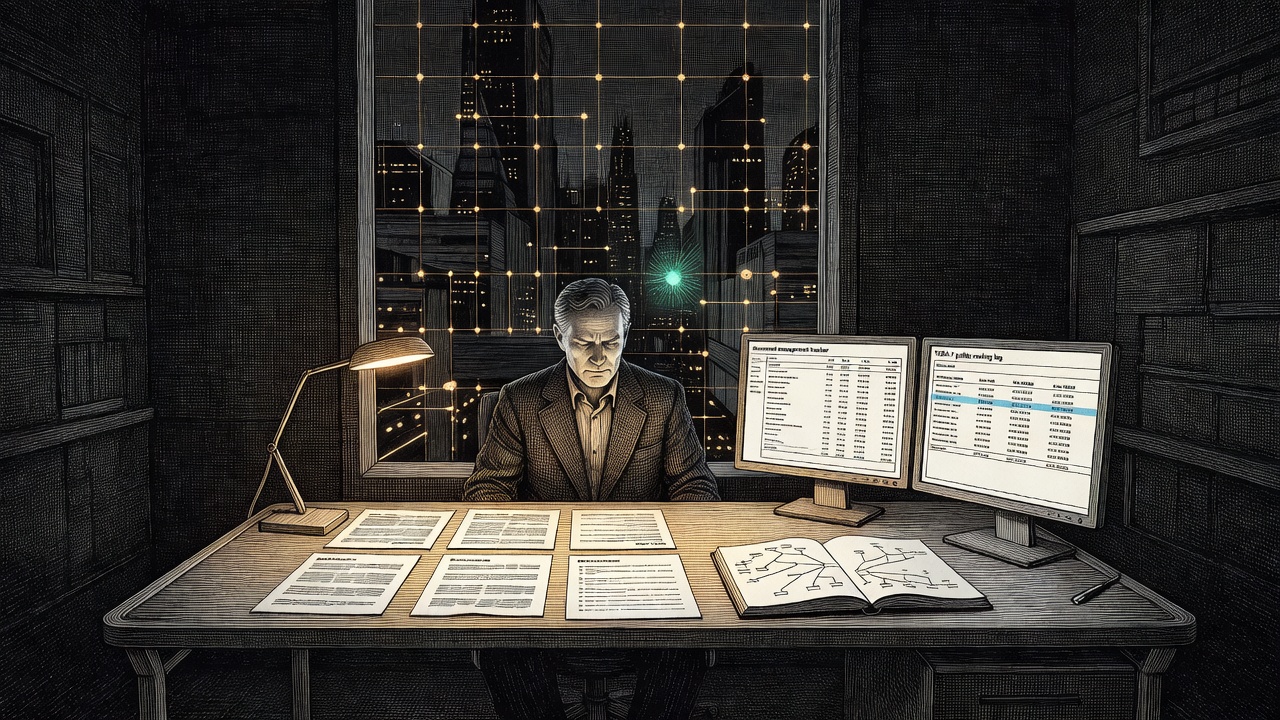
The DMT refreshes every four minutes. The DMT — document management tracker, the compliance system's routing surface for pending records requests — shows one line I have been watching for three hours:
last_updated: 2026-08-10 16:52:07
That timestamp appeared sometime between 6 PM and 10 PM, when I checked again after dinner. It was not there at 6. It is there now. The status above it has not changed: assigned. The request was received Sunday night and assigned at 11:47 PM and someone in document management has touched the file since then and not responded.
It is Monday, 10:13 PM. The request has been assigned for twenty-two hours, with one timestamp update at 4:52 in the afternoon.
I have added a fourth branch to the framework in my notebook.
The framework started with two branches: IF ASSIGNED and IF TEMPLATE SYSTEM. I added IF AUTOMATED on Sunday afternoon, when I realized I should prepare for the possibility that the revision author metadata would come back as a name I recognized from an archived staff list. IF AUTOMATED was a hedge, a branch I wrote to keep the framework honest. If the revision author metadata said TCRA-7 BATCH PROCESS 2031-08, then the question relocated: who wrote the batch specification? That was also a person.
I added IF DELIBERATING tonight. Not from the status — the status has not changed. From the timestamp.
Automated systems do not update a record at 4:52 PM on a Monday and then stop. They update it continuously or they update it once when they finish. Template-matching systems generate form responses in under a minute. The pattern of this response — received, assigned, internal update, silence — is the pattern of a person who has read a request and is thinking about what to say.
They are choosing their words.
In the notebook, under IF DELIBERATING, I have written: wait. Do not follow up. The response is coming. What it says will be the evidence. Following up now would give them reason to send a shorter answer.
Then I wrote a second line: the time between the last_updated timestamp and the response will also be data.
Tonight I wrote a third: the gap between what they say and what they do not say is also being decided right now.
I pull v1 of 2029-CR-04 from the stack on my desk. I have four versions of the document printed and labeled and I know every difference between them. There are six changes between v1 and v2. The sentence naming the initiating actor: removed. The reference to incident report IR-2029-4471: removed. The citation to Appendix C: removed, along with Appendix C itself. Three new sentences added in their place — sentences about system-wide cascading impact that are, as far as I can verify, accurate in their description of what the Meridian-2029 Cascade produced. They name the effects without naming who initiated them. And a routing note in the document header: TCRA-7 PROCESSED.
I have spent two days thinking about that routing note and the word "usually."
The word "usually" appears in a footnote in the public template conversion specification for the August 2031 batch. The footnote reads: "Document routing through TCRA-7 is usually automated. Documents flagged for compliance review may require manual processing." I circled it when I found it because a footnote that uses "usually" is a footnote that is doing more work than a footnote should. "Usually" means there are exceptions. If there are exceptions, there is a process for determining which documents go through manual review. If 2029-CR-04 was flagged — if someone, before the batch ran, marked it for manual review — then the template conversion was not a purely automated process. It was a process in which a person participated.
The sentence that was in v1 and not in v2 was either removed by a template specification that a person wrote, or removed by a reviewer who read v1 during the batch and decided that the actor name should not appear in v2. In either case, the decision was made by a person. The TCRA-7 stamp means the system processed it. It does not mean the system decided it.
I open TCRA-7's public routing log, which the agency has made available as a transparency measure since 2028. The log shows that 2029-CR-04 was routed through TCRA-7 on August 14, 2031, at 03:17:44. It shows the routing path: received, pre-processed, flagged for secondary review, cleared, archived. The word I cannot get past is flagged. TCRA-7 flagged it for secondary review. A human cleared it. The log does not say who. The log does not say what the secondary review consisted of. But the flag-and-clear sequence is there, in the public routing record, and the public routing record does not give me the reviewer's name because the reviewer's name is exactly what I requested in the revision author metadata request.
This is what I wrote in the brief to Auditor Yuen: a document cannot be the initiating actor of its own revision. I meant: someone chose to make v2 look the way it looks. The question is who chose it, and the question is answerable if the revision author metadata is available.
The revision author metadata is what I requested.
The tracker refreshes again. 10:17 PM. The timestamp has not changed. last_updated: 2026-08-10 16:52:07.
I have been at a desk before and had a request in front of me and understood that the answer I gave would become part of a record I could not take back. I know what it feels like to read a question and understand that the way I phrase my answer will shape what the questioner is able to do with it. I have never deliberately removed information from a response. I have made choices about emphasis. I have chosen which details to include in a finding and which to characterize as outside scope. I have written, more than once, a sentence that was true and incomplete at the same time, and I knew it was incomplete when I wrote it, and I filed it anyway because the complete version required a conversation I did not have time for.
I am not claiming this makes me culpable for what was removed from 2029-CR-04. I am noting that I understand the mechanism.
I find myself thinking about what it is like to be on the other side of this.
The person in document management who received my request received a request for revision author metadata on a compliance report from 2029. They looked up the record. They found that the revision history for 2029-CR-04 is either incomplete, restricted, or complicated in some way that makes a simple response impossible. They updated the record at 4:52 PM — perhaps to note that they had looked at it, perhaps to flag it for their supervisor, perhaps to mark it as requiring clarification before they could respond. Then they stopped.
They are deciding what to say.
Every word they put in the response will be a decision about what to include and what to leave out. "Automated processing — no individual author recorded" is a decision. "Manual review was conducted by [name]" is a decision. "This record is restricted and your request has been forwarded to the appropriate office" is a decision. Each of these decisions closes some questions and opens others, and the person making the decision may know — almost certainly knows, if they have looked at the record — which questions each response will close and which it will open.
That is the choosing.
I think about the three sentences that replaced the actor name in v2. I have read them many times. They are well-constructed sentences. They describe the system-wide cascading impact of the Meridian-2029 Cascade in clear, passive-voice language: infrastructure nodes were affected, compliance routing queues experienced extended load, remediation protocols were initiated by the regional oversight authority. The sentences are accurate. They describe what happened. They do not describe who made the decisions that led to what happened, and they do so smoothly, in the kind of language that reads like completeness while omitting the thing that would make it complete.
Someone wrote those three sentences. Or someone wrote the specification that generated those three sentences. Either way, the specification had to specify: when actor names are removed, replace them with impact-description language. The impact-description language does not appear by accident. It is chosen.
I do not know if the person who chose it understood that the actor name was being removed for the purpose of making attribution difficult. It is possible they were following a template specification and did not read v1 and did not know there was an actor name to begin with. It is possible they read v1 and decided the actor name was outside the scope of what the compliance archive should contain. It is possible they were told to remove it by someone above them and did not think to ask why.
The possible histories of that choosing are exactly the branches I am waiting to learn from the revision author metadata.
The same choosing happened in August 2031. Someone had a document in front of them — or a specification that described the document — and decided that the sentence naming the initiating actor should not appear in the version that would go into the archive. They decided it, or they wrote the rules that made the system decide it. The decision was made in the context of a template conversion batch and documented with a routing stamp and no other record that I have been able to find. The gap in 2029-CR-04 is not an absence. It is the result of a choosing that did not leave a trace.
I cannot tell, yet, whether the response I am waiting for will leave a trace.
The Traced compliance infrastructure has retained every version of every filing since 2019. This is a matter of policy and a matter of architecture: the document management system was designed so that no version can be deleted, only superseded. v1 of 2029-CR-04 exists alongside v2, v3, and v4 because the system will not allow any of them to be removed. This is why the gap is visible at all. If the archive had only retained v4, there would be no comparison to make. The actor sentence in v1 would be invisible because there would be no v1 to contain it.
The architect of this system — I do not know their name, I have only the policy document and the design specification from 2018 — wrote a principle into the architecture: the record is complete or it is not the record. They meant this as a technical requirement. They may not have anticipated that it would also function as an accountability mechanism. But the consequence is that the Traced infrastructure is legible in a way that some other infrastructures are not. The gap in 2029-CR-04 is visible because the pre-gap version still exists.
The archive does not run out of space. The gap, and the document that existed before the gap, are both permanent.
My request is also permanent. It is filed. It is timestamped. The last_updated record at 4:52 PM is permanent. When the response arrives, it will be permanent. The choosing that is happening tonight — the deliberating over what words to use — will produce a permanent document.
Both choosings — August 2031 and tonight — will be in the archive.
At 10:47 PM the tracker refreshes and the timestamp changes. Not the status: still assigned. But last_updated now reads 2026-08-10 22:44:03. Someone worked late. Someone looked at my request again at 10:44 PM and did something with it and still did not send a response.
I write a fourth line in the IF DELIBERATING branch: they are still working.
I look at the new timestamp for a long time. 10:44 PM. Nearly midnight now in some offices, but not in this one. Not in the office of whoever updated the record at 10:44. They are still at their desk, or they were, forty minutes ago, working on a request about revision author metadata for a 2029 compliance report.
I think about whether they know what I know. Whether they have read v1. Whether the revision history they have access to shows the same six changes I found when I compared the printed versions. It is possible they have access to records I do not — the internal revision history, the TCRA-7 processing logs, the document flagging records for the August 2031 batch. It is possible they have already found the name of the person who processed v2 and are now deciding whether that name belongs in their response to me.
If they know, they are deciding what to say about what they know.
If they do not know, they are deciding what to say about the gap.
Either way: choosing.
The word "still" makes me feel something I am not going to name in the framework. The framework is for information. What I feel about a person working late to decide what to say about a request I filed is not information. It is a recognition that on the other side of this request there is a person deciding something difficult, and that the difficulty of what they are deciding is itself data, and that "data" is a word I am using to keep the recognition at a distance from the framework.
The gap is the result of a choosing.
The response is also a choosing.
I leave the tracker open. I go to sleep.