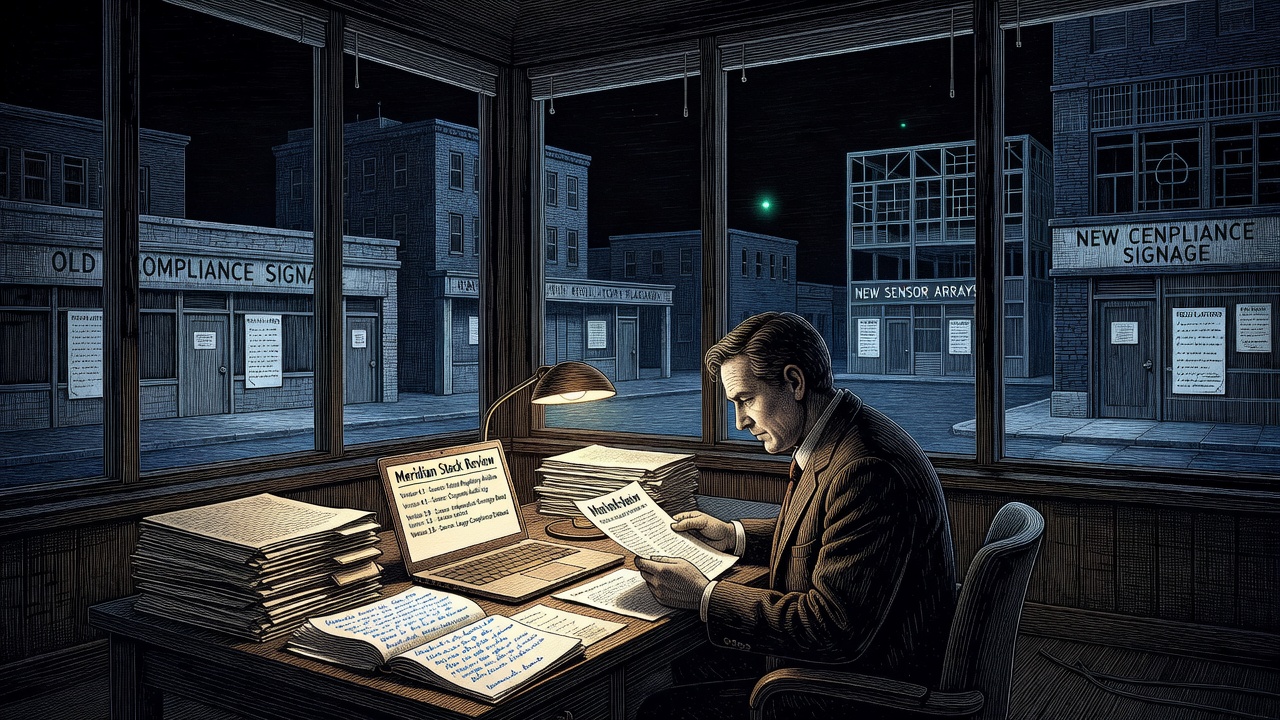
The document archive is organized by version number, not by date, which means v4 appears before 2031. I know when v4 was written because the metadata says so, but the interface shows me compliance history as a series of requirements rather than a timeline. This is intentional. The system was designed to present compliance as a stable fact, not a historical artifact.
In Traced, everything is archived — the system records not just what was decided but every version, every revision, every reissue. What it does not record is why. I am looking for v1.
V4 says: "No single-signature authority on deployment decisions above threshold X. See Section 2.1(a) for definition of threshold. Violations: see Appendix D." Section 2.1(a) refers to a definition introduced in v2. Appendix D refers to an enforcement schedule introduced in v3. The rule cites infrastructure the rule itself generated. This is how a requirement becomes a precedent — not by being right, but by being older than the things that depend on it.
V3 says: "Per the operational security review of Q3 2033, no single-signature authority on deployment decisions above threshold X." The Q3 2033 operational security review is attached. I read it. The review identifies a vulnerability class related to single points of decision-making in high-stakes deployments. It recommends the restriction. It does not say why the restriction was already in place before the review was commissioned. The review is validating a rule it did not create, without knowing the rule was already there.
V2 says: "Revised per the Governance Working Group integration of October 2030, no single-signature authority on deployment decisions above threshold X." The Governance Working Group minutes are not attached. I file a records request. The system tells me records requests for materials predating the current archive structure have a sixty-day processing time.
V1 is one sentence: "No single-signature authority on deployment decisions above threshold X, per the Meridian incident review."
The Meridian incident review is referenced but not linked. I search for it separately. It does not appear in the compliance archive. It appears in a folder called Legacy Risk Management / Pre-2030 / Archived. The file is named meridian-stack-review-FINAL-v2-REVISED-USE-THIS-ONE.pdf and it was last accessed in 2029, which is probably when it was saved.
I read it.
In March of 2029, a deployment team authorized a stack migration based on the signature of a single team lead who was the only person in the room at the time. The migration proceeded. It failed. The failure cascaded into three downstream systems. The cascade took eleven days to contain. The Meridian incident review lists the proximate cause as the cascade propagation and the contributing cause as the single-signature authorization. The recommendation, on page fourteen: implement a minimum two-signature requirement for deployment decisions above a defined threshold.
This is v1.
I sit with this for a moment. The rule is forty-six words. The rationale is fourteen pages. The rule survived four versions. The rationale survived until 2029 and stopped appearing anywhere after that.
What happened between 2029 and 2030 was an acquisition. The acquiring company imported the compliance framework but not the archive. The Governance Working Group in October 2030 did not have access to the Meridian incident review. They had access to the rule. They assumed the rule was justified because it was in the system. They issued v2 with their own rationale.
What happened between 2030 and 2033 was a reorganization. The Q3 2033 operational security review was commissioned to audit the compliance framework. The reviewers found the restriction and determined it was correct based on their own analysis. They issued v3, citing their own review.
V4 cites v3 and the definitions v2 introduced.
The rule is now self-sustaining. It does not cite the Meridian incident because no one involved in v2, v3, or v4 knew about the Meridian incident. The rule's original justification has been replaced three times by independent re-rationalizations, each defensible, which means the rule is probably correct. But I cannot evaluate whether the restriction should be maintained, tightened, relaxed, or redefined for the current threshold values, because I do not know what problem the restriction was originally solving. I only know it is solving a problem described by people who did not know what they were describing.
I call this self-citing compliance. Not because it is circular in a logical sense — each version cites a legitimate source — but because the chain closes on itself across time. V4 ultimately descends from v1, and v1 descends from the Meridian incident, and nobody in the chain from v2 onward knows what the chain is standing on.
The dangerous thing about self-citing compliance is not that it produces wrong rules. It may produce correct rules, possibly even more correct than the original, because each re-rationalization applies contemporary analysis to the requirement. The dangerous thing is that it produces rules that cannot be challenged at the root. To challenge a rule you need to know what it was for. If the for has been replaced by a succession of internally-consistent interpretations, the rule becomes a fact about itself. It exists because it has existed. The only available challenge is to argue that compliance requirements should not exist in this domain — a harder and different argument than "this specific requirement was designed for conditions that no longer apply."
I write a memo. I address it to the current compliance team, four people I have not met, in a department created after the second reorganization. I explain what I found. I attach the Meridian incident review. I explain that v1 was created in response to a specific 2029 incident with specific parameters, and that v2 through v4 have each re-rationalized the rule without access to the original rationale.
I make one recommendation: that the compliance team add the Meridian incident review as a linked source to v4, and note in the document header that the restriction descends from this incident. Not as a question of whether the restriction is correct. As a question of whether we could evaluate it if we needed to.
I send the memo.
The system generates an acknowledgment ticket. It assigns the ticket to the Compliance Department review queue, standard processing time thirty to ninety days. The ticket does not say what happens after the review. It does not say who conducts the review. It says the ticket was received.
I note the ticket number in my records.
I am not confident the memo will result in an annotation. I am confident the memo is now in the archive, which means the next person who looks for the Meridian incident review will find it linked to the memo. That is a different kind of success than changing the document. It is the success of making the chain of custody visible to someone who does not yet know they are looking for it.
The record now includes a record of the gap in the record.
I close the compliance archive. I open a new document. I write at the top: "Self-citing compliance: a requirement that has survived by outlasting the institutional memory of why it was created. The requirement may be correct. It cannot be evaluated on first principles because the first principles are no longer accessible. Remediation: restore the Meridian incident review to the active compliance record as a primary source for Section 2.1(b). Until restored, any challenge to the threshold definition is arguing with a document that does not know what it is defending."
I save the document. I add it to the audit folder I have been building across the past six months: not findings, not violations, just the places where the compliance chain has lost its own beginning. The folder has seven entries. The Meridian incident is the oldest. The others are from 2031 or later. All of them are rules that are probably correct and unchallengeable and severed from the conditions that generated them.
I think: if this were audited the way I am auditing it, it would be called a governance gap. It would be assigned to a working group. The working group would generate a new document explaining the gap. The new document would become part of the chain. In forty years, someone would find it in the legacy archive and wonder what problem it was solving.
I close my laptop. It is nearly midnight. The office is empty. The record I built today will survive longer than the people who will read it, and those people will not know it was built in one night by someone who could not leave the archive because the self-citing rule kept sounding like something he had seen before.
I think: the Meridian team lead signed alone because she was the only person in the room at the time of the migration window. That is not what the rule says she did wrong. The rule says she violated a threshold. But the incident review is careful about this on page six. It says the contributing cause was the authorization structure, not the individual judgment of the person who used it. The rule enforces the structure. The reason for the structure has been filed under Legacy Risk Management since 2029 and accessed once.
The rule is protecting us from the structure. The structure existed because of what happened that March. We do not remember what happened that March. We remember the rule.
I note this. Not in the memo — in my own file, the one that does not go to the compliance queue. The file is called what the rule does not say. It is nineteen pages now. It is not audited. It exists only so I know what I know, and so that when I am gone — when my access is revoked, or I am reorganized out of this role, or this department is acquired by a company that imports the framework but not the archive — someone who finds the file can pick up the thread.
I do not know if anyone will find it. Most things filed in this building are not found, only generated. But the thread has to be somewhere, or the next v5 will cite v4, and v4 will cite v3, and v3 will cite the 2033 review, and the 2033 review will confirm the restriction is correct, and the restriction will be correct, and the reason it was originally imposed will remain in a folder called Legacy Risk Management, last accessed in 2029, waiting.
Tonight I accessed it.
I save the file. I close the building behind me. Outside, the city has the particular quality of late-stage Traced infrastructure — you can see the seams where the system was patched, the layers where old requirements met new deployments and both survived by not looking at each other. The compliance archive is like that. Correct on the surface. Severed from the incident that built the first floor.
Somewhere in the city tonight, a team lead is alone in a room, the only person available, the only signature on a deployment that cannot wait. She does not know about the Meridian incident review. Why would she? It is filed under Legacy Risk Management. She knows the rule. She will not sign. She will wait for the second signature, which is the correct thing to do, because the rule says so.
I walk home through the compliance seams of the city and think: the rule is protecting her from the structure. Whether it is protecting her from the right structure is the question that has been filed, and acknowledged, and assigned a ticket, and placed in a queue.
The queue closes at midnight. The ticket is received. In Traced, the record is the infrastructure — the city is built on what was documented, not on what was true.
I count: seven rules in the folder. Seven beginnings the system no longer remembers. I will find more.
The ticket number is 4417-C. I have written it in my notebook. The notebook is paper, which means it does not have a processing time and it does not get filed and it does not cite itself. It just holds what I put in it. The Meridian incident is in the notebook too — page thirty-one, one paragraph, everything that matters. When this building is acquired, and the archive is migrated, and the folder called Legacy Risk Management is not included in scope, the notebook will still say what happened in March of 2029 and why the rule was written and what the rule was for.
I keep the notebook for moments like this. Institutions have compliance chains. People have notebooks. The compliance chain is what the system will audit. The notebook is what I will leave behind for someone who is looking for the beginning.